Summary
- Most ACGME compliance tools are reactive, meaning they only flag duty hour violations after they have already happened.
- Proactive tools are superior because they build schedules that are compliant from the start, preventing violations before they ever happen.
- This guide evaluates 8 top tools based on whether they are proactive or reactive, helping you choose a system that prevents problems instead of just documenting them.
- For a fully proactive solution, a managed service like Scheduling Wizard delivers mathematically guaranteed compliant schedules, removing the entire compliance burden from your team.
Every program coordinator and chief resident eventually faces the same two high-stakes moments: the sinking feeling when a duty hour violation alert fires, and the scramble to verify whether your program's accreditation status is still clean. These are two very different problems — one is about what happened last week, the other is about where your program stands right now — but both carry real consequences for residents, patients, and the institution.
Duty hour violations aren't just administrative headaches. As one resident put it on Reddit: "The only month when I violated hours, I got an email from the program coordinator for an explanation, and then had to set up a meeting with the PD where it was made clear that the blame lies either with me or with the rest of my team." The ACGME's rules exist to prevent burnout and protect patient safety, but when a schedule is built wrong upstream, the fallout lands on residents downstream.
Accreditation status anxiety is just as real. Whether you're an applicant researching programs or a trainee worried about your program's standing, being “concerned about the status of a residency program” is an incredibly common experience that deserves a clear answer.
This guide reviews the 8 best ACGME compliance checker tools available today, evaluated across three criteria:
- Specialty Coverage — Does the tool understand subspecialty-specific rules (surgical vs. internal medicine, fellowship vs. residency)?
- Automation Depth — Does it merely flag issues, or does it actively prevent them?
- Proactive vs. Reactive — Does it help you after a schedule is built, or does it guarantee compliance before a schedule is ever published?
Category 1: Proactive & Automated ACGME Compliance
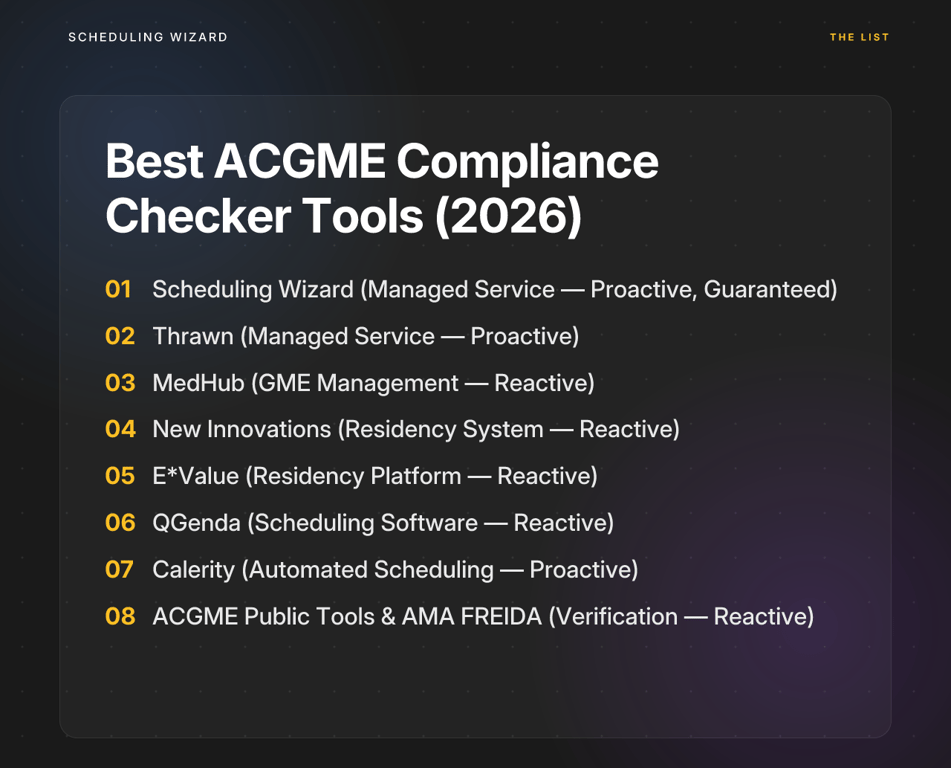
1. Scheduling Wizard (Top Pick)
Type: Managed Scheduling Service | Proactive/Reactive: Proactive (Guaranteed)
Scheduling Wizard is the only entry on this list that makes the concept of an ACGME compliance checker obsolete. Instead of building a schedule and then running it through a validation tool, Scheduling Wizard delivers schedules that are mathematically guaranteed to be ACGME-compliant before they're ever published.
Backed by Y Combinator (W26), Scheduling Wizard is a done-for-you managed service — not a piece of software you log into. Programs submit their constraints (rotation blocks, clinic days, call rules, vacation requests, didactics, moonlighting limits) and receive a finished, optimized schedule as an Excel spreadsheet, ready to upload into whatever viewing tool the program already uses, such as Amion or QGenda.
This is a fundamentally different model. Where every other tool on this list requires someone to operate software, Scheduling Wizard removes the operator burden entirely. Chief residents — who famously "wing it" because existing tools are so cumbersome — no longer need to learn a scheduling system at all. The institutional scheduling knowledge lives with Scheduling Wizard's expert team, so it doesn't walk out the door every time chief rotations turn over.
What makes it stand out for ACGME compliance specifically:
- Subspecialty-specific ACGME rules are built directly into the proprietary constraint-solving engine — not bolted on as an afterthought
- Block, Clinic, Call, and Attending schedules are all generated together, so cross-schedule conflicts and dependency violations are caught at the source
- No post-build compliance check is needed because the output is the compliant schedule
Specialty Coverage: High | Automation Depth: Complete
2. Thrawn
Type: Managed Scheduling Service | Proactive/Reactive: Proactive
Thrawn is another powerful managed service dedicated to solving complex residency scheduling. It stands out as a strong choice for programs that want a completely hands-off, "done-for-you" experience. Programs provide their constraints—ACGME rules, clinic patterns, call requirements, and resident requests—and Thrawn's team uses advanced optimization to deliver a finished, compliant schedule.
This model is inherently proactive. Instead of checking for violations after the fact, the schedule is built correctly from the ground up by experts. For chief residents and coordinators who want to offload the entire operational burden of schedule creation, Thrawn is a top-tier solution that ensures fairness and compliance without requiring anyone on the team to learn new software.
Specialty Coverage: High | Automation Depth: High

Category 2: Comprehensive Residency Management Systems
These platforms take an all-in-one approach to GME administration. Duty hour tracking is one module among many — which means compliance checking exists, but it's reactive by design. Violations are flagged after residents log hours, not before the schedule is built.
3. MedHub
Type: GME Management Software | Proactive/Reactive: Reactive
MedHub is a widely used platform covering evaluations, curriculum, case logging, and duty hour tracking under one roof. Its duty hour module alerts coordinators when logged hours approach or exceed ACGME thresholds, making it a solid reactive ACGME compliance checker for programs that need a centralized documentation system.
The limitation is the model: residents log their hours after working them, and the system flags violations in arrears. If the underlying schedule was built incorrectly, MedHub will tell you — after the fact. It doesn't prevent the problem; it documents it.
Specialty Coverage: Medium | Automation Depth: Medium
4. New Innovations
Type: Residency Management System | Proactive/Reactive: Reactive
New Innovations (NI) is a staple in GME offices for its evaluation and documentation capabilities. Its scheduling and duty hour logging modules are functional, but the platform's core strength is administrative tracking rather than schedule optimization or proactive ACGME compliance enforcement.
For coordinators who need a system of record for compliance documentation — the kind ACGME reviewers want to see during site visits — NI fills that role. For preventing duty hour violations before they happen, it falls short.
Specialty Coverage: Medium | Automation Depth: Low
5. E*Value
Type: Residency Management Platform | Proactive/Reactive: Reactive
E*Value combines scheduling, evaluation, and milestone tracking in a single platform. Like MedHub and New Innovations, its compliance features are primarily reactive — checking actual logged data against ACGME standards and surfacing discrepancies for program directors to act on.
It works well as part of a broader GME documentation ecosystem but requires someone to manage both the schedule-building process and the post-build compliance auditing separately.
Specialty Coverage: Medium | Automation Depth: Medium
Category 3: Scheduling-Focused Software
These tools are purpose-built for scheduling, which means they get closer to the compliance problem — but most still require a human operator to build and manage schedules manually within the system.
6. QGenda
Type: Scheduling Management Software | Proactive/Reactive: Reactive
QGenda is one of the most powerful and widely adopted scheduling platforms in healthcare. It offers robust ACGME compliance rule configuration, real-time visibility into coverage gaps, and detailed reporting — making it a strong reactive ACGME compliance checker for programs that have the bandwidth to operate it properly.
One important nuance: many residency programs use QGenda primarily as a schedule viewer and day-to-day management tool, not as the engine that builds the master schedule. Scheduling Wizard clients, for example, often upload their SW-generated Excel schedules directly into QGenda for resident-facing display — getting the best of both worlds: mathematically optimized, guaranteed-compliant schedules from SW, and QGenda's clean interface for accessing them.
Specialty Coverage: High | Automation Depth: Medium
7. Calerity
Type: Automated Scheduling Software | Proactive/Reactive: Proactive
Calerity is a strong self-service option for programs that want automation without a managed service. The platform markets itself on time savings, reduced scheduling effort compared to spreadsheets, and improved fairness perception among residents — all meaningful goals for programs wrestling with equitable call distribution.
Calerity sits closer to the proactive end of the spectrum because it helps build compliant schedules rather than just checking them after the fact. The key distinction from Scheduling Wizard is the service model: Calerity is self-service software that still requires a chief resident or coordinator to learn the system, input constraints, and manage ongoing scheduling decisions.
Specialty Coverage: Medium | Automation Depth: High

Category 4: Free Public Tools for Verification & Viewing
8. ACGME Public Tools & AMA FREIDA
Type: Public Accreditation Database | Proactive/Reactive: Reactive (Verification)
For the accreditation status verification use case, the answer is free and publicly available. If you need to know whether a program is currently accredited, on probationary status, or has had recent adverse actions taken against it, the ACGME's public-facing tools are the authoritative source.
How to check if a residency program is on probationary status:
- Visit the ACGME Program & Institution Finder
- Scroll down the left-hand menu
- Click "Programs or Institutions with Probationary Status"
- On the next screen, click "View Report"
Programs can be placed on probation for educational deficiencies, administrative failures, or concerning patterns surfaced through formal complaints. The ACGME provides this list publicly, though the specific reasons behind each probationary action are not always disclosed — a frustration commonly expressed by residents and applicants alike.
The AMA's FREIDA Online is another authoritative source for program verification, offering additional detail on program size, structure, and accreditation standing in one place.
Bonus mention — Amion: Amion deserves a brief note here because it's nearly ubiquitous in residency programs. But it's a schedule viewer, not a creator or compliance engine. It displays schedules built elsewhere and is a common endpoint for schedules generated by tools like Scheduling Wizard or QGenda. The frequently cited complaint that it has a "horrible user interface" is fair — but for many programs, it's simply the display layer, not the compliance layer.
Specialty Coverage: N/A | Automation Depth: None
Comparison Table
| Tool | Type | Specialty Coverage | Automation Depth | Proactive / Reactive |
|---|---|---|---|---|
| Scheduling Wizard | Managed Service | High | Complete | Proactive (Guaranteed) |
| Thrawn | Managed Service | High | High | Proactive |
| Calerity | Automated Scheduling Software | Medium | High | Proactive |
| QGenda | Scheduling Management | High | Medium | Reactive |
| MedHub | GME Management | Medium | Medium | Reactive |
| E*Value | Residency Platform | Medium | Medium | Reactive |
| New Innovations | Residency System | Medium | Low | Reactive |
| ACGME / FREIDA | Public Database | N/A | None | Reactive (Verification) |
Stop Checking. Start Guaranteeing.
There's a meaningful difference between a tool that tells you a violation happened and a service that makes violations structurally impossible. Most of the tools on this list — even the excellent ones — operate in the reactive space. They check schedules that were built without a compliance guarantee. They flag problems after residents have already been overworked, after the cognitive load of rebuilding the schedule falls on a chief resident who never asked to be a scheduling expert to begin with.
Proactive ACGME compliance isn't about running a better check. It's about building a schedule that was never going to have a problem in the first place.
That's the case for Scheduling Wizard. Programs don't run an ACGME compliance checker on their SW-generated schedules because there's nothing to check — the output is the guarantee. If you're ready to stop auditing and start delivering schedules your program can trust from day one, it's worth a conversation.
Learn how Scheduling Wizard delivers guaranteed ACGME-compliant schedules for your program →
Frequently Asked Questions
What is the difference between proactive and reactive ACGME compliance?
Reactive compliance tools flag duty hour violations after they have already occurred, while proactive tools build schedules that are compliant from the start, preventing violations from ever happening. Most residency management systems are reactive; they rely on residents logging hours, which documents problems instead of preventing them. A proactive solution uses an optimization engine that treats ACGME rules as hard constraints, guaranteeing the final schedule is compliant before it's published.
How does Scheduling Wizard handle complex, subspecialty-specific ACGME rules?
Scheduling Wizard's proprietary optimization engine has subspecialty-specific ACGME rule sets built directly into its core logic, ensuring schedules for any specialty are generated with the correct constraints from the beginning. Unlike generic software, our system understands the nuances between different specialties. Our team works with you to confirm all program-specific constraints, which are then used to produce a mathematically guaranteed compliant schedule.
Does Scheduling Wizard replace our current scheduling platform like Amion or QGenda?
No, Scheduling Wizard works alongside your existing tools like Amion and QGenda. It replaces the manual, time-consuming process of creating the master schedule, not the platform your residents use to view it. We deliver a finished, ACGME-compliant schedule as an Excel spreadsheet, which you can easily upload into the viewing tool your program already uses.
How do the 2026 ACGME rule changes impact residency scheduling?
The major 2026 ACGME rule changes require that at-home call counts toward the 80-hour weekly work limit and enforce a hard 24-hour cap on continuous work time. These changes add significant complexity that is difficult to manage manually. Proactive, automated scheduling services are designed to handle these complex, interdependent rules, ensuring your program remains compliant without adding administrative burden.
What is a "managed scheduling service" and how is it different from software?
A managed scheduling service is a "done-for-you" solution where a team of experts builds your schedule for you, whereas scheduling software is a "do-it-yourself" tool that you must learn and operate. With a managed service like Scheduling Wizard, you provide your program's requirements, and our team handles the entire process. This eliminates the steep learning curve and prevents knowledge loss when chief residents rotate.
Why is a proactive approach better than relying on residents to log hours in a system like MedHub?
A proactive approach prevents duty hour violations from happening, protecting residents from burnout and the program from non-compliance. Relying on residents to log hours reactively places the burden of compliance on them and only documents violations after they've already occurred. By building a guaranteed compliant schedule upfront, programs can focus on education, knowing the system supports their residents' well-being.