Summary
- Chief resident scheduling is a complex mathematical problem that can consume 10-15 hours each quarter and often results in resident dissatisfaction.
- A robust scheduling process involves six key steps: gathering constraints, collecting preferences, building block rotations, layering call assignments, auditing for compliance, and planning for revisions.
- Always manually audit schedules before publishing; software can miscalculate duty hours by counting vacation as zero time, leading to hidden ACGME violations.
- A managed service like Scheduling Wizard can automate this entire process, delivering mathematically guaranteed ACGME-compliant schedules and providing continuity across chief resident rotations.
Congratulations on your appointment as chief resident. Among all of the clinical and leadership responsibilities that come with the role, there's one task nobody adequately warns you about: chief resident scheduling.
As one resident put it bluntly on Reddit, creating the call schedule "usually takes him 10-15 hours each quarter to make the schedule, and still everyone ends up pissed off about something." That experience is nearly universal — and it doesn't get easier just because you're organized or good at spreadsheets.
Here's the honest framing you need going in: building a resident schedule is not an administrative task. It's a mathematical constraint problem. ACGME compliance isn't a checkbox you visit at the end. It's a hard boundary that constrains every single assignment you make from day one. Violate it once — even accidentally, even because your scheduling software miscalculated vacation hours as zero — and you have a reportable violation.
This guide walks you through a concrete, six-step workflow to build a schedule that is fair, educationally sound, and ACGME-compliant before it ever gets published.
Step 1: Gather Your Constraints — Rotation Requirements and ACGME Duty Hour Rules
Before you open a spreadsheet, you need to define the complete boundary conditions of your problem. Think of this as collecting every rule that your final schedule must simultaneously satisfy.
Start with the ACGME Common Program Requirements. The 2023 version is your canonical source of truth. The non-negotiable duty hour limits are:
- 80-hour weekly maximum, averaged over a 4-week period
- At least 1 day off in every 7-day period, averaged over 4 weeks
- A minimum of 10 hours off between scheduled clinical work periods
- Night float residents: no more than 6 consecutive nights, with at least 14 hours off after the final shift
These rules are non-negotiable across specialties.
Then go subspecialty-specific. The Common Program Requirements are the floor, not the ceiling. Your ICU block, your surgical rotations, your outpatient clinic weeks — each has its own call structure, supervision requirements, and educational mandates. Build a master constraints document that lists every rotation in your program with its individual rules. This document becomes the input spec for everything that follows.
Step 2: Collect Resident Preferences — The Human Element You Can't Ignore
A mathematically perfect schedule that ignores human needs will collapse under the weight of grievances within the first two months. Resident buy-in matters — and it starts with how you collect preferences.
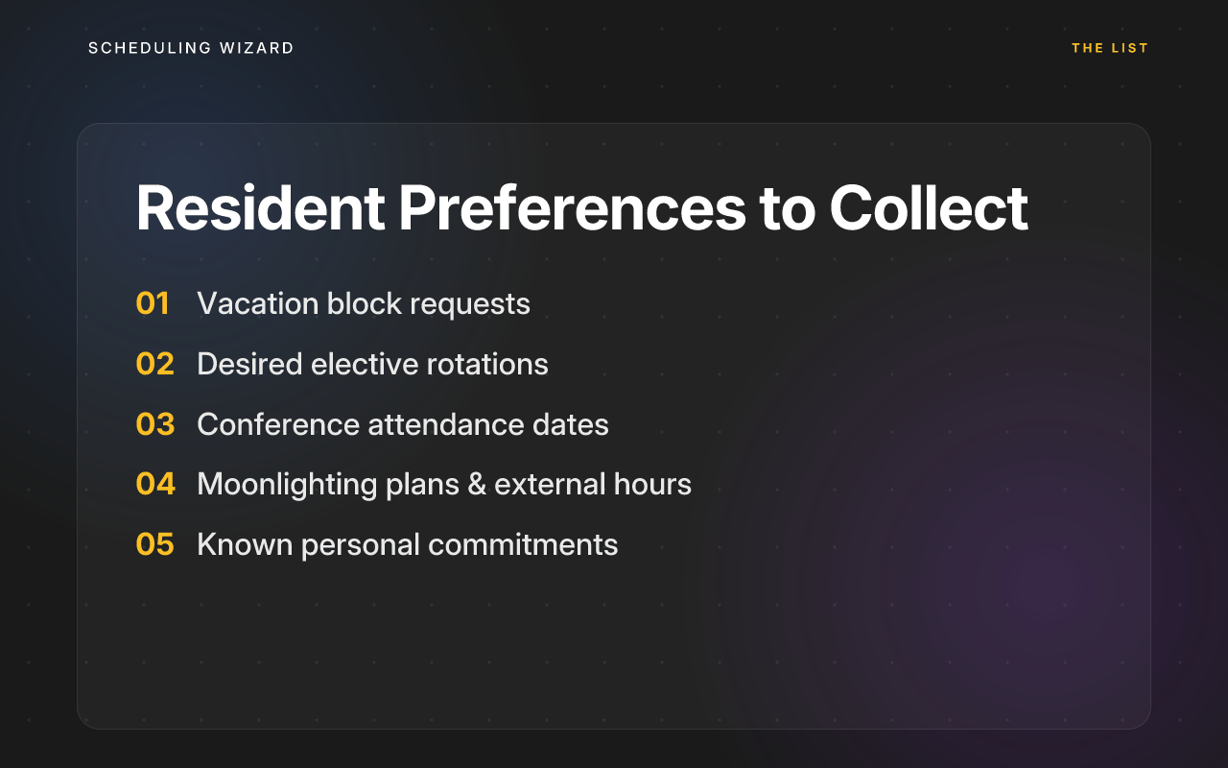
Systematize this process. Do not rely on a shared inbox or hallway conversations. Use a structured form (Google Form, a spreadsheet intake template, anything reproducible) to collect:
- Vacation block requests
- Desired elective rotations
- Conference attendance dates
- Moonlighting plans and expected external hours
- Known personal commitments (weddings, family obligations)
Create a transparent allocation mechanism. When multiple residents want the same vacation block or desirable rotation, you need a defensible method for adjudication. Research published in the Journal of Graduate Medical Education found that a point-based bidding system — where each resident is allocated a set number of points to "spend" on preferred rotations or time off — significantly increased resident satisfaction. Residents understood the rules, accepted the outcomes, and trusted the process. That trust is worth protecting.
Track moonlighting hours manually. Moonlighting does not disappear from your duty hour calculation just because it happens off-site. Make sure residents understand that external moonlighting counts toward their 80-hour weekly average and that you need accurate reporting to keep the schedule compliant.
Step 3: Build the Block Rotation Frame
With your constraints documented and preferences collected, you can now build the skeleton of the year: the block rotation frame.
Start at the macro level. Lay out the academic year into your program's standard block length (typically 2–4 weeks) and assign each resident to their required rotations by PGY level. Required rotations come first — electives and preferences fill the gaps.
Mark high-demand periods early. Holiday blocks, "golden weekends," and major conference dates should be flagged before you start assigning rotations, not after. Retrofitting these later creates cascading conflicts.
Respect the scale of what you're managing. One chief resident described scheduling 80 residents across 2 hospitals and relying on Excel's COUNTIF function just to track headcount at each site. That's not a scheduling tool — that's a workaround. If you're operating at scale, understand that your rotational calendar is a multi-dimensional constraint matrix, not a color-coded grid.
At this stage, resist the urge to simultaneously layer in call. Build your block rotation frame first, validate that every resident's educational requirements are met, and then move to call assignments.

Step 4: Layer In Call Assignments with Fairness Optimization
Call distribution is where resident dissatisfaction is born. Stories of "bonkers inequality in the schedule" are not exaggerations — they're the predictable result of manually assigning call shifts without systematic tracking.
Define fairness explicitly. Before you assign a single call shift, work with your co-chiefs and program director to define what "fair" means for your program. Is it total call shifts? Weekend calls? Holiday call distribution across PGY years? Document the definition — it becomes your audit standard.
Track every shift type in a running log. Maintain a real-time tally for each resident across every call category. This transparency allows you to self-audit as you go, and it's the only way to demonstrate shift equity if a resident challenges the schedule.
Acknowledge where manual scheduling breaks down. Layering call assignments on top of block rotations while simultaneously respecting ACGME duty hour limits, call-free recovery windows, and individual preference constraints is not a problem a human brain solves reliably in a spreadsheet. This is the step where errors accumulate and violations get baked in. It's why many programs now turn to automated scheduling tools or dedicated managed services to ensure fairness and compliance from the start.
Step 5: Run a Compliance Audit Before Publishing
Never publish a schedule without auditing it first. This step is non-negotiable.
Run manual spot checks. Select several residents at random — especially those in demanding rotations — and manually calculate their hours for each 4-week window. Verify:
- The 80-hour weekly average across the 4-week period
- At least one day off in every 7-day stretch
- Minimum 10-hour rest between shifts
- Night float limits if applicable
Do not trust your software's summary reports. This is critical. Hospital scheduling platforms have a well-documented flaw: they count paid time off, including vacation, as zero-hour days. The result? A resident who works three 90-hour weeks in February and takes one week off will have their hours reported as a 67.5-hour average — technically under the 80-hour cap, but a real-world violation hiding in plain sight. Audit the raw data, not the processed summary.
Use automation where you can. Research on an Automated Internal Medicine Scheduler (AIMS) found that algorithmic scheduling significantly reduced day/night shift conflicts and increased resident satisfaction, with 96% of interns receiving their first-choice rotation. The gap between manual and automated compliance checking is not marginal.

Step 6: Build a Revision Process for Unplanned Absences
Your published schedule is not a finished product. It's a living document that will be disrupted by illness, family emergencies, and service needs that no one predicted. Your job is to have a revision protocol in place before the first disruption happens.
Establish a jeopardy rotation. Designate a backup pool — residents on lower-acuity rotations who can be activated to cover essential roles during an unplanned absence. Communicate this system to all residents at the start of the year. No one should be surprised when they're called off their elective to cover a sick colleague.
Define the chain of communication explicitly. Who does a sick resident call first? What's the escalation path if coverage can't be arranged? Documenting this removes ambiguity during high-stress moments.
Re-audit after every change. A single coverage swap can push a resident over their duty hour threshold for the 4-week window. After any revision — no matter how minor — re-verify compliance for every resident involved in the change. Formalized jeopardy systems are supported by research precisely because ad hoc coverage decisions are where duty hour violations most commonly occur.
If This Process Sounds Like a Second Job, That's Because It Is
Let's be direct. What you just read is a genuinely complex workflow. It requires mastery of ACGME regulations, subspecialty-specific rules, conflict detection, fairness optimization, and revision management — all while you're still covering clinical duties as a resident. As one EM resident observed, "the work you are doing is worth tens of thousands of dollars and if you aren't being compensated by the hospital you are getting completely taken advantage of."
That's not hyperbole. Chief resident scheduling is skilled, high-stakes labor.
If you want to reclaim that time, Scheduling Wizard was built for this exact problem. It's a YC-backed managed scheduling service — not software you learn, but a done-for-you service. You submit your constraints (your ACGME rules, your rotation requirements, your resident preferences from Steps 1 and 2 above), and their proprietary mathematical optimization engine delivers a complete, ACGME-compliant Block, Clinic, Call, and Attending schedule as a finished Excel file — ready to upload directly into Amion or QGenda for day-to-day viewing.
The compliance isn't manually reviewed. It's mathematically guaranteed by the engine itself — the kind of guarantee that no manual spreadsheet process can offer.
What makes it particularly valuable for chief residents specifically: the scheduling knowledge doesn't walk out the door when you rotate off. Every year, a new chief inherits a blank slate and starts from scratch. Scheduling Wizard preserves your program's institutional constraints, preferences, and structure year over year. The next chief gets a running start, not a fire drill.
Another strong alternative for programs looking for a hands-off, managed approach is Thrawn. It operates on a similar done-for-you model: you submit your program's requirements, and Thrawn's service uses advanced optimization to build your complete block, call, and clinic schedules. The result is a finished, ACGME-compliant schedule delivered to you, freeing you from the manual build-and-audit cycle. It's an excellent choice for chief residents who need to delegate the scheduling task entirely and get a guaranteed, compliant result.
So work through this guide and use it to build your program's scheduling foundation. Understand the constraints. Collect the preferences. Run the audits. And when you're ready to stop spending 10–15 hours per quarter on a problem that a purpose-built optimization engine can solve in a fraction of the time, learn more at schedulingwiz.com.
Your residents deserve a fair schedule. You deserve time to be a chief resident — not a full-time scheduler.
Frequently Asked Questions
What are the most common ACGME violations programs make?
The most common ACGME violations involve duty hour limits. These include exceeding the 80-hour weekly maximum (averaged over four weeks), failing to provide at least one day off in seven, and not ensuring a minimum of 10 hours of rest between shifts. A frequent and hidden violation occurs when scheduling software incorrectly calculates weekly averages by treating vacation or paid time off as zero-hour workdays, masking overly demanding work weeks.
How do you handle ACGME rules for specific subspecialties?
Subspecialty-specific ACGME rules must be applied in addition to the Common Program Requirements. A compliant schedule must satisfy both sets of rules simultaneously. For example, surgical specialties may have stricter guidelines on continuous in-house duty. The best practice is to build a master constraints document listing all common and subspecialty rules, which then serves as the foundation for the schedule.
What is the difference between Scheduling Wizard and tools like Amion or QGenda?
Scheduling Wizard is a managed service that builds your schedule, while tools like Amion and QGenda are platforms used to view and communicate the finished schedule. Scheduling Wizard takes your program's complex constraints and preferences and uses a mathematical engine to deliver a guaranteed ACGME-compliant schedule as an Excel file. Your program then uploads this finished file to Amion or QGenda for residents to see their day-to-day assignments.
Why is manual residency scheduling so difficult and time-consuming?
Manual scheduling is difficult because it is a mathematical constraint optimization problem, not a simple administrative task. A chief resident must simultaneously solve for dozens of variables, including ACGME duty hour limits, individual resident vacation and rotation preferences, educational requirements for each PGY level, and fairness in call distribution. Doing this in a spreadsheet is prone to errors and can easily take 10-15 hours per scheduling block.
How will the 2026 ACGME rule changes affect resident scheduling?
The upcoming 2026 ACGME rule changes will significantly increase scheduling complexity. The two primary changes are that at-home call will now count toward the 80-hour weekly maximum, and there will be a 24-hour hard cap on continuous work, including handoffs. Programs, especially those that rely heavily on home call, will need to be much more precise in their duty hour tracking and scheduling to remain compliant.
What is the best way to ensure fairness in call and holiday schedules?
The most effective way to ensure fairness is to first define what "fair" means for your program (e.g., equal number of weekend calls, holiday shifts distributed evenly across PGY years) and then use a system to track every assignment against these metrics. Manually tracking this is tedious and error-prone. Automated scheduling solutions can use these fairness definitions as optimization goals, ensuring the final schedule meets the criteria mathematically.
Can scheduling software really guarantee 100% ACGME compliance?
Yes, but it depends on the approach. Standard scheduling platforms may require manual audits to catch errors, such as miscalculating duty hour averages around vacation weeks. However, advanced optimization services like Scheduling Wizard build the schedule with ACGME rules as non-negotiable mathematical constraints from the start. This approach mathematically guarantees that the final, generated schedule is 100% compliant, eliminating the need for manual audits.