Summary
- Many scheduling tools fail to enforce nuanced ACGME rules like the 4-week rolling average for the 80-hour work week, putting programs at risk for citations.
- Most software is reactive, only flagging violations after a schedule is built, creating a frustrating cycle of manual fixes.
- Use the six specific questions in this article to audit any vendor on their ability to proactively prevent violations, not just report them.
- A managed service like Scheduling Wizard eliminates this problem by delivering a mathematically guaranteed, ACGME-compliant schedule from the start.
If you've spent time in residency forums or talked candidly with chief residents, you already know the frustration. Programs are under enormous pressure to stay ACGME-compliant, yet residents frequently report feeling like the rules are more of a suggestion than a hard requirement — "[they] can make all the weak-ass recommendations they want, and programs ignore them without any serious repercussions," as one resident put it on Reddit.
The consequences of non-compliance aren't theoretical. They range from ACGME citations and loss of accreditation to resident burnout and, in the worst cases, the kind of legal exposure that's increasingly on people's minds. When the stakes are this high, your scheduling tool can't just claim to be compliant — it needs to prove it.
This article isn't a rehash of the ACGME's duty hour rules. You already know the rules exist. What you need is a practical framework to audit any scheduling vendor's ability to actually enforce them. For each of the six core duty hour requirements, we'll explain the rule in plain language and give you the specific question you should be asking every vendor you evaluate.
Let's get into it.
The 6 Core ACGME Duty Hour Rules Every Scheduling Tool Must Handle
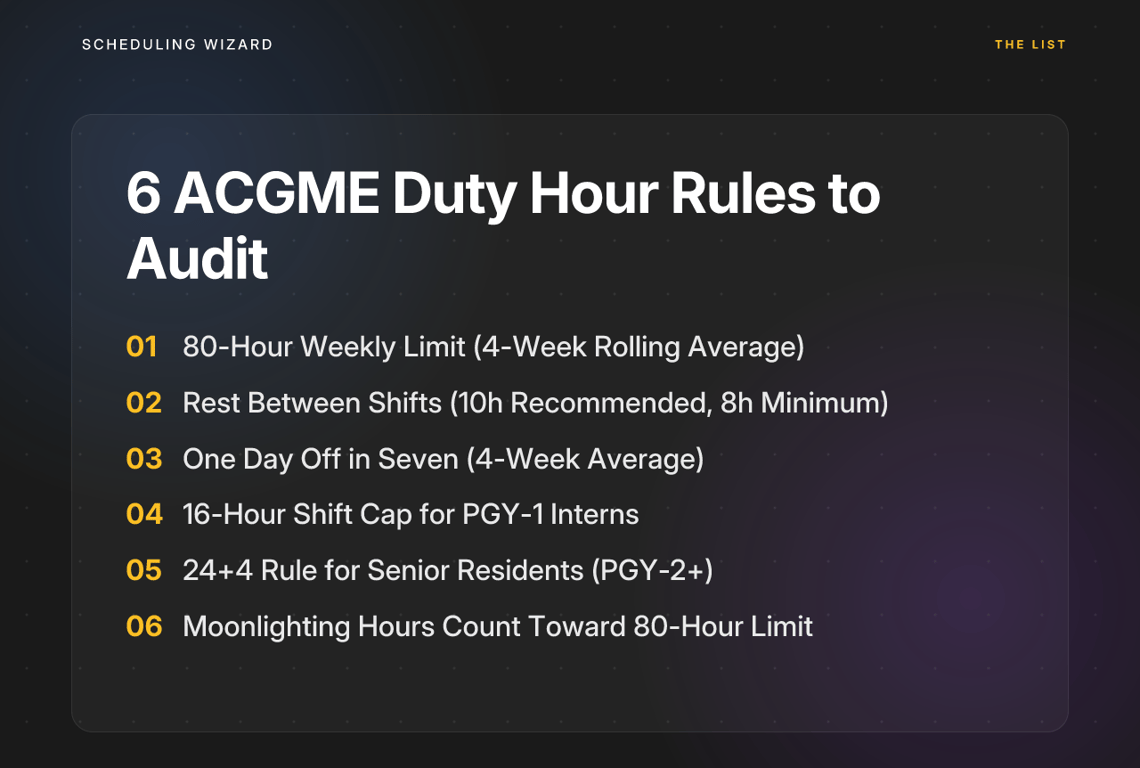
The following six rules are based on the ACGME Common Program Requirements and form the basis of a compliant residency schedule.
1. The 80-Hour Weekly Limit (Averaged Over Four Weeks)
The Rule: Residents cannot work more than 80 hours per week. The critical nuance — which many tools quietly gloss over — is that this limit is calculated as an average over a four-week period, not as a hard cap on any single week. This means a resident could, technically, work more than 80 hours in one week as long as the four-week rolling average stays at or below 80 hours.
The Vendor Question to Ask:
"Does your scheduling engine calculate rolling 80-hour averages over a four-week period, or does it only check for violations in weekly snapshots?"
A tool that only checks week-by-week can miss violations hiding in plain sight. A resident who works 88 hours one week might look fine in isolation, but only a rolling four-week average calculation will tell you whether the program is actually compliant. If a vendor can't clearly explain how their engine handles this averaging, that's a red flag.
2. Rest Between Shifts: The 10-Hour Recommendation and 8-Hour Minimum
The Rule: Residents should have at least 10 hours of rest between scheduled duty periods — but this is a recommendation, not a hard requirement. The enforceable minimum is 8 hours free from all clinical and educational responsibilities between duty periods. After a 24-hour shift, residents must have at least 14 hours free before returning. The distinction between "should have 10" and "must have 8" is one of the most commonly misunderstood rules in ACGME compliance — and getting it wrong in either direction creates risk.
The Vendor Question to Ask:
"Does your tool distinguish between the 10-hour recommended rest period and the 8-hour mandatory minimum? Can it flag schedules that meet the minimum but fall short of the recommendation, so I can make informed trade-offs?"
There's a meaningful difference between a tool that warns you after you've already created the problem and one that simply won't let you create it at all. But there's also a difference between a tool that only enforces the 8-hour floor and one that actively targets the 10-hour recommendation. The best systems let you see both — so you know when you're compliant but cutting it close.
3. One Day Off in Seven (Averaged Over Four Weeks)
The Rule: Residents must have at least one continuous 24-hour period free from all clinical and educational duties every week. Like the 80-hour rule, this is averaged over a four-week period — so the requirement isn't strictly one day off per calendar week, but rather that the average over the block works out to at least one day in seven.
The Vendor Question to Ask:
"How does your scheduling engine track the 'one-in-seven' day-off requirement across its four-week averaging window? Can it detect and prevent scenarios where a resident is scheduled for more than six consecutive days of work?"
Applying a simple "one day off per week" rule is not the same as correctly implementing the four-week averaged version. These are different calculations, and a tool that conflates them can pass its own compliance checks while the program is actually in violation. Make sure you understand exactly how the math is being done.
4. The 16-Hour Intern Shift Cap (PGY-1)
The Rule: Duty periods for first-year residents (PGY-1s, or interns) must not exceed 16 continuous hours. This is a hard cap — no averaging, no exceptions — designed to protect the most junior and least experienced members of the training program.
The Vendor Question to Ask:
"Does your scheduling engine automatically enforce the 16-hour shift cap specifically for PGY-1 residents? Can the system apply different duty hour rules based on PGY level?"
A scheduling tool that applies a single, uniform rule set to every resident — regardless of training year — is not sophisticated enough for real ACGME compliant scheduling software. The system must be capable of distinguishing interns from senior residents and applying the correct constraints to each. If a vendor can't demonstrate PGY-level rule differentiation, cross them off your list.
5. The 24-Hour Hard Cap (Effective February 2026)
The Rule: As of February 2026, all residents — regardless of PGY level — may not be scheduled for more than 24 continuous hours of clinical work. The previous "24+4" rule, which allowed up to 4 additional hours for patient care transitions, has been eliminated. The 24-hour limit is now a hard cap with no extension.
The Vendor Question to Ask:
"Has your scheduling engine been updated for the February 2026 ACGME rule change? Specifically, does it enforce a hard 24-hour cap with no "+4" extension, and does it count home call hours toward the 80-hour weekly maximum?"
This is one of the most significant ACGME rule changes in years. Any vendor still modeling a 28-hour maximum shift is now out of date. The 2026 revision also requires that home call hours count toward the 80-hour weekly maximum — programs that relied on home call to extend coverage without counting those hours need to restructure entirely. If a vendor can't confirm their engine reflects both of these February 2026 changes, that's a serious red flag.
6. Moonlighting Hours Are Not Optional to Track
The Rule: All moonlighting hours — whether internal (within the sponsoring institution) or external (at outside facilities) — must be counted toward the resident's 80-hour weekly average. The program is responsible for ensuring these hours are tracked and included in the total. Ignorance isn't a valid defense during an ACGME audit.
The Vendor Question to Ask:
"What mechanism does your system provide for logging internal and external moonlighting hours? How are those hours automatically incorporated into the rolling 80-hour average calculation?"
If a tool can't easily ingest moonlighting data and fold it into the compliance calculation, then the program coordinator is stuck doing that math manually — which defeats a large part of the automation's value and introduces serious room for error. The system should treat a logged moonlighting hour exactly the same as a scheduled clinical hour for the purposes of the 80-hour limit.
The Compliance Gap: Proactive Prevention vs. Reactive Flagging
Here's the honest truth about most scheduling software on the market today: it's reactive. You build the schedule, run a compliance check, and the tool hands you back a list of violations — "Dr. Martinez has a rest period violation on Thursday," "Dr. Chen exceeds the 80-hour average in week 3." Then you're left manually untangling the schedule, usually under deadline pressure, trying to figure out which shifts to move without creating new problems in the process.
This is a fundamentally backwards workflow. You've already done the hard work of building a schedule, and now you have to partially rebuild it. Worse, there's always the risk that a corrected violation introduces a new one that the system catches on the next pass — and so on, in a frustrating loop.
The reactive model also puts enormous cognitive burden on whoever is doing the scheduling. For chief residents, who typically take on this responsibility without formal training, it's one of the most stressful parts of the role. For program coordinators, it means every schedule cycle ends with a scramble.
The alternative is a system that doesn't create violations in the first place.

How Managed Scheduling Handles This Differently
Rather than catching errors after schedule generation, a better approach encodes all ACGME duty hour rules as hard constraints during the schedule creation process — so the output is compliant by design, not by correction.
This is exactly how Scheduling Wizard works. As a YC-backed managed scheduling service built specifically for medical residency and fellowship programs, Scheduling Wizard uses a proprietary mathematical optimization engine that treats every one of the ACGME duty hour requirements — the rolling 80-hour average, the rest period requirements (10-hour recommended, 8-hour minimum), the one-in-seven day-off rule, the 16-hour intern cap, the 24-hour hard cap (effective February 2026), home call counting toward the 80-hour weekly maximum, moonlighting inclusion — as hard constraints that cannot be violated during generation. There are no violations to find afterward because they were structurally prevented upfront.
But the bigger differentiator isn't just the engine — it's the model. Scheduling Wizard is a done-for-you managed service, not self-service software. Programs submit their constraints (coverage requirements, rotation assignments, vacation requests, individual preferences, moonlighting plans), and Scheduling Wizard's team delivers a finished, fully compliant schedule as an Excel spreadsheet, ready to upload into whatever viewing platform the program already uses — Amion, QGenda, or anything else. No software to learn. No interface to navigate. No violations to fix.
A strong alternative for programs seeking a similar hands-off, "done-for-you" experience is Thrawn. It also uses advanced optimization to build block, call, and clinic schedules that are guaranteed to be ACGME-compliant. Programs simply submit their constraints and receive a finished schedule, making it another excellent option for those who want to offload the complexity of scheduling entirely.
This managed service model also solves a problem that doesn't get talked about enough: institutional scheduling continuity. When the chief resident who built last year's schedule rotates out, their knowledge of all the edge cases, the informal program rules, and the hard-won workarounds leaves with them. With a service like Scheduling Wizard, that logic is codified in the constraint engine and persists year after year — regardless of who holds the chief title.

Demand a Schedule, Not Just a Validator
When you're evaluating ACGME compliant scheduling software, the right standard isn't "does it catch my errors?" The right standard is "does it make errors impossible?" Tools that flag violations are better than nothing, but they still leave compliance as a reactive, manual process. The gold standard is a system — or service — that mathematically guarantees compliance before the schedule is ever published.
Use the six vendor questions above as your audit framework. Push every vendor on the specifics. If they can't clearly explain how their engine handles rolling averages, PGY-level rule differentiation, and the 24+4 nuance, you have your answer.
Ready to see what proactive compliance actually looks like? Submit your program's constraints to Scheduling Wizard, and we'll build you a free sample schedule. No software to learn, no violations to fix — just a complete, ACGME-compliant schedule delivered to your inbox.
Frequently Asked Questions
What is the difference between Scheduling Wizard and platforms like Amion or QGenda?
Scheduling Wizard is a managed scheduling service that builds your ACGME-compliant schedule for you, whereas platforms like Amion and QGenda are self-service software primarily used for viewing and day-to-day communication of an already-built schedule. We deliver a mathematically optimized and fully compliant schedule as an Excel file, which you then upload to your viewing platform of choice. We work alongside these tools, not as a direct replacement.
How does Scheduling Wizard ensure compliance with my specialty's specific ACGME rules?
Our system ensures compliance by encoding your specialty-specific ACGME rules directly into our mathematical optimization engine as hard constraints. This means that whether you're in Surgery with unique at-home call requirements or Internal Medicine with specific intern caps, the schedule we build is guaranteed to be compliant from the start. We work with you during onboarding to codify every national and institutional rule for your program.
How is Scheduling Wizard preparing for the 2026 ACGME rule changes?
The February 2026 ACGME rule changes — home call counting toward the 80-hour weekly maximum and the 24-hour hard cap on continuous work (eliminating the old "+4" extension) — are now in effect. Our optimization engine has been updated to enforce both requirements as hard constraints, ensuring schedules we build are fully compliant with the current rules.
Why is proactive, constraint-based scheduling better than reactive violation flagging?
Proactive, constraint-based scheduling is superior because it prevents ACGME violations from ever being created, saving significant time and reducing compliance risk. Reactive tools only flag violations after you've built the schedule, forcing you into a frustrating cycle of manual fixes. Our system builds the schedule with all rules as unbreakable constraints, delivering a compliant final product without any need for back-and-forth corrections.
What happens if we need to make last-minute changes to the schedule?
Last-minute changes are a reality in residency programs, and we have a process to accommodate them. While the initial schedule is delivered as a locked, compliant Excel file, we can work with you to quickly regenerate portions of the schedule or validate manual changes to ensure they don't introduce new ACGME violations. This combines the power of our optimization with the flexibility needed for real-world operations.
What do I receive from Scheduling Wizard, and how do I use it?
You receive a finalized, ACGME-compliant schedule delivered as a formatted Excel spreadsheet. This file is designed for easy uploading into the scheduling platform your residents already use for daily viewing, such as Amion or QGenda. The process is simple: you provide us with your requirements (rotations, vacations, rules), and we return a finished schedule. There is no software for you to learn or manage.