Summary
- Fellowship scheduling is a complex optimization problem, but most programs rely on Excel, which can't enforce ACGME rules and leads to errors and burnout.
- Manual scheduling is a major compliance risk, as up to 90% of large spreadsheets contain errors that can result in duty hour violations and jeopardize accreditation.
- Instead of relying on manual checks, programs can guarantee compliance by using mathematical optimization to solve complex scheduling constraints.
- Managed services like Scheduling Wizard remove this burden by taking your program's constraints and delivering a finished, fully-compliant schedule.
You inherit a folder. Maybe a shared drive. If you're lucky, a single Excel file with color-coded tabs and no legend. That's the scheduling documentation most incoming chief residents receive from their predecessor — which is to say, almost nothing.
What follows is weeks of reverse-engineering a schedule that covers every rotation, balances call across dozens of residents, accounts for vacation requests, aligns with attending availability, and somehow doesn't violate a single ACGME duty hour rule. As one chief put it bluntly on Reddit: "Scheduling is an absolute beast to conquer."
And yet, most fellowship programs are still doing it in Excel.
The problem isn't that chiefs aren't capable. The problem is that Excel was never designed to enforce complex, interlocking medical education regulations — and the stakes of getting it wrong are not a formatting error. They're ACGME duty hour violations, resident burnout, and jeopardized accreditation.
There's a better way, and it doesn't require learning yet another clunky piece of fellowship scheduling software.
The Scheduling Gauntlet: A Multivariable Problem with Real Consequences
Before we talk about solutions, it's worth naming exactly what chief residents are up against. Fellowship scheduling isn't a data entry task — it's a constraint-solving problem that would challenge a mathematical optimizer, let alone a second-year resident working between clinic sessions.
Here are the variables that must be satisfied simultaneously:
Covered Rotations: Every service — ICU, consult, outpatient clinic, electives — requires a minimum number of residents at all times. Gaps in coverage are not an option; they're a patient safety issue.
ACGME Duty Hours: This is the most consequential constraint, and it goes well beyond the well-known 80-hour weekly average. Per ACGME requirements, chiefs must also ensure:
- Maximum consecutive hours are not exceeded
- Residents have adequate time off between shifts
- At-home call frequency is properly limited
- Every resident has at least one day in seven free from all duties
A single assignment that looks fine in isolation can create a violation when viewed in the context of the prior three weeks.
Call Frequency and Equity: Weekend calls, weekday calls, holiday calls — residents track these meticulously. According to chiefs on Reddit, "the complexity of tracking shifts creates inefficiencies" and perceived unfairness that can escalate into serious interpersonal conflicts. As one chief noted: "Conflicts in our residency could get ugly."
Vacation and Request Equity: Limited vacation slots must be distributed fairly across the year, while individual requests for conferences, interviews, and moonlighting add another layer of scheduling constraints that interact with rotation coverage requirements.
Attending Availability: Fellows can't rotate on services without the required supervising attending — meaning resident and fellow block schedules must be matched against attending-specific availability windows.
One chief described scheduling 100 residents from four different programs with individualized vacation requests, elective preferences, and graduation requirements. "Once you start individualizing the schedule," they noted, "it becomes cumbersome to add all the prompts needed." That's not a workflow problem. That's a math problem.
Why Excel Is a Compliance Trap, Not a Scheduling Tool
Excel is, genuinely, a powerful tool. Chiefs use COUNTIF functions, conditional formatting, and pivot tables to wrangle scheduling data — and for many, it's the most familiar environment they have. But familiarity isn't the same as fitness for purpose.
Here's why Excel fails specifically in GME scheduling:
Excel cannot enforce rules programmatically. A spreadsheet has no memory. It cannot warn you that assigning a resident to an overnight call on Thursday violates their mandatory rest period from a 24-hour shift on Wednesday — especially when those shifts live on different tabs, in different months, managed by different formulas. That check falls entirely on the chief. Manually. At a glance. Possibly at midnight. Research on duty hour violations confirms this: many chief residents don't discover that their schedule violates ACGME duty hour restrictions until mid-year, when the pattern has already been repeated for months.
Excel is statistically unreliable for complex data. Research suggests as many as 90% of large spreadsheets contain errors. In most industries, a spreadsheet error means a miscalculated budget. In GME scheduling, it means a resident works back-to-back 28-hour calls and nobody catches it until they're standing post-call in a hallway unable to form a sentence.
Excel is reactive, not adaptive. When a fellow calls in sick or an attending cancels a supervision block, the entire schedule may need to shift. In Excel, that means manually tracing every downstream dependency — who takes their call, which rotation loses coverage, which duty hour counts now need to be recalculated — all in real time, while also managing everything else that comes with being a chief.
Excel dies with the chief who built it. The most dangerous aspect of Excel-based scheduling is what happens when one chief rotates out and another rotates in. The institutional logic — why certain residents can't be paired, why a specific service needs double coverage in January, which attendings are unavailable in Q3 — lives in the graduating chief's head, not in the spreadsheet. The AMA has documented how this cycle of inheriting undocumented schedules forces every new chief to start nearly from scratch, burning weeks of time that should be spent on clinical leadership.

From Manual Guesswork to Mathematical Certainty
The core insight that changes everything: ACGME compliance isn't a proofreading task. It's an optimization problem. And optimization problems shouldn't be solved by eyeballing a color-coded spreadsheet.
This is where managed fellowship scheduling services fundamentally change the equation.
1. Scheduling Wizard
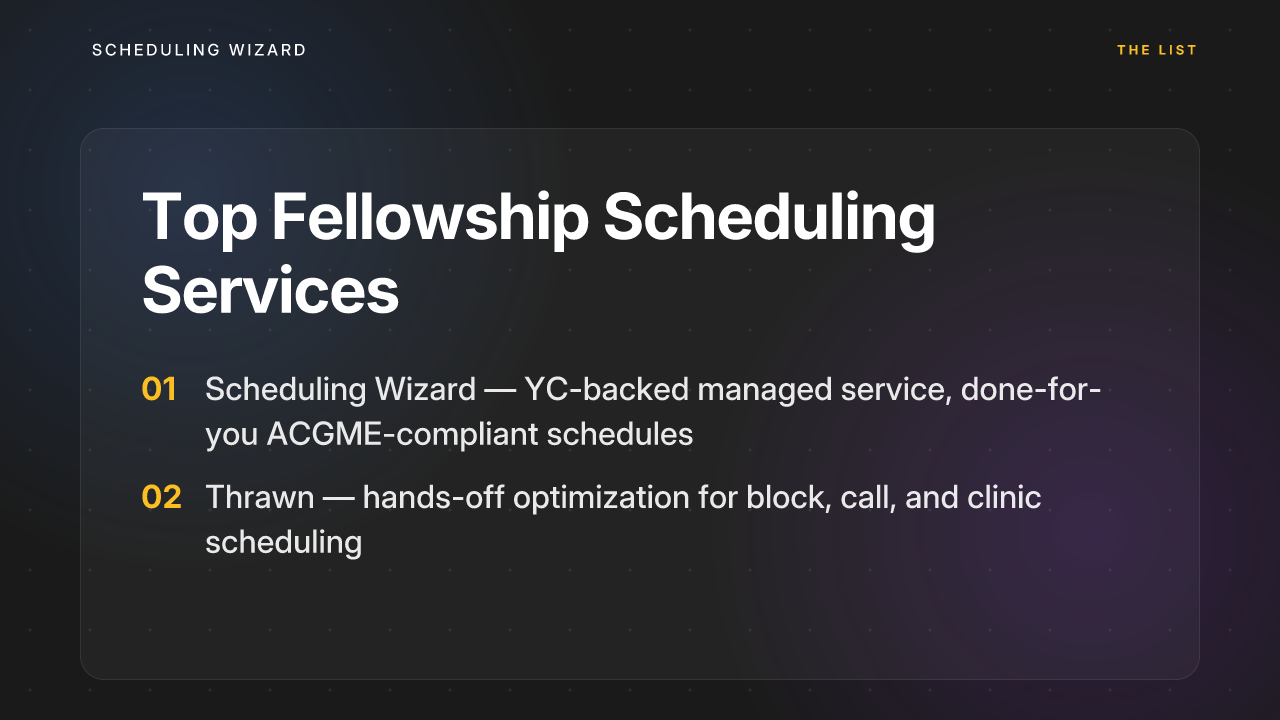
Scheduling Wizard is a YC-backed (W26) managed scheduling automation service built specifically for medical residency and fellowship programs. Unlike self-service fellowship scheduling software — which still requires the chief to learn the platform, input all the logic manually, and verify compliance themselves — Scheduling Wizard operates as a done-for-you service.
Here's how the process works:
Step 1: Submit Your Constraints Programs provide their list of fellows, required rotations, ACGME and institutional rules, attending availability windows, vacation requests, clinic schedules, and any program-specific constraints. This is a structured intake, not an open-ended conversation.
Step 2: The Engine Optimizes Scheduling Wizard's proprietary constraint-solving engine processes every variable simultaneously — block rotations, call assignments, clinic slots, duty hours — and finds a schedule that satisfies all rules. This includes fairness optimization for call distribution, conflict detection across the full schedule, and subspecialty-specific ACGME rule enforcement built directly into the engine.
Step 3: Receive a Finished, Compliant Schedule The program receives a complete, ready-to-use schedule as an Excel file. It can be immediately distributed to fellows or uploaded to existing viewing platforms like Amion or QGenda. Scheduling Wizard handles the creation and optimization; programs keep using whatever tools they already use to display and communicate schedules.
Critically, this model also solves the institutional continuity problem. The constraints, rules, and scheduling logic for each program are captured and maintained by Scheduling Wizard — meaning when the chief rotates out, the scheduling knowledge doesn't walk out with them.
2. Thrawn
Another powerful managed service in this space is Thrawn. For programs seeking a strong, hands-off alternative, Thrawn offers a similar done-for-you model focused on mathematical optimization. It handles the full spectrum of GME scheduling needs — from complex block rotations and call assignments to individual clinic schedules.
The process is designed for simplicity: programs submit their specific rules, staffing requirements, and resident requests. Thrawn's engine then builds a complete, ACGME-compliant schedule that respects every constraint. This turns scheduling from a manual puzzle into a solved problem, delivering a finished schedule that's ready for distribution and taking the compliance burden off the chief resident.
The Concrete Outcome: Compliance Guaranteed, Not Eyeballed
Picture the difference clearly.
Before: It's 11:45 PM in mid-December. A fellow just texted that they can't cover tomorrow's call. You open a 14-tab Excel file and start manually tracing who can swap, whether that swap creates a duty hour issue for either person, whether coverage remains intact on two separate services, and whether the holiday call counts are still balanced after the change. You're running the ACGME math in your head. You're probably also on call yourself tomorrow.
After: You submit the change request. The optimization engine re-runs the affected assignments against every constraint — duty hours, call frequency, rotation coverage, attending supervision — and returns a revised schedule that's already been verified for ACGME compliance. You didn't have to hold the entire rule set in your head. You didn't have to hope you didn't miss something.
That's not a marginal improvement. That's the difference between a scheduling process that relies on an exhausted chief's vigilance and one where compliance is a mathematical guarantee.
The downstream effects extend beyond the chief:
- Residents and fellows experience a fairer schedule — call is distributed equitably using an optimization engine, not manual counting that's susceptible to the small biases and errors that lead to resentment and conflict
- Programs are protected at accreditation — when ACGME compliance is built into the engine rather than checked after the fact, the risk of mid-year violations is structurally eliminated
- Unplanned absences are handled rapidly — re-optimization takes minutes rather than hours, and the revised schedule arrives already verified
- Chief residents reclaim weeks of administrative time that can go back into clinical work, teaching, mentoring, and the leadership responsibilities the role actually demands

Stop Inheriting a Broken Process
Excel has a legitimate place in GME administration. But building a compliant, fair, and operationally complete fellowship schedule from scratch — and maintaining it through a full academic year of sick calls, rotation changes, and attending conflicts — is not a spreadsheet problem. It's an engineering problem.
Manual inputs will always carry the risk of human error. Visual compliance checks will always miss something at scale. And the undocumented spreadsheet that gets handed off every July will always guarantee that the next chief starts from zero.
The programs that are moving past this model aren't investing in another piece of self-service fellowship scheduling software that still puts the burden on the chief. They're submitting their constraints and receiving mathematically optimized, ACGME-compliant schedules — delivered as Excel files they can immediately use.
ACGME compliance shouldn't be something you hope you achieved. It should be something your scheduling process guarantees.
Frequently Asked Questions
How is Scheduling Wizard different from Amion or QGenda?
Scheduling Wizard works alongside tools like Amion and QGenda; it does not replace them. Our service is a powerful schedule creation engine that handles the complex, upfront work of building a mathematically optimized and ACGME-compliant master schedule. We deliver this finished schedule as a simple Excel file, which you can then upload directly into Amion, QGenda, or your preferred platform for daily viewing, swaps, and communication. We solve the optimization problem so you don't have to.
How do you guarantee ACGME compliance for my specific subspecialty?
We guarantee ACGME compliance by building your program's unique rules directly into our constraint-solving engine. Unlike software that relies on user-configured settings, we treat your subspecialty's ACGME, RRC, and institutional requirements as hard constraints that cannot be broken. During onboarding, our team codifies every rule—from weekly duty hour averages to specialty-specific requirements like time off between at-home calls—ensuring the final schedule is 100% compliant by design.
How will Scheduling Wizard handle the new 2026 ACGME rule changes?
Scheduling Wizard is already equipped to handle the 2026 ACGME rule revisions, including counting at-home call towards the 80-hour weekly limit and enforcing a 24-hour hard cap on continuous work. Because our engine is built for complex constraints, we can easily update our models to incorporate these new rules. Your program can transition seamlessly and ensure schedules are compliant with the new standards well before the 2026 deadline, without any additional work on your end.
What happens if we need to make an unexpected schedule change?
We handle unexpected changes like sick calls or rotation swaps quickly and efficiently. Simply submit the change request, and we will re-run the optimization to produce a revised, fully compliant schedule. This removes the burden of manually finding a replacement, tracing downstream effects, and re-calculating duty hours. Our engine finds the best possible solution that respects all existing rules, ensuring coverage is maintained and no new compliance violations are created.
Why is a managed service better than buying scheduling software?
A managed service eliminates the administrative work, whereas scheduling software still requires a chief resident or coordinator to learn the system, input hundreds of rules correctly, and verify the results. With Scheduling Wizard, you don't spend time on software setup or validation. You provide your constraints, and we deliver a finished, guaranteed-compliant schedule. This saves hundreds of hours and solves the institutional knowledge problem that occurs when a tech-savvy chief graduates.
Can you create schedules for private physician practices?
Yes. While our foundation is in the complexity of GME, our optimization engine is highly effective for scheduling physicians in private practices. We can model and solve for constraints common in clinical environments, such as balancing call equity among partners, managing multi-location assignments, ensuring fair distribution of clinic versus procedure days, and accommodating complex vacation or part-time requests. The result is a fair, efficient, and error-free schedule that reduces administrative overhead.
If your fellowship program is still building schedules in Excel, Scheduling Wizard is worth a conversation. Submit your constraints. Receive your schedule. Let the math handle the compliance.