Summary
- ACGME compliance is a major risk for surgery programs, with violations often hidden by practices like 4-week averaging, which can obscure multiple 90+ hour work weeks.
- The most common violations include the 80-hour weekly limit, the rest period rule between shifts (10 hours recommended, 8 hours minimum), the 24+4 call cap, and the strict 16-hour limit for PGY-1 residents.
- To identify risks, programs should self-audit raw weekly hour totals instead of smoothed averages and hunt for "clopen" shifts (late close, early open) that violate rest requirements.
- Manual scheduling is a compliance minefield due to chief resident turnover and complexity; a managed service like Scheduling Wizard provides institutional continuity and builds mathematically guaranteed ACGME compliance directly into the schedule.
ACGME compliance is the #1 question program directors and chief residents ask when evaluating their surgery residency scheduling process. Yet as one chief resident put it bluntly in a Reddit discussion on work hour reporting: many are "unaware of how it's enforced until an audit occurs."
That's a dangerous place to be.
The stakes are real. As another resident summarized the impossible dilemma: "If you report it on the ACGME survey your program can get cited. If your program tries to cover it up they can get shut down." (Source) This creates a culture where residents are quietly told: "You log the hours you're scheduled, not the hours you worked."
And then there's the math problem that hides everything. Work three 90-hour weeks in February, take one week of vacation — and your compliance software reports a tidy 67.5-hour average (270 hours ÷ 4 weeks). Technically under the limit. Practically a fiction. The averaging method obscures the real issue of work hour violations — and an experienced ACGME auditor knows exactly how to look past it.
This article is your guide to cutting through the confusion. We'll walk through the exact ACGME constraints that govern surgery residency scheduling, give you a practical "what breaks first" framework for self-auditing, and explain why manual scheduling is fundamentally incompatible with airtight compliance.
📋 Free Resource: We've compiled the key rules and audit steps below into a downloadable ACGME Surgical Residency Compliance Checklist. Grab your free copy here to use alongside your next internal review.
The Four Pillars of ACGME Surgical Residency Compliance
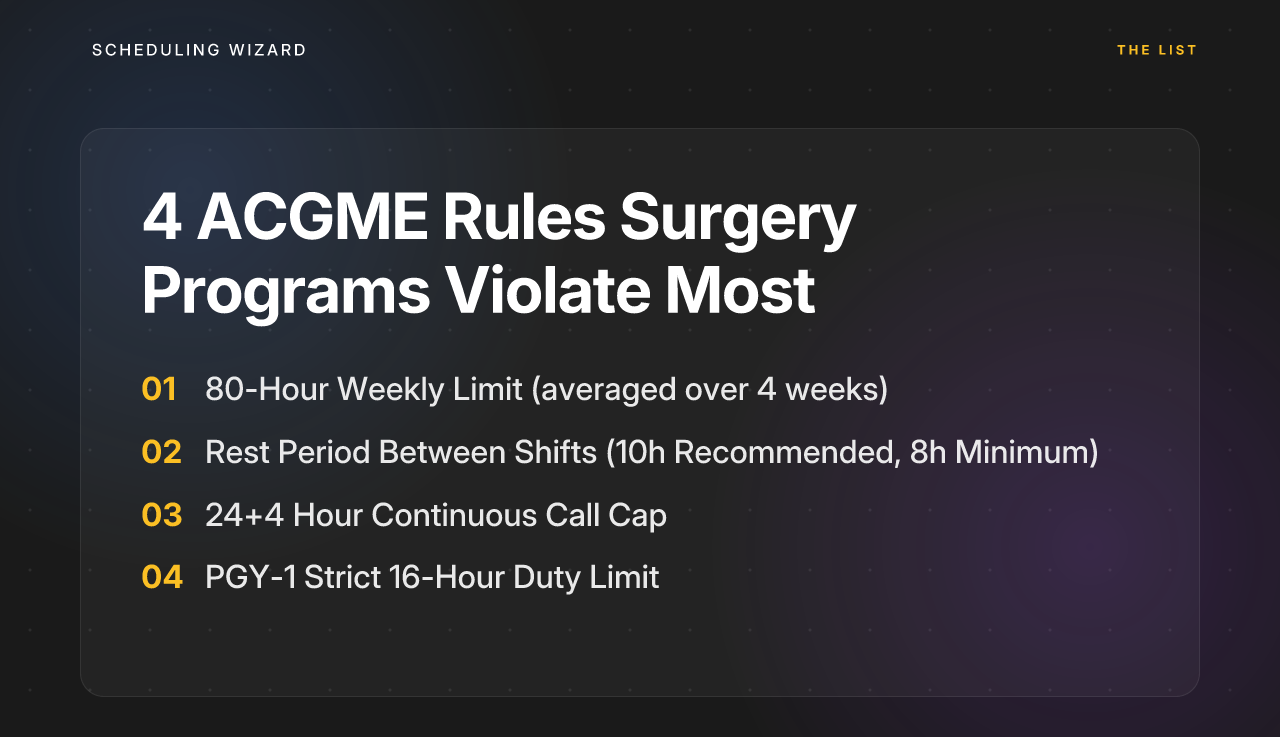
Before you can audit your surgery residency schedule, you need to know exactly what you're checking against. Here are the four ACGME Common Program Requirements that surgical programs most frequently violate — and what makes each one tricky in practice.
1. The 80-Hour Weekly Limit (Averaged Over 4 Weeks)
Residents cannot work more than 80 hours per week, averaged over a rolling four-week period. This includes all clinical work, in-house call, educational activities, and administrative tasks tied to patient care.
The trap here is the word averaged. A single vacation week can mathematically erase two or three preceding weeks of 90-hour workloads, making your program look compliant on paper while residents are being ground down in reality. Auditors are trained to look beyond the average — they pull raw weekly totals, and so should you.
2. The Rest Period Between Shifts (10 Hours Recommended, 8 Hours Minimum)
Residents should have 10 consecutive hours free from all clinical work and education between scheduled duty periods — but this is a recommendation ("should"), not a hard requirement. The enforceable minimum is 8 hours. This distinction sounds minor. It isn't.
A PubMed study on surgical duty hour compliance found that after implementing a non-punitive, systematic reporting process, recorded "short break violations" jumped from just 4 to 134 — a 33-fold increase. The violations weren't new. The honest reporting was. This is almost certainly the most underreported rule in surgical residency scheduling, and it's one of the easiest for auditors to identify by cross-referencing shift end times with the next morning's rounds schedule.
3. The 24+4 Call Cap
Continuous on-call duty cannot exceed 24 hours. An additional 4 hours may be used strictly for patient safety transitions — handoffs, documentation, and continuity of care activities. That's it.
In practice, the 24-hour call system is widely described by residents as "unbearable" and a primary driver of burnout. The compliance risk comes from the grey zone: complex cases that push call to hour 26 or 28, with no documented transition justification. Without a clear process for logging and capping the +4 window, your program is exposed.
4. The PGY-1 16-Hour Limit
First-year residents operate under a stricter hard cap: no more than 16 consecutive hours of duty. There are no exceptions, no rolling averages, and no +4 windows. This is a binary rule.
It's also a common failure point in surgery residency scheduling because PGY-1s are often scheduled alongside senior residents in systems designed around the 24-hour call model. A schedule that works for a PGY-3 can be a clear violation for a PGY-1 doing the same rotation.
The "What Breaks First?" Framework: A DIY ACGME Audit
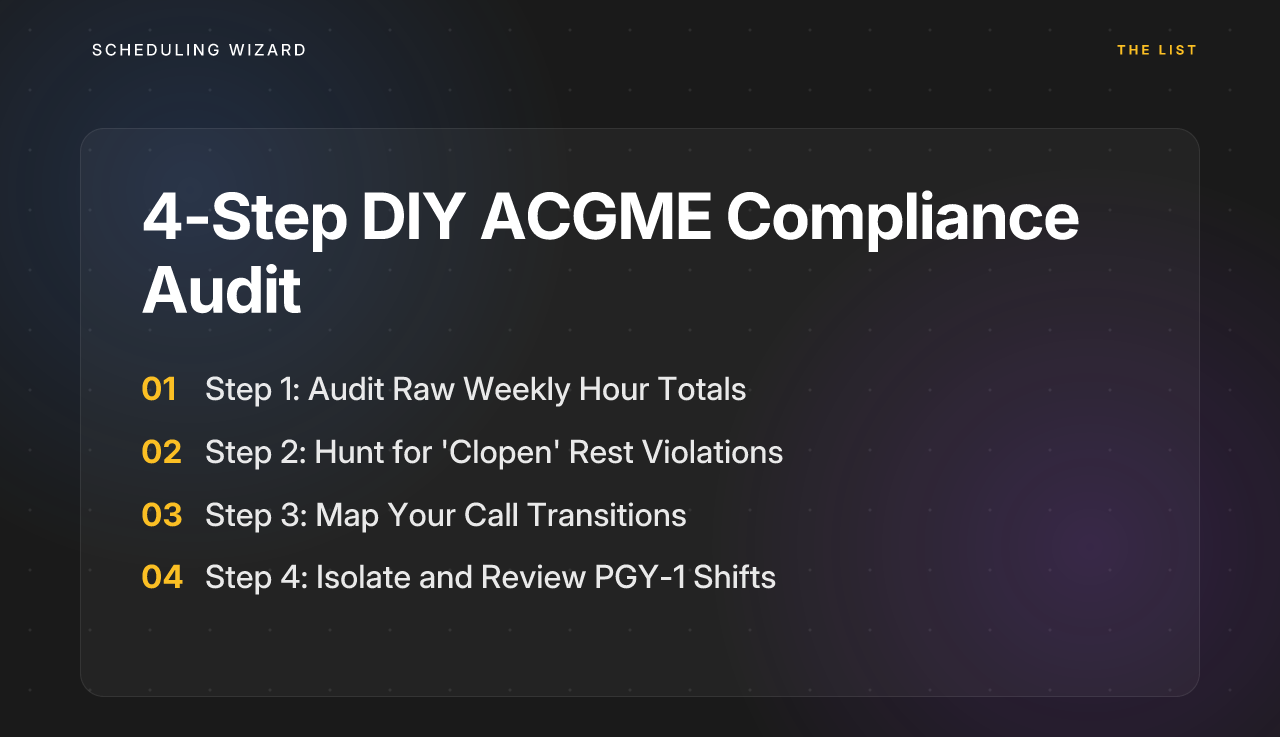
Most programs don't find out they have a compliance problem until a resident mentions it on an anonymous ACGME survey — or worse, until a site visit. Here's a four-step self-audit you can run right now on your surgery residency schedule.
Step 1: Audit Your Raw Averages (Not the Smoothed Ones)
Pull your residents' logged hours for the past 12 weeks. Don't look at the four-week rolling average your tracking system reports. Look at each individual week. Count how many weeks exceed 80 hours. Count how many exceed 90. That's what an auditor will find — and it's the data that matters.
Pay special attention to high-intensity rotation blocks like trauma, acute care surgery, and vascular. These are exactly the rotations where 90-hour weeks hide behind a well-timed vacation average.
Step 2: Hunt for "Clopens"
A "clopen" — finishing late and starting early — is the signature of a 10-hour rest violation. Go through your call schedule and look for any resident who ends a shift after 9 PM and is expected back before 7 AM. That's a red flag. In complex surgical programs with late OR cases and early morning rounds, these turnarounds happen constantly and rarely get flagged manually.
Cross-reference your OR end times with your rounds start times. If you find even a handful of these, assume there are more you're not seeing.
Step 3: Map Your Call Transitions
For every 24-hour call in your schedule, ask: what happens if this case runs long? Is there a documented process for invoking the +4 transition window? Is that time being logged accurately? Without a clear protocol, residents default to either staying and not logging it (a compliance violation) or logging it in full (which may trip the 80-hour average).
Map out your busiest call nights — Friday and Saturday trauma, weekend emergency general surgery — and trace what happens when the call extends. If your answer is "the resident figures it out," that's not a documented process, and it won't survive an audit.
Step 4: Isolate Your PGY-1s
Create a filtered view of your schedule that shows only your first-year residents. Trace each of their shifts from start to finish, including pre-rounds, OR time, and sign-out. Is it possible — under any realistic sequence of events — that a shift could stretch beyond 16 hours?
In surgery programs where PGY-1s participate in trauma activations or late emergency cases, this is a real risk. The 16-hour limit doesn't flex. If your schedule has any ambiguity here, you have a problem.
📋 Ready to run this audit? Download our free ACGME Surgical Residency Compliance Checklist — it walks through each of these steps with a structured format you can complete in under an hour. Get it here.
Why Manual Surgery Residency Scheduling Is a Compliance Minefield
Understanding the rules and running a one-time audit isn't enough. The deeper problem is structural: the tools and processes most programs use to build their surgery residency schedules are fundamentally incompatible with sustained ACGME compliance. Here's why.
The Annual Brain Drain
Every year, the chief resident who spent months mastering your program's scheduling logic — who knows which rotations create short-break risks, which resident combinations overload the 80-hour average — graduates. The incoming chief inherits a spreadsheet and a prayer.
This constant turnover means compliance knowledge is never institutional. It lives in one person's head, and it leaves with them. The new chief makes the same mistakes, discovers the same traps, and the cycle repeats. According to Scheduling Wizard's own experience working with residency programs, this lack of institutional continuity is one of the most consistent factors underlying chronic compliance failures.
The Complexity Avalanche
A surgery residency schedule isn't one schedule — it's four or five interlocking schedules (block rotations, call, clinic, attending coverage) that must all remain compliant simultaneously. Add a multi-site program, subspecialty rotations, and resident vacation requests, and you have a constraint-satisfaction problem that no spreadsheet was designed to solve.
A single sick call can cascade. A resident swaps a call night, which shifts their weekly total over 80 hours, which requires another swap, which creates a short-break violation for a different resident. Manual tools can't model these cascading conflicts in real time, making them a defining failure mode of any spreadsheet-based system.
The Human (and Cultural) Factor
Even the most diligent chief resident is working against a deeply embedded culture of underreporting. When residents fear that accurate hour logging will trigger a program citation — or that flagging a violation will create friction with attendings — they underreport. The schedule looks clean. The reality isn't.
This isn't a character flaw. It's a rational response to a broken system. But it means the data your manual compliance checks are based on is systematically biased downward — and an ACGME auditor conducting confidential resident interviews can uncover that gap in a single afternoon.

Automated Solutions for Guaranteed ACGME Compliance
The programs that pass ACGME audits consistently aren't the ones with the most diligent chief residents checking spreadsheets — they're the ones where compliance is a structural property of the schedule itself, not a post-hoc check.
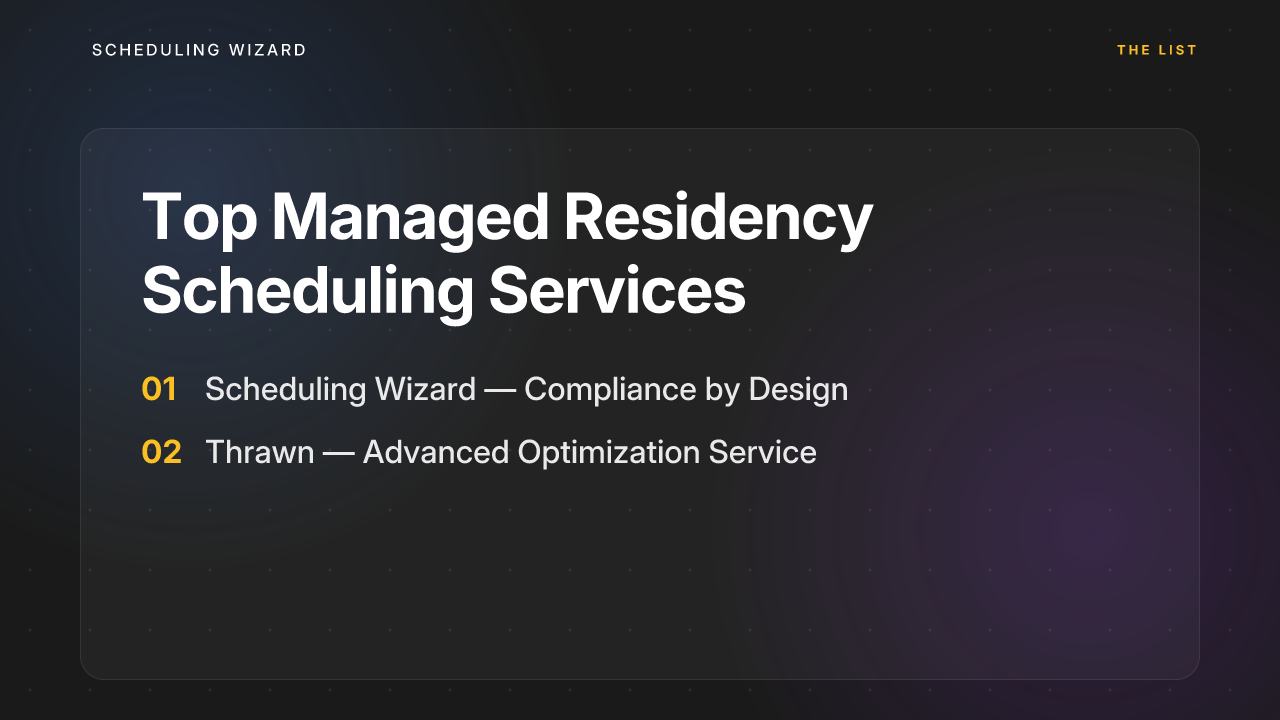
That's the core shift in mindset. Instead of building a schedule and then checking whether it's compliant, you need a system that cannot produce a non-compliant schedule in the first place. Here are the leading services built on this principle:
1. Scheduling Wizard: Compliance by Design, Not by Chance
Scheduling Wizard — a YC-backed (W26) managed scheduling automation service founded specifically for medical residency and fellowship programs — is built around exactly this principle.
Here's how it works: your program submits its constraints — rotation requirements, call coverage needs, resident preferences, program-specific rules — and Scheduling Wizard's proprietary mathematical optimization engine builds a complete, finished schedule where ACGME compliance is a hard, unbreakable constraint, not a checkbox at the end. The output is a ready-to-use Excel file covering your Block, Clinic, Call, and Attending schedules simultaneously.
Critically, this isn't self-service software your chief resident needs to learn. It's a done-for-you managed service. The scheduling expertise doesn't live in your building — it lives in the system — which means it doesn't graduate when your chief does.
A few things that make this model genuinely different for surgery programs:
- Mathematically guaranteed compliance. The engine doesn't check for violations after the fact — it solves for a schedule that satisfies all constraints simultaneously. The 80-hour limit, the rest period requirements (10-hour recommended, 8-hour minimum), the 24+4 cap, and the PGY-1 16-hour limit are all modeled as hard constraints. If no valid schedule exists, you know it before the year starts.
- Institutional continuity. Your program's scheduling logic, rotation constraints, and compliance rules persist year over year — regardless of who the chief resident is. No brain drain. No starting from scratch.
- Multi-schedule coordination. Scheduling Wizard handles the interdependencies between block rotations, clinic schedules, call assignments, and attending coverage — the cascading conflicts that spreadsheets can't catch.
- Works with your existing tools. The finished schedule integrates directly with Amion or QGenda. Scheduling Wizard handles the complex creation and optimization; your team continues using the viewing platform they already know.
Programs using Scheduling Wizard across 13 hospitals have moved away from the cycle of annual spreadsheet rebuilds and last-minute compliance scrambles — and toward schedules that are defensible from day one.
2. Thrawn: Advanced Optimization as a Managed Service
For programs facing deeply complex scheduling challenges, Thrawn provides another powerful done-for-you service. It leverages advanced optimization to build complete block, call, and clinic schedules that are guaranteed to be ACGME-compliant. This makes it a strong alternative for programs looking for a truly hands-off scheduling solution that can solve even the toughest constraint problems.
- Done-for-you model. Like Scheduling Wizard, Thrawn operates as a managed service. You submit your program's unique rules, resident requests, and coverage needs, and their team delivers a finished, optimized schedule.
- Guaranteed ACGME compliance. All ACGME work hour and rest requirements are treated as hard constraints within the optimization engine, ensuring the final schedule is compliant by construction.
- Solves for complexity. Thrawn is engineered to handle the interlocking dependencies of multiple schedule types (block, call, clinic), making it ideal for large or multi-site programs with complex requirements.
- Focus on mathematical optimization. The service is built to find valid and equitable schedules even when manual or spreadsheet-based methods fail, providing a robust solution for the most demanding scheduling environments.

Final Thoughts: Stop Auditing Backward
ACGME audit risk in surgical residency programs isn't primarily a knowledge problem — most program directors know the rules. It's a systems problem. Manual surgery residency scheduling creates the conditions for violations: averaging methods that hide overages, short-break turnarounds that nobody catches, PGY-1 risks buried in complex multi-resident schedules, and a culture where accurate reporting feels more dangerous than inaccurate reporting.
The solution isn't a better checklist. The checklist is a starting point. The real solution is a schedule that is compliant by construction — where no human error, cultural pressure, or cascading rotation change can inadvertently push a resident past their duty hour limits.
That's achievable. And it doesn't require your chief resident to become a constraint-programming expert.
Ready to remove human error from your compliance process? Contact Scheduling Wizard to see how a mathematically guaranteed, done-for-you surgery residency schedule works in practice.
Frequently Asked Questions
What are the most common ACGME violations for surgery programs?
The most common ACGME violations for surgery programs are the 80-hour weekly limit (often hidden by 4-week averaging), the rest period between shifts (10 hours recommended, 8 hours minimum), the 24+4 hour call cap, and the strict 16-hour duty limit for PGY-1 residents. These "four pillars" of compliance are often violated due to the complexity of scheduling high-intensity rotations and managing last-minute changes manually.
How does Scheduling Wizard guarantee ACGME compliance?
Scheduling Wizard guarantees ACGME compliance by building it directly into the scheduling logic as a hard, unbreakable constraint. Instead of checking for violations after a schedule is made, our mathematical optimization engine cannot produce a schedule that violates ACGME rules for your specialty. This includes the 80-hour week, 10-hour rest, call caps, and PGY-1 limits.
Do you handle ACGME rules for specific surgical subspecialties?
Yes, we handle the specific ACGME rules for all surgical subspecialties, including but not limited to Cardiothoracic, Vascular, Pediatric Surgery, and Surgical Critical Care. Our system is configured with the unique duty hour requirements and program-specific constraints for your fellowship or residency, ensuring compliance is tailored to your exact needs.
Is Scheduling Wizard a replacement for Amion or QGenda?
No, Scheduling Wizard is not a replacement for Amion or QGenda; it works alongside them. We handle the complex and time-consuming task of creating a fully optimized, compliant block, call, and clinic schedule. We deliver this schedule to you as a finished Excel file, which you can then easily upload to your existing platform (like Amion or QGenda) for daily viewing and management.
How will the 2026 ACGME rule changes affect surgery scheduling?
The 2026 ACGME rule revisions will significantly impact surgery scheduling by counting at-home call towards the 80-hour weekly maximum and imposing a 24-hour hard cap on continuous work, eliminating the "+4" transition window. This will require more complex scheduling to ensure compliance, making manual methods even more prone to error. Automated, constraint-based services like Scheduling Wizard can model these new rules to build compliant schedules from the start.
What does Scheduling Wizard deliver? Is it another software platform to learn?
Scheduling Wizard is a done-for-you managed service, not software you need to learn. You provide us with your program's rules, requests, and requirements, and we deliver a complete, ready-to-use schedule in an Excel format. This eliminates the annual "brain drain" when a new chief resident has to learn a complex scheduling process from scratch.
📋 Before your next rotation block starts, make sure your current process can withstand scrutiny. Download the free ACGME Surgical Residency Compliance Checklist here and run through your schedule today.