Summary
- Standard "doctor scheduling software" isn't built for the unique challenges of GME programs, like complex ACGME rules and the annual "knowledge drain" when chief residents graduate.
- The primary issue is operational, not technological; every year, the chief resident who mastered the schedule leaves, forcing their replacement to start from scratch and risking errors.
- Solutions are either DIY software, which perpetuates this cycle of retraining, or managed services, which retain institutional knowledge externally and eliminate the operator burden.
- To solve this recurring problem permanently, a managed service like Scheduling Wizard delivers finished, compliant schedules, removing the burden from the chief resident entirely.
If you've ever searched "best doctor scheduling software," you've probably landed on a listicle raving about tools built for outpatient clinics, private practices, and hospital staffing teams with dedicated, full-time administrators. Those lists aren't wrong — they're just written for the wrong audience.
GME programs operate in an entirely different world. You're not managing a stable roster of employed physicians with fixed preferences. You're managing complex, constraint-laden rotations governed by ACGME Common Program Requirements, shifting PGY-year eligibility rules, off-service rotators, call fairness obligations, and a program culture where the person responsible for building the schedule changes every single year.
One chief resident put it plainly in a Reddit thread on residency scheduling: "...my brain is so tired of all this thinking!" Another described the goal simply: "...lessen the administrative burden and allow me to still study enough." These aren't complaints about bad software UX. They're signals of a fundamentally broken process.
The Real Problem: The Annual Knowledge Drain
Every July, most residency programs face what's sometimes called the "July Problem" — not just the well-known clinical risk of new interns starting, but a quieter operational catastrophe: the chief resident who spent 12 months mastering your program's scheduling logic graduates. Their mental model — every constraint, exception, and workaround baked into your call schedule — walks out the door with them.
The incoming chief starts from scratch. And as one EM resident noted on Reddit, this transition often leads to "schedules containing duty hour violations and inequality between individual residents."
This isn't a technology problem. It's a structural, recurring operational problem. And it's the lens through which you should evaluate every tool on this list.
Two Models: DIY Software vs. Done-for-You Services
Before we dive in, understand that the tools below fall into two fundamentally different categories:
- Self-Service (DIY) Software: Platforms that give your chief resident the tools to build the schedule themselves. The program bears the full operator burden — configuration, rule-modeling, compliance checking, and re-training each year.
- Managed Services (Done-for-You): A newer model where scheduling experts handle the entire build on your behalf. You provide constraints and preferences; they deliver a finished, optimized schedule. Institutional knowledge lives in the service, not in a rotating resident.
Our GME-Specific Evaluation Criteria
We evaluated each tool on four criteria that actually matter to residency programs — informed by research on effective residency scheduling:
| Criterion | Why It Matters |
|---|---|
| ACGME Compliance Handling | Does it prevent violations, or just flag them after the fact? |
| Onboarding Burden | How long before a new chief can actually use it? |
| Subspecialty Rule Support | Can it handle PGY-specific and rotation-specific constraints? |
| Institutional Knowledge Transfer | What happens when the chief resident changes? |
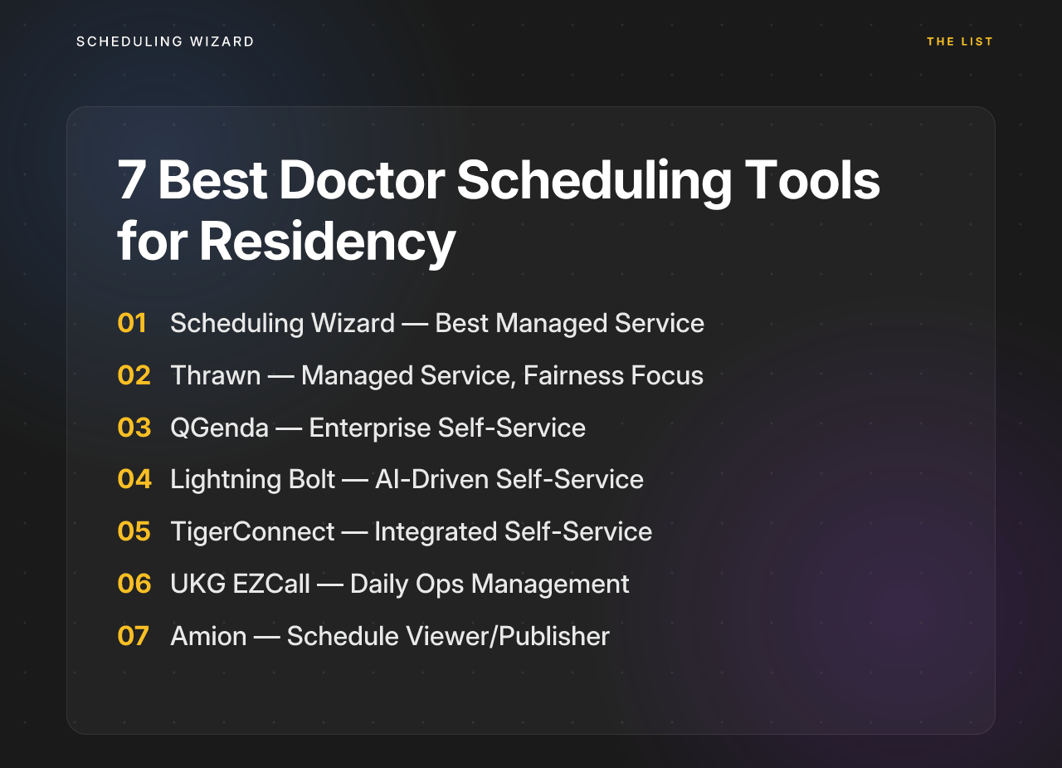
The 7 Best Doctor Scheduling Tools for Medical Residency Programs
1. Scheduling Wizard ⭐ Top Pick — Best Managed Service
Model: Managed Scheduling Service (Done-for-You) Best For: Residency and fellowship programs that want to eliminate administrative burden, guarantee ACGME compliance, and permanently solve the institutional knowledge drain.
Scheduling Wizard is a YC-backed (W26) managed scheduling automation service built specifically for GME programs — and it's the only tool on this list that operates as a done-for-you service, not software the chief resident has to learn.
Here's how it works: your program submits its constraints — rotation requirements, call rules, vacation requests, clinic days, moonlighting constraints, PGY-year restrictions — and Scheduling Wizard's proprietary mathematical optimization engine produces finished Block, Call, Clinic, and Attending schedules delivered as ready-to-use Excel spreadsheets. No interface to configure. No learning curve. No re-training in July.
Critically, the output integrates seamlessly with tools your program already uses. Many programs upload the finished schedule directly into Amion or QGenda for day-to-day viewing — so Scheduling Wizard handles the hard part (creation and optimization), while your existing tools handle display.
What separates Scheduling Wizard from every self-service tool on this list is what happens when the chief rotates: nothing changes. The program's constraints, rules, and scheduling history are retained within the service. The new chief doesn't inherit a software account they've never touched — they inherit a working, optimized schedule built by experts who already know your program.
| Criterion | Rating |
|---|---|
| ACGME Compliance Handling | ✅ Excellent — mathematically guaranteed, not manually checked |
| Onboarding Burden | ✅ Minimal — consultation to gather constraints, no software training |
| Subspecialty Rule Support | ✅ Excellent — proprietary constraint modeling language handles complex, specialty-specific rules |
| Institutional Knowledge Transfer | ✅ Completely Solved — scheduling logic persists in the service across chief transitions |
Key capabilities: Block/Rotation schedule generation, Call schedule generation with fairness optimization (shift equity), conflict detection, resident preference integration, and rapid re-optimization for unplanned absences.
2. Thrawn
Model: Managed Scheduling Service (Done-for-You) Best For: Programs that want a hands-off solution with a strong emphasis on fairness and equity in the final schedule.
Thrawn is another managed service in the GME scheduling space. Like Scheduling Wizard, Thrawn builds and delivers finished residency schedules rather than handing your chief a platform to operate. They use a proprietary Scheduling Programming Language (SPL) to model fairness and compliance constraints from the ground up — not as a post-hoc check.
| Criterion | Rating |
|---|---|
| ACGME Compliance Handling | ✅ Very Good |
| Onboarding Burden | ✅ Minimal |
| Subspecialty Rule Support | ✔️ Good |
| Institutional Knowledge Transfer | ✅ Completely Solved |
If your program's primary pain point is shift equity — the kind of measurable fairness concerns where residents feel the schedule is unfair and the data confirms it — Thrawn is worth evaluating alongside Scheduling Wizard.
3. QGenda
Model: Self-Service Software (DIY) Best For: Large enterprise health systems with dedicated, non-rotating administrative staff to manage the platform long-term.
QGenda is one of the dominant names in physician scheduling software, and for good reason — it's powerful, highly customizable, and deeply integrated into many hospital systems. But power comes with complexity, and complexity is a liability when the person operating the system changes every 12 months.
As one resident described the experience: "the learning curve and you have to manually input all your constraints and shifts." For a chief resident already balancing clinical duties, leadership responsibilities, and their own education, that burden is significant.
QGenda can flag ACGME duty hour violations, but the responsibility for preventing them still falls on the user. When the chief who built and configured your QGenda instance graduates, that institutional knowledge — every custom rule, every exception, every workaround — lives in their head, not in the software.
| Criterion | Rating |
|---|---|
| ACGME Compliance Handling | ⚠️ Fair — flags violations but doesn't prevent them through optimization |
| Onboarding Burden | ❌ High — extensive implementation and training required |
| Subspecialty Rule Support | ✔️ Good |
| Institutional Knowledge Transfer | ❌ Poor — expertise is tied to the operator, not the platform |
Bottom line: QGenda is best suited for programs with stable, dedicated scheduling administrators — not rotating chief residents.
4. Lightning Bolt (by PerfectServe)
Model: Self-Service Software (DIY) Best For: Tech-savvy programs with stable staff who have the bandwidth to configure and maintain a sophisticated rules engine.
Lightning Bolt uses AI-driven, rule-based automation to generate and optimize physician schedules. Its performance data is genuinely impressive — case studies report up to a 50% reduction in schedule creation time and a 30% increase in physician satisfaction. It has earned top KLAS rankings in physician scheduling for good reason.
The tradeoff is setup complexity. The rules engine is powerful, but it requires deep, program-specific configuration before it delivers value. For a self-service tool, it's among the best at constraint modeling and subspecialty rule support — but it still demands a knowledgeable operator to unlock that potential.
| Criterion | Rating |
|---|---|
| ACGME Compliance Handling | ✔️ Good |
| Onboarding Burden | ❌ High — deep configuration required upfront |
| Subspecialty Rule Support | ✅ Very Good |
| Institutional Knowledge Transfer | ❌ Poor — configured knowledge lives with the user |
Bottom line: Lightning Bolt is among the strongest self-service options for programs with the administrative stability to support it. For programs with annual chief turnover, the setup investment resets every year.
5. TigerConnect Physician Scheduling
Model: Self-Service Software (DIY) Best For: Programs already embedded in the TigerConnect clinical communication ecosystem.
TigerConnect Physician Scheduling is generally more approachable than QGenda or Lightning Bolt, with a cleaner interface and easier onboarding. Its primary strength is integration — if your department already uses TigerConnect for secure messaging and care team communication, adding its scheduling module creates a unified operational workflow.
Outside of that ecosystem context, it's a competent but not exceptional self-service scheduling tool. It still places the full administrative burden on your chief resident and does nothing to solve the institutional knowledge problem when they rotate out.
| Criterion | Rating |
|---|---|
| ACGME Compliance Handling | ⚠️ Fair |
| Onboarding Burden | ⚠️ Moderate |
| Subspecialty Rule Support | ✔️ Good |
| Institutional Knowledge Transfer | ❌ Poor |
Bottom line: Worth evaluating if you're already a TigerConnect shop. Otherwise, there are stronger options depending on whether you prefer DIY or done-for-you.
6. UKG EZCall
Model: Self-Service Software (DIY) Best For: Programs focused on daily on-call management, shift swaps, and PTO tracking rather than master schedule creation.
UKG EZCall has a friendly interface and handles the day-to-day logistics of managing an existing schedule reasonably well — swap requests, absence tracking, real-time visibility into coverage. What it is not designed to do is generate a complex, constraint-laden GME master schedule from the ground up.
If your program already has a solid schedule-creation process (or a managed service handling that work) and needs a lightweight tool for daily management, EZCall has its uses. But if you're looking for doctor scheduling software that can handle ACGME duty hour constraints and optimization across a full academic year, this isn't it.
| Criterion | Rating |
|---|---|
| ACGME Compliance Handling | ❌ Limited — not designed for optimization |
| Onboarding Burden | ⚠️ Moderate |
| Subspecialty Rule Support | ⚠️ Fair |
| Institutional Knowledge Transfer | ❌ Poor |
Bottom line: A supplementary tool for daily operations, not a scheduling solution for GME programs.
7. Amion
Model: Schedule Viewer / Publisher Best For: Publishing and displaying a schedule that was already created somewhere else.
Let's be direct: Amion is not a scheduling tool — it's a schedule display tool. It's ubiquitous in residency programs, and for good reason. It's simple, affordable, accessible on mobile, and residents genuinely like using it to view their schedules.
But Amion does not create, optimize, or check schedules. You manually enter the grid. It has no constraint engine, no ACGME compliance logic, and no ability to detect duty hour violations or inequitable call distribution. The scheduling intelligence lives entirely with whoever built the schedule and entered it — which is to say, it lives with the chief resident, and leaves with them in June.
Many programs that use managed services like Scheduling Wizard use Amion as their viewing layer — the optimized schedule gets delivered as an Excel file and uploaded into Amion for day-to-day access. That's actually the ideal use case for it.
| Criterion | Rating |
|---|---|
| ACGME Compliance Handling | ❌ None |
| Onboarding Burden | ✅ Low |
| Subspecialty Rule Support | ❌ N/A |
| Institutional Knowledge Transfer | ❌ Very Poor — flat display, no logic retained |
Bottom line: Use Amion for what it's good at: showing residents where they need to be. Don't confuse it for a scheduling solution.
The Final Verdict: DIY Software or a Done-for-You Service?
Here's the honest decision framework for program directors and incoming chiefs:
Ask yourself three questions:
- Is our chief resident spending 80–100+ hours per year building and managing schedules — time taken away from clinical education and leadership development?
- Have we experienced ACGME compliance near-misses, duty hour violations, or resident complaints about fairness in the weeks after the July transition?
- Do we re-train a new resident on scheduling software every summer, investing weeks of effort in knowledge that will leave with them in 12 months?
If you answered yes to any of those, the problem isn't a lack of software features. You're caught in a repeating operational cycle where institutional scheduling knowledge is built, lost, rebuilt, and lost again — every year.
Self-service scheduling software, no matter how sophisticated, perpetuates that cycle. It demands an operator, and your operator rotates.
A managed service breaks the cycle. The expertise lives outside your program. The constraints, rules, and history are retained across every chief transition. Your new chief doesn't inherit a software account they've never seen — they inherit a working system.
As one frustrated EM resident acknowledged online: "I think you're probably right, as much as I wanted to solve this problem myself." Sometimes the right answer isn't a better tool — it's removing the burden from the chief entirely.
Frequently Asked Questions
How does Scheduling Wizard ensure ACGME compliance?
Scheduling Wizard guarantees 100% ACGME compliance by building all Common and specialty-specific Program Requirements directly into its mathematical optimization engine. Unlike software that merely flags potential violations for a human to fix, our system treats ACGME rules as hard constraints that cannot be broken. During onboarding, we codify your program's specific requirements—from the 80-hour work week and 1-in-7 days off to nuanced subspecialty rules—ensuring the final schedule is mathematically proven to be compliant from the start.
Will Scheduling Wizard work with our existing tools like Amion or QGenda?
Yes, Scheduling Wizard is designed to work alongside your current scheduling viewer. We handle the complex, time-consuming work of creating an optimized, compliant block and call schedule. We deliver this schedule to you as a formatted Excel spreadsheet, which you can then easily upload into platforms like Amion, QGenda, or TigerConnect for daily viewing, swaps, and communication. We replace the manual creation process, not your day-to-day viewing tool.
What happens when our chief resident graduates?
Nothing changes with your scheduling process. Scheduling Wizard retains all of your program's rules, constraints, and historical data, ensuring a seamless transition. This solves the "institutional knowledge drain" that happens every July. The incoming chief resident doesn't need to learn new software or re-enter years of scheduling logic; the knowledge lives with us, providing stability and continuity year after year.
Can you handle the upcoming 2026 ACGME rule changes?
Yes, our system is already prepared to handle the 2026 ACGME rule revisions, including counting home call towards the 80-hour weekly maximum and enforcing the 24-hour hard cap on continuous work. Because we model ACGME rules as mathematical constraints, we can help your program model different scenarios to understand the impact of these changes on your call structure and staffing needs well before the 2026 deadline.
What is the onboarding process like?
The onboarding process is a simple consultation, not a lengthy software implementation. We start with a series of meetings with your program leaders to gather all your requirements—rotations, call schedules, resident preferences, faculty needs, and all ACGME constraints. We handle all the setup on our end. There is no software for your team to configure or learn.
Is Scheduling Wizard suitable for private practices?
While our core focus is solving the unique challenges of GME programs, our optimization engine is also highly effective for complex physician scheduling in private practices and hospital departments. The challenges of balancing fairness, physician preferences, call equity, and complex staffing rules are universal. If your practice struggles with a time-consuming scheduling process, a managed service can provide the same benefits.
If your program loses scheduling institutional knowledge every year when the chief rotates, a managed service beats self-service software every time. Scheduling Wizard is built exactly for that problem — and it's the only option on this list designed from the ground up to solve it.