Summary
- GME fellowship scheduling is a high-stakes task where errors risk ACGME accreditation and resident morale, yet many programs still rely on manual spreadsheets.
- This guide compares the top 6 scheduling tools on four key criteria: ACGME compliance, call fairness, rotation coverage, and ease of use for chief residents.
- A major finding is the shift towards managed services, which offload the scheduling burden from chief residents and prevent the annual loss of institutional knowledge.
- For programs looking to eliminate this administrative work, services like Scheduling Wizard deliver finished, mathematically optimized, and ACGME-compliant schedules as a done-for-you service.
When you search for "fellowship scheduling software," you might fall into one of two camps. The first is the general program administrator looking for appointment booking or fellowship application tracking. The second — and the audience this article is written for — is the GME program director, program coordinator, or chief resident staring down the barrel of scheduling 80 residents across two hospitals, managing individual vacation requests, elective requests, graduation requirements, emergency call, didactics, and morning report, all while keeping ACGME compliance intact.
If you're in that second camp, you already know the stakes. A scheduling error isn't just an inconvenience — it's an accreditation risk. A missed constraint doesn't just frustrate residents — it tanks morale and, in some cases, patient safety. And yet, many GME programs are still cobbling together their block schedules in spreadsheets, fighting clunky software interfaces, and losing institutional knowledge every time a new chief takes over.
This guide covers the six best fellowship scheduling software tools available to GME programs today, evaluated on the four criteria that matter most: ACGME compliance, call fairness, rotation coverage, and ease of use for chief residents. Whether you're scheduling 12 fellows or coordinating 100 residents from 4 different programs, there's a solution on this list for you.
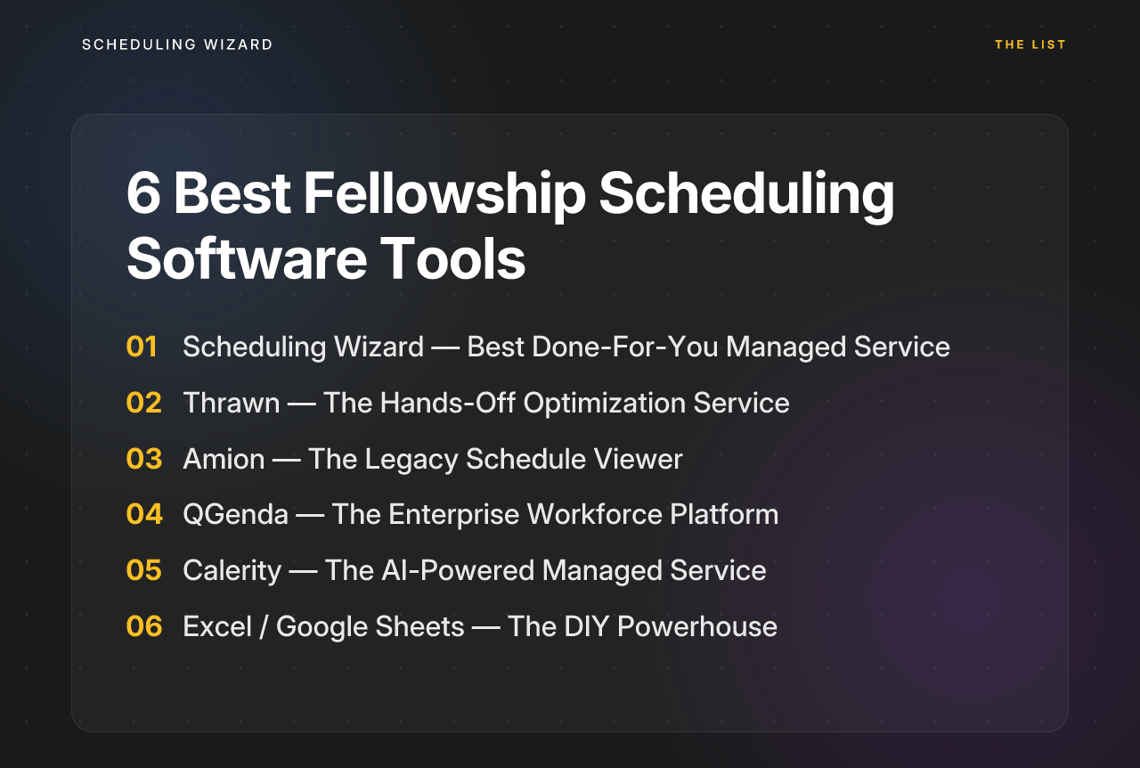
The 6 Best Fellowship Scheduling Software Tools for GME Programs
1. Scheduling Wizard — Best Done-For-You Managed Service
If your chief resident's job is to lead residents, not become a scheduling software expert, Scheduling Wizard is the most powerful option on this list — because it isn't software at all. It's a managed scheduling automation service, meaning your program submits its constraints and receives a finished, optimized, ACGME-compliant schedule in return.
Here's what that looks like in practice: your program coordinator or chief fellow submits rotation requirements, clinic needs, call duties, subspecialty-specific ACGME rules, and individual resident preferences (vacation, electives, moonlighting, conferences). Scheduling Wizard's proprietary mathematical optimization engine takes all of that in and outputs complete Block, Clinic, Call, and Attending schedules — delivered as ready-to-use Excel spreadsheets. If your program already uses Amion or QGenda to display schedules, you simply upload the finished file. Scheduling Wizard builds the schedule; your existing tools display it.
ACGME Compliance: This is Scheduling Wizard's strongest differentiator. Compliance isn't a checkbox your chief manually verifies — it's mathematically guaranteed by the engine itself. Subspecialty-specific rules are baked in, which is critical for fellowship programs with unique duty hour configurations.
Call Fairness: The optimization engine distributes call duties equitably across your resident pool. No more residents whispering that someone got more holiday weekends than everyone else.
Rotation Coverage: The system resolves cross-schedule dependencies automatically, ensuring no gaps or overstaffing across rotations, clinics, and call pools — even when constraints like "no more than 6 residents on wards at any given time" are in play.
Ease of Use for Chief Residents: Unmatched. There is no software to learn. This single fact eliminates one of the biggest frustrations in GME scheduling: the annual knowledge drain that happens when a new chief inherits a complex spreadsheet they can't decipher. With Scheduling Wizard, the institutional scheduling logic persists year after year, regardless of chief turnover.
Founded in 2024 and backed by Y Combinator (W26), Scheduling Wizard currently serves 18 departments across 13 hospitals. For GME programs that want scheduling done right without making it a part-time job, it's the clear first choice.
2. Thrawn — The Hands-Off Optimization Service
For programs that value the done-for-you model but want a laser focus on pure scheduling optimization, Thrawn is a powerful alternative. Like other managed services, Thrawn takes your program's complex web of constraints — from ACGME rules to individual vacation requests — and delivers a finished schedule. The core difference is its emphasis on a hands-off, "black box" approach where the complexity is entirely handled for you.
Programs submit their requirements for block, call, and clinic schedules, and Thrawn's advanced optimization engine builds the most efficient and equitable schedule possible. It's a true "done-for-you" model designed for chief residents and program coordinators who want to submit their needs and receive a finished product without back-and-forth or software configuration.
ACGME Compliance: Built into the core of the optimization engine. Thrawn guarantees that the schedules it produces are fully compliant with all relevant ACGME duty hour regulations.
Call Fairness: The service uses mathematical optimization to ensure that call, holiday, and weekend duties are distributed as fairly as possible across all residents.
Rotation Coverage: Thrawn's engine is designed to solve for full coverage, ensuring that all clinical services are staffed appropriately according to the program's rules.
Ease of Use for Chief Residents: Excellent. As a managed service, there is no software to learn or manage. The process is simple: submit constraints, receive a schedule. This model makes it a strong contender for programs looking for a completely hands-off scheduling solution.
3. Amion — The Legacy Schedule Viewer
Amion has been around long enough that it's practically a household name in GME. Walk into almost any residency program's administrative office and there's a good chance Amion is up on a screen somewhere. But it's important to understand what Amion actually is: primarily a schedule viewer and manual editor, not a schedule generator.
The typical workflow is that a chief resident builds the schedule elsewhere — usually in Excel — and then inputs or uploads it into Amion so residents can view their assignments and on-call duties. Amion can flag basic conflicts, but it won't proactively prevent you from creating a non-compliant schedule. Compliance is entirely on the human scheduler.
ACGME Compliance: Manual. The software will not stop you from violating duty hour rules. Every constraint must be tracked and verified by whoever is building the schedule.
Call Fairness: Also manual. If you want fair call distribution, you need to calculate it yourself before you plug the schedule into the system.
Rotation Coverage: Amion is a display platform. It shows you what you've built; it doesn't help you build it better.
Ease of Use for Chief Residents: Functional, but widely criticized. On Reddit's r/Residency, a common sentiment from former chiefs is straightforward: "I hated it," with others describing it as "clunkier" than alternatives. It works for viewing, but it's not a tool that makes creating complex GME schedules any easier.
Worth noting: Amion and Scheduling Wizard aren't mutually exclusive. Many programs use Amion as their day-to-day viewing layer while using Scheduling Wizard to actually generate and optimize the schedule. It's a natural pairing.

4. QGenda — The Enterprise Workforce Platform
QGenda is the heavy-hitter of healthcare provider scheduling. It's used by a majority of large U.S. health systems and goes well beyond scheduling into credentialing, workforce analytics, and real-time coverage alerts. For a hospital system with a dedicated scheduling team and the budget to match, it's a genuinely powerful platform.
For a single GME department managed by a rotating chief resident? It's often overkill.
ACGME Compliance: QGenda can be configured with ACGME rules, but it remains a rule-based system — meaning the burden of correctly setting up and applying those rules falls on the user. It's not the same as mathematically guaranteed compliance.
Call Fairness: Can be achieved with careful setup using QGenda's task and tag system. One chief resident on Reddit noted that "QGenda is nice because you can create 'tasks'" and tag residents by role, which helps organize complex pools. But extracting that value requires significant upfront configuration.
Rotation Coverage: Excellent visibility once the system is configured. Real-time alerts and coverage dashboards are genuine strengths for programs with dedicated administrative staff.
Ease of Use for Chief Residents: This is the core limitation for GME use cases. QGenda is an enterprise-grade platform with a steep learning curve and pricing to match. A chief resident taking on this system for a single year faces a significant investment of time just to become proficient — time that should be spent on clinical education and patient care.
5. Calerity — The AI-Powered Managed Service
Calerity positions itself similarly to Scheduling Wizard as a managed service for clinical scheduling. Programs submit their constraints, and Calerity's AI-powered system generates a schedule optimized for fair assignment distribution and clinical coverage.
ACGME Compliance: Listed as a core feature of the service.
Call Fairness: AI-driven distribution is central to the platform's value proposition.
Rotation Coverage: Designed to prevent gaps and optimize coverage across complex scheduling grids.
Ease of Use for Chief Residents: As a managed service, Calerity removes the software learning curve — a genuine advantage for busy chief residents. It's a credible alternative for programs exploring the managed service model and wanting to compare options before committing.
The managed service category as a whole — Scheduling Wizard and Calerity being the two primary players — represents a meaningful shift in how GME programs think about scheduling. Instead of asking "which software do we learn," the question becomes "which expert service do we trust."
6. Excel / Google Sheets — The DIY Powerhouse
No honest list of fellowship scheduling software tools is complete without acknowledging the tool that powers a surprising number of GME programs: Excel. And for good reason. As one chief resident put it bluntly on Reddit: "nothing was able to deliver quite like Excel."
Excel is free (or included in the Office suite your institution already pays for), infinitely flexible, and familiar to almost everyone. Chiefs have built remarkably sophisticated systems using the COUNTIF function to track the number of residents at each hospital, conditional formatting to color-code fellows by rotation at a glance, and shared Google Sheets to collaborate with co-chiefs in real time. For a small program with a tech-savvy chief and relatively simple constraints, it genuinely works.
ACGME Compliance: This is where Excel becomes dangerous. There are no guardrails. No alert fires when a resident exceeds duty hour limits. No engine flags a scheduling conflict. Every compliance check is entirely manual — and a single missed cell can become an accreditation issue.
Call Fairness: Achievable, but only as good as the human doing the math. Unintentional inequities are common, especially when vacation swaps and ad-hoc changes accumulate over the year.
Rotation Coverage: Again, entirely on the scheduler. Excel will happily let you leave a rotation uncovered without saying a word.
Ease of Use for Chief Residents: It depends enormously on the individual. An Excel power user can build something impressive. But that expertise rarely transfers cleanly to the next chief — the formulas are cryptic, the logic is undocumented, and the incoming chief often starts from scratch. This is the institutional knowledge problem in its purest form.
Excel remains king for programs with limited budgets, but its hidden costs — chief resident hours, compliance risk, and the annual knowledge reset — are real and worth accounting for.

Decision Matrix: Choosing the Right Fellowship Scheduling Tool
| Scheduling Wizard | Thrawn | Amion | QGenda | Calerity | Excel / Google Sheets | |
|---|---|---|---|---|---|---|
| Model | Managed Service | Managed Service | Self-Service Viewer | Enterprise Platform | Managed Service | Manual / DIY |
| Best For | Programs eliminating scheduling burden & guaranteeing compliance | Hands-off scheduling with a focus on optimization | Low-cost schedule viewing | Large health systems with dedicated scheduling staff | Programs exploring AI-based managed services | Small programs with tight budgets & spreadsheet expertise |
| ACGME Compliance | Mathematically guaranteed | Mathematically guaranteed | Manual check required | Rule-based, user-managed | Automated | Entirely manual — high risk |
| Call Fairness | Optimization-driven | Optimization-driven | Manual | Configurable | AI-driven | Manual calculation |
| Rotation Coverage | Auto-resolved, no gaps | Auto-resolved, no gaps | Display only | High visibility, manual setup | Optimized | No guardrails |
| Ease of Use (Chief Residents) | None — no software to learn | None — no software to learn | Moderate (clunky UI) | High learning curve | None — no software to learn | Requires Excel expertise |
| Institutional Continuity | Built-in (persists across chiefs) | Built-in (persists across chiefs) | Lost annually | Partial | Varies | Lost annually |
Stop Building Schedules — Start Reviewing Them
The most important shift in modern GME scheduling isn't about which software has the best interface. It's about who should bear the burden of building the schedule in the first place.
Chief residents are in training. Their year as chief is meant to develop leadership, administrative, and clinical skills — not to turn them into scheduling software experts or Excel formula architects. And yet, that's exactly what many programs ask of them, consuming hundreds of hours better spent on education, mentorship, and patient care.
Self-service tools like Amion and QGenda have their place — especially for viewing and displaying schedules day-to-day. Enterprise tools like QGenda serve large health systems with dedicated scheduling staff well. And Excel, for all its limitations, will always have a loyal following among the technically inclined.
But for GME fellowship programs that want ACGME compliance guaranteed, call fairness optimized, and their chief residents focused on medicine instead of spreadsheets, managed services represent the future. Between Scheduling Wizard and Calerity, that category now has real, proven options.
Frequently Asked Questions
What is the difference between scheduling software and a managed scheduling service?
The primary difference is who does the work. With scheduling software (like QGenda or Amion), your team builds the schedule using the tool's interface. With a managed scheduling service (like Scheduling Wizard), you provide your rules and constraints, and an expert team with specialized technology builds the finished schedule for you. This "done-for-you" model eliminates the need for chief residents or program coordinators to learn complex software, manually check for compliance errors, or spend hundreds of hours on data entry. It also preserves institutional knowledge, as the scheduling logic is maintained by the service, not lost each year when a new chief takes over.
How do managed services like Scheduling Wizard handle ACGME compliance for different subspecialties?
Managed services handle ACGME compliance by building your program's specific rules directly into their scheduling engine. Instead of relying on manual checks, compliance with both common and subspecialty-specific requirements (e.g., for Cardiology, Gastroenterology, or Surgical subspecialties) is mathematically guaranteed in the final schedule. When you onboard with a service like Scheduling Wizard, you provide all relevant ACGME duty hour rules for your fellowship. These constraints are encoded as core requirements. The optimization engine then produces a schedule that is guaranteed to be compliant, saving your program from the risk of accreditation issues and the tedious work of manual verification.
Can I use Scheduling Wizard if my program already uses Amion or QGenda?
Yes, absolutely. Scheduling Wizard is designed to work alongside schedule viewers like Amion and QGenda, not replace them. The workflow is simple: Scheduling Wizard generates the optimized, compliant Block, Call, and Clinic schedules and delivers them as an Excel file. Your program coordinator then simply uploads this finished file into your existing Amion or QGenda account for day-to-day viewing by residents and faculty. This allows you to keep your familiar viewing platform while eliminating the manual labor of building the schedule itself.
How does fellowship scheduling software address the new 2026 ACGME home call rules?
Advanced scheduling tools and managed services address the 2026 ACGME rule changes by incorporating the new constraints directly into their logic. Specifically, they can ensure that at-home call counts toward the 80-hour weekly maximum and that no clinical work period, including call, exceeds the 24-hour hard cap. The upcoming rule changes make manual scheduling with spreadsheets even more complex and risky. A managed service like Scheduling Wizard can configure its optimization engine to strictly adhere to these new rules, providing GME programs with peace of mind and guaranteed compliance before the 2026 deadline arrives.
Why is Excel a risky choice for GME fellowship scheduling?
Excel is risky for GME scheduling because it has no built-in safeguards for ACGME compliance. A single formula error or manual mistake can lead to duty hour violations, potentially jeopardizing a program's accreditation status. While flexible, Excel also creates significant challenges with call fairness, rotation coverage, and institutional continuity. Schedules built in Excel are often difficult for the next chief resident to understand, forcing them to start from scratch each year. This annual knowledge drain and high risk of manual error are the primary reasons programs move to dedicated software or managed services.
How much time can a chief resident save by using a managed scheduling service?
A chief resident can save hundreds of hours per year by using a managed scheduling service. The time spent building, revising, and verifying a schedule—often cited as 200-300 hours—is almost entirely eliminated. By offloading the scheduling task, chief residents can reclaim that time to focus on their primary responsibilities: clinical education, mentorship, patient care, and leadership development. The service handles the complex optimization and compliance checks, reducing the chief's role to simply reviewing a finished, high-quality schedule.
What happens when our program's scheduling needs change mid-year?
Managed scheduling services are built to handle mid-year changes. When an unexpected event occurs, such as a resident going on leave or a rotation requirement changing, you simply submit the new constraints to the service. Services like Scheduling Wizard can quickly re-run the optimization to generate a revised schedule that accommodates the change while keeping all other rules and fairness metrics intact. This is far more efficient than manually untangling and rebuilding a complex schedule in a spreadsheet.
How is call fairness calculated and ensured in these systems?
Optimization-driven systems ensure call fairness by using mathematical algorithms to distribute assignments as equitably as possible. They can balance the total number of calls, as well as the number of weekend, holiday, and weekday calls for each resident over the entire year. Rather than relying on a chief resident's manual count, the system treats fairness as a key constraint to be solved. This data-driven approach removes unintentional bias and provides a transparent, defensible schedule that improves resident morale by ensuring no one is consistently over- or under-burdened.
See What a Finished Schedule Looks Like
Tired of wrestling with spreadsheets and second-guessing your ACGME compliance? Scheduling Wizard can show you exactly what a finished, optimized, mathematically compliant schedule looks like for a program like yours — before you commit to anything.