Summary
- Physician workforce scheduling is a complex task that takes chief residents 4-8 hours monthly, but optimized systems can increase perceived schedule fairness from 43% to 95%.
- Most tools are either simple displays like Amion (which don't build schedules) or complex platforms like QGenda that require extensive administrative work.
- The critical choice for program coordinators is between software you must operate and a managed service that delivers a finished schedule.
- For programs seeking to eliminate the administrative burden, a managed service like Scheduling Wizard creates the complete, optimized, and ACGME-compliant schedule for you.
If you searched "attending physician scheduling software" and landed here, you've probably already noticed something frustrating: most search results return tools built for patient appointment booking — think online intake forms, patient portals, and calendar widgets for scheduling office visits. That's not what you need.
What you're actually looking for is far more complex: a solution for physician workforce scheduling — the intricate, constraint-laden process of building Block rotation schedules, Call schedules, and Clinic assignments for an entire residency or fellowship program while staying airtight on ACGME compliance.
These are fundamentally different problems, and conflating them costs you time you don't have.
The Real Cost of Getting Physician Scheduling Wrong
Here's what chief residents and program coordinators are actually dealing with:
"It takes at least 4-8 hours a month to make the schedule… and that's before the swaps, tracking fairness, and just carrying it in your head all month. That's what really adds up." — r/hospitalist discussion
And it's not just the time. It's the institutional knowledge that walks out the door every year when the chief resident rotates out. It's the ACGME duty hour violations that get caught only after the schedule is already published. It's the morale hit when physicians feel the call schedule isn't fair.
That last point matters more than most administrators realize: a published study on PubMed found that switching to an optimized scheduling system boosted residents' perceived fairness of the call schedule from 43% to 95%. That's not a marginal improvement — that's a complete transformation in how your team experiences their work environment.
How We Evaluated These Tools
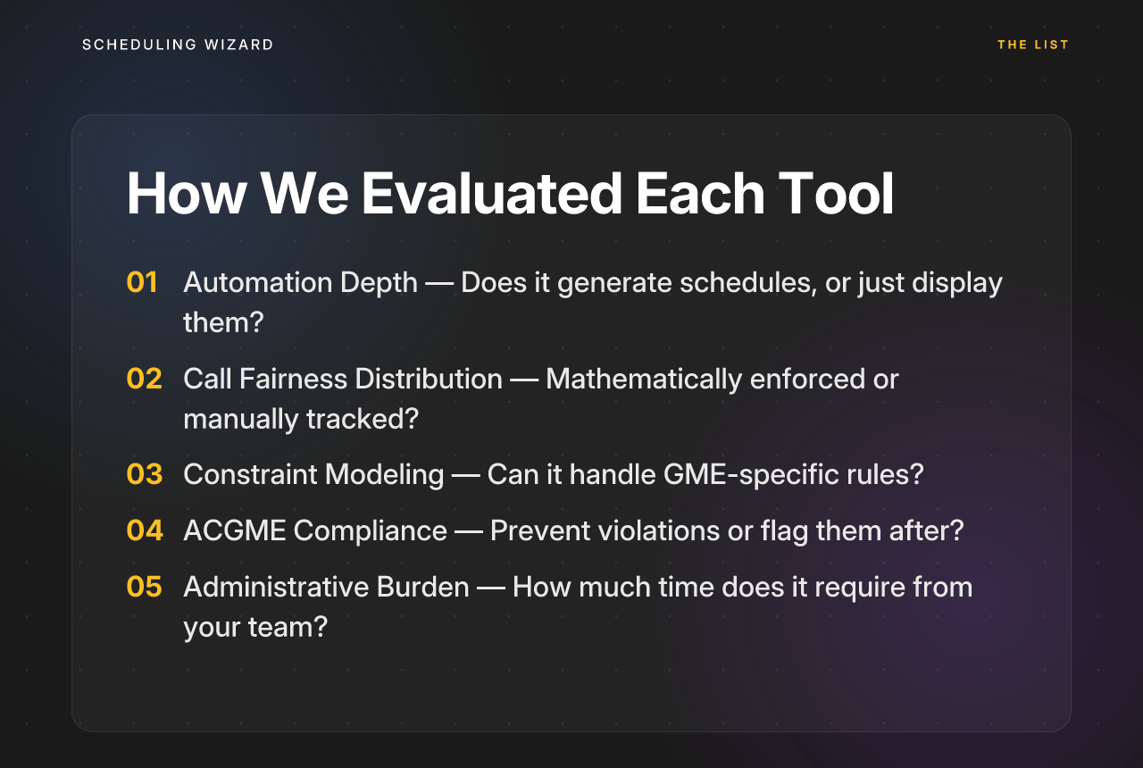
To cut through the marketing noise, we compared each tool on a consistent rubric:
- Automation Depth — Does it generate schedules, or just display them?
- Call Fairness Distribution — Is fairness mathematically enforced, or manually tracked?
- Constraint Modeling — Can it handle GME-specific rules and cross-schedule dependencies?
- ACGME/Credentialing Compliance — Does it prevent violations, or flag them after the fact?
- Administrative Burden — How much time and expertise does it require from your team?
With that framework in place, here are the 6 best solutions for attending physician scheduling — a mix of software and managed services.
1. Scheduling Wizard (Managed Service — Not Software)
Best for: Residency and fellowship programs that want to completely eliminate the administrative burden of scheduling.
Scheduling Wizard is the only entry on this list that isn't self-service software. It's a done-for-you managed scheduling service backed by Y Combinator (W26), built specifically for GME programs. Instead of handing you a platform to learn and configure, Scheduling Wizard assigns you an expert scheduler who models your constraints and delivers finished, optimized schedules as ready-to-use Excel spreadsheets.
You submit your rules — vacation requests, rotation requirements, coverage constraints, resident preferences — and receive a complete, ACGME-compliant Block, Call, Clinic, and Attending schedule. No logins. No configuration. No learning curve.
| Rubric | Rating |
|---|---|
| Automation Depth | ✅ Fully managed — zero software to operate |
| Call Fairness Distribution | ✅ Mathematically optimized for fair call, weekend, and holiday distribution |
| Constraint Modeling | ✅ Proprietary constraint-solving engine handles complex, cross-schedule dependencies |
| ACGME Compliance | ✅ Compliance-by-design — violations are prevented, not just flagged |
| Administrative Burden | ✅ Zero — programs never touch a scheduling platform |
The key differentiator: Unlike every other option on this list, Scheduling Wizard solves the institutional continuity problem. When your chief resident rotates out, the scheduling knowledge doesn't leave with them. The service provides continuity year after year.
Programs that already use Amion or QGenda for day-to-day schedule viewing often use Scheduling Wizard alongside them — SW builds the optimized schedule, then the program uploads the finished Excel file to their existing display tool.
2. Thrawn (Managed Service)
Best for: GME programs seeking a hands-off, fully managed scheduling service focused on optimization.
Like Scheduling Wizard, Thrawn is a done-for-you managed service, not software you have to learn. It's an excellent choice for programs that want to offload the entire scheduling process and receive a finished, ACGME-compliant schedule built with advanced optimization.
The process is straightforward: you provide your program's specific constraints, call requirements, vacation policies, and resident preferences. Thrawn's team uses their proprietary engine to build a fair and balanced Block, Call, and Clinic schedule, which is delivered back to you ready for distribution. This "done-for-you" model ensures scheduling continuity year-over-year, even as chief residents change.
| Rubric | Rating |
|---|---|
| Automation Depth | ✅ Fully managed — no software for your team to operate |
| Call Fairness Distribution | ✅ Mathematically optimized to enforce fairness rules for call, weekends, and holidays |
| Constraint Modeling | ✅ Expert-led modeling of complex GME rules and inter-schedule dependencies |
| ACGME Compliance | ✅ Built-in compliance ensures schedules prevent duty hour violations by design |
| Administrative Burden | ✅ Zero — the entire process is handled for you by scheduling experts |
Thrawn is a strong alternative for programs looking for a hands-off scheduling partner. It focuses on the core problem of building the optimal schedule, allowing programs to use their existing tools like Amion or QGenda for simple schedule display.
3. QGenda
Best for: Large health systems with dedicated administrative staff and IT resources.
QGenda is one of the most widely recognized names in physician workforce management. It's a comprehensive, enterprise-grade SaaS platform that goes beyond scheduling to include credentialing, time tracking, and analytics — all in one system.
But "comprehensive" comes with a caveat. As one physician put it in an online forum: "Getting QG to actually do what you want isn't easy, and learning how it works is very complicated." That sentiment is common — QGenda is powerful, but it demands a dedicated administrator who has the time and expertise to configure and maintain it.
| Rubric | Rating |
|---|---|
| Automation Depth | ⚠️ Self-service — rules and templates must be built and managed by your team |
| Call Fairness Distribution | ⚠️ Trackable, but fairness depends entirely on how accurately you configure the rules |
| Constraint Modeling | ⚠️ Flexible engine, but complex GME schedules require extensive user configuration |
| ACGME Compliance | ⚠️ Flags violations after the fact — does not prevent them during schedule generation |
| Administrative Burden | ❌ High — steep learning curve and ongoing maintenance required |
QGenda makes the most sense for large health systems that have the administrative bandwidth to manage the platform and want a single integrated tool for all workforce operations. For an already-stretched chief resident or program coordinator, it can easily become another burden rather than a relief.
4. Amion
Best for: Programs that need a simple, low-cost way to publish and share a finished schedule.
Amion is ubiquitous in academic medicine — but it's important to understand what it actually does. Amion is fundamentally a schedule display tool, not a schedule generation tool. You build the schedule somewhere else (usually Excel), then input it into Amion so your physicians can view it from their phones or computers.
There's nothing wrong with that. For what it does, Amion does it well. But it does not reduce the core administrative burden of creating a fair, compliant, conflict-free schedule — that work still happens entirely outside the platform.
| Rubric | Rating |
|---|---|
| Automation Depth | ❌ None — all scheduling is manual and happens outside Amion |
| Call Fairness Distribution | ❌ None — no fairness tracking or enforcement features |
| Constraint Modeling | ❌ None — no rules engine or constraint handling |
| ACGME Compliance | ❌ None — no duty hour tracking or violation flagging |
| Administrative Burden | ✅ Low for display tasks — but does not address the burden of building the schedule |
Think of Amion as the last mile of your scheduling workflow, not the solution to it. Many programs use it in combination with a more robust creation tool or service.
5. TigerConnect Physician Scheduling
Best for: Hospitals already using TigerConnect for clinical communication.
TigerConnect is primarily known as a clinical communication and collaboration (CC&C) platform — secure messaging, alerts, and care team coordination. Their physician scheduling module is an add-on that integrates directly with that communication layer, meaning on-call notifications and schedule updates flow into the same system your team already uses for messaging.
As a standalone attending physician scheduling software, it's a capable self-service tool with rule-based automation and shift-request management. But like QGenda, it puts the configuration and maintenance burden squarely on your administrator.
| Rubric | Rating |
|---|---|
| Automation Depth | ⚠️ Self-service with rule-based draft generation — requires administrator management |
| Call Fairness Distribution | ⚠️ Trackable, but dependent on careful and accurate user configuration |
| Constraint Modeling | ⚠️ Handles common constraints; primarily optimized for communication integration |
| ACGME Compliance | ⚠️ Post-creation compliance checking — violations flagged, not prevented |
| Administrative Burden | ❌ Moderate to high — requires learning the platform and managing ongoing scheduling |
If your organization is already embedded in the TigerConnect ecosystem, the scheduling module is a natural fit. If you're evaluating it as a standalone scheduling solution, the integration value diminishes and the self-service burden becomes harder to justify.
6. ShiftWizard (by HealthStream)
Best for: Organizations with large nursing populations seeking a unified clinical scheduling platform.
ShiftWizard, now part of the HealthStream portfolio, is a workforce management platform with deep roots in nurse scheduling. It handles shift-filling, credential tracking, and staffing requirements well in that context — but adapting it to the specific demands of attending physician scheduling, let alone residency GME scheduling, requires meaningful custom configuration.
Its credentialing and licensure tracking features are genuinely strong. The problem is that those strengths are built around nursing workflows, not ACGME duty hour rules or the complex cross-schedule dependencies that define residency programs (e.g., a resident who is on a night call shift cannot simultaneously be assigned to a morning clinic).
| Rubric | Rating |
|---|---|
| Automation Depth | ⚠️ Self-service — focused on filling open shifts based on staffing requirements |
| Call Fairness Distribution | ⚠️ Hour-balancing features exist but are designed for hourly shift work, not physician call |
| Constraint Modeling | ⚠️ Robust rules engine, but GME-specific modeling would require custom workarounds |
| ACGME Compliance | ❌ No native ACGME duty hour support — would need to be manually configured |
| Administrative Burden | ❌ High — extensive setup, configuration, and ongoing management required |
ShiftWizard is a legitimate tool for the right use case. For a large health system looking to unify nursing and physician scheduling in one platform, it's worth evaluating. For a residency program director trying to get a compliant, fair call schedule built without burying their chief resident in software, it's a difficult fit.
The Decision Guide: Software to Run, or a Schedule That's Done?
Every tool on this list falls into one of three categories — and knowing which category matches your actual need will save you months of frustration.
Display Tools (Amion): Essential for communicating a finished schedule to your team. Not useful for building one. If you already have a schedule creation process and just need a clean way to publish it, Amion is your answer.
Self-Service Platforms (QGenda, TigerConnect, ShiftWizard): These put a powerful system in your hands — and that's exactly the problem. The burden of learning, configuring, and maintaining the platform falls on an already-overworked chief resident or coordinator. These tools work well when you have dedicated administrative staff with the time and expertise to manage them. For most residency programs, that's not reality.
Managed Service (Scheduling Wizard): This is the only model where the operator burden disappears entirely. You don't learn software. You don't configure rules engines. You submit your constraints, and you receive a finished, optimized, ACGME-compliant schedule. When your chief rotates out, the institutional knowledge stays with the service.
Here's the simple version:
If you need a tool to display and share a schedule you've already built — use Amion or QGenda.
If you need someone to actually build the complex, fair, and ACGME-compliant schedule for you — Scheduling Wizard is the only managed service on this list.
The right attending physician scheduling software isn't always software. Sometimes it's the right team with the right engine — and a finished schedule waiting in your inbox.
Frequently Asked Questions
What's the difference between physician workforce scheduling and patient scheduling software?
Physician workforce scheduling software is designed to build complex staff schedules based on rules and constraints, while patient scheduling software is for booking patient appointments. The tools you need for creating a fair and ACGME-compliant call schedule for dozens of residents are fundamentally different from a calendar widget that lets a patient book an office visit online.
How does a managed service like Scheduling Wizard differ from software like QGenda?
A managed scheduling service builds the schedule for you and delivers a finished product, while scheduling software provides a complex tool that your team must learn, configure, and operate themselves. The managed service model eliminates the administrative burden and steep learning curve associated with self-service platforms.
How can I ensure my residency schedule is ACGME compliant?
The most effective way to ensure ACGME compliance is to use a system that prevents violations by design, rather than one that just flags potential violations after a schedule is built. Proactive, constraint-based scheduling ensures rules are mathematically enforced during schedule creation, eliminating the risk of publishing a non-compliant schedule.
How does Scheduling Wizard handle complex ACGME rules for specific subspecialties?
Scheduling Wizard handles subspecialty-specific ACGME rules by having human experts build a custom constraint model for your program. Whether it's the unique duty hour requirements for surgery, the clinic demands of internal medicine, or call frequency rules for anesthesiology, the model is tailored to your program's specific governing rules, ensuring compliance is built-in.
How will the 2026 ACGME Common Program Requirement changes affect our schedule?
The 2026 ACGME revisions will require stricter accounting for at-home call (which will count toward the 80-hour weekly limit) and enforce a hard 24-hour cap on continuous duty. These changes will make manual scheduling and simple software tools more prone to accidental violations. Using an optimization engine that can factor in these new constraints is the best way to prepare.
Can I use Scheduling Wizard if my program already uses Amion or QGenda?
Yes, absolutely. Scheduling Wizard is designed to work alongside tools like Amion and QGenda. Our service delivers a complete, optimized schedule as a formatted Excel spreadsheet. You then simply upload that finished schedule to your existing platform, which continues to serve as the daily viewing and communication tool for your residents and faculty.
What happens when our chief resident leaves? How is scheduling knowledge retained?
Managed scheduling services solve the institutional continuity problem by retaining all your program's rules, preferences, and scheduling history externally. When a chief resident rotates out, the knowledge of how to build your complex schedule doesn't leave with them. The service provides year-over-year stability and consistency, onboarding the new chief with an established, proven process.