Summary
- GME scheduling is a complex optimization problem, not a simple rota, complicated by strict ACGME rules and the annual loss of expertise when chief residents graduate (the "July problem").
- Scheduling solutions are divided into two types: self-service software (DIY) which you must learn and operate, and managed services (done-for-you) which deliver a finished schedule.
- The core challenge for most programs isn't just finding software, but solving the loss of institutional knowledge each year—a problem most DIY tools don't address.
- Managed services like Scheduling Wizard eliminate the administrative burden, guarantee compliance, and preserve your program's logic, saving hundreds of hours annually.
If you've ever watched a chief resident spend their entire winter break hunched over a spreadsheet — cross-referencing rotation requirements, vacation requests, call fairness, and conference leave — you already know that GME scheduling is not just another doctor's rota.
It's an optimization problem of staggering complexity. And as one healthcare administrator put it bluntly in a recent Reddit thread, "Scheduling is such an important piece. Current software is outdated, AI is just moving so fast, everyone is scrambling."
The challenges that make residency program scheduling categorically different from standard physician scheduling are well-documented. ACGME duty hour rules — including the 80-hour workweek cap established in 2003 and the 16-hour maximum shift for interns added in 2011 — are non-negotiable constraints with serious accreditation consequences if violated. On top of that, you have interlocking block rotations, subspecialty training requirements, call fairness mandates, and clinic coordination, all of which must be held in balance simultaneously.
And then there's the July problem: every year, the chief resident who finally cracked the code on your program's scheduling logic graduates. The institutional knowledge walks out the door, and their successor starts from scratch. The cycle of late nights, missed requirements, and resentful residents begins again.
The good news? The market for automated physician scheduling tools has matured. The bad news? Not all tools are built for the complexity of GME. Some are powerful but require months of setup. Others are easy to use but lack the depth to handle subspecialty-specific ACGME rules. And some — like the beloved Amion — aren't really scheduling builders at all.
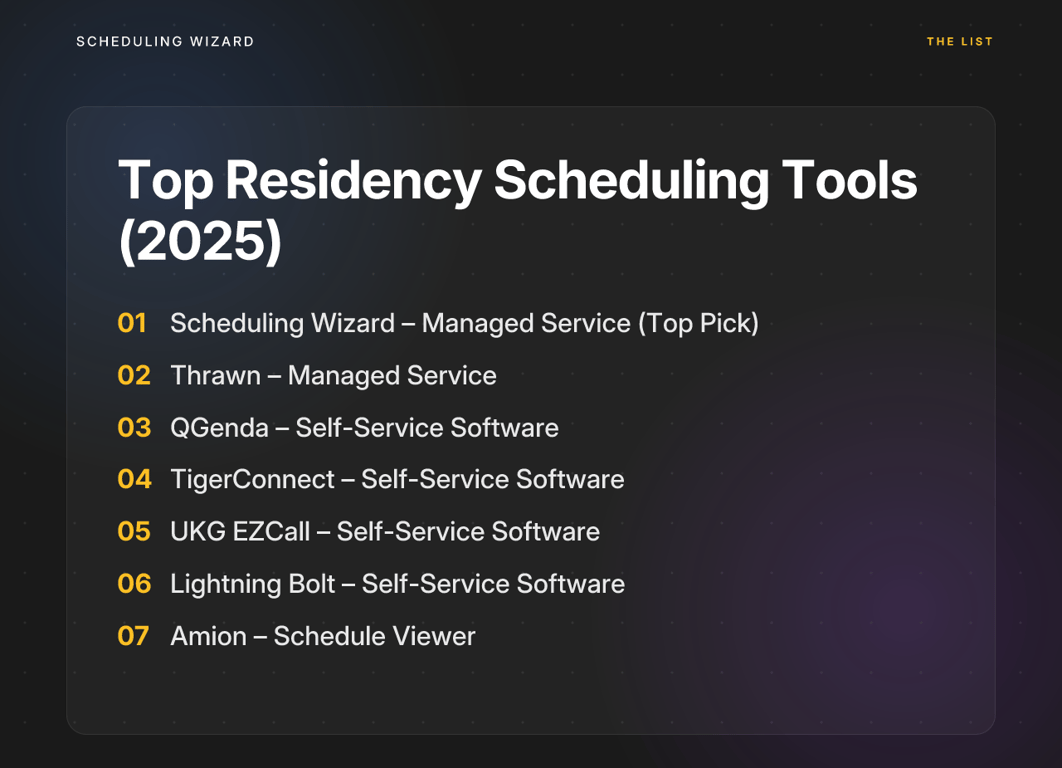
This guide breaks down the 7 best options into two clear categories: managed services that do the work for you, and self-service software that you operate yourself. For each, we evaluate on the four criteria that matter most to program directors and chief residents: ACGME compliance handling, setup burden, subspecialty rule support, and institutional knowledge transfer.
The Done-for-You Model: Managed Scheduling Services
This model is for programs that want to eliminate the scheduling burden entirely — no new software to learn, no knowledge lost to graduation.
1. Scheduling Wizard ⭐ Top Pick
Model: Managed Scheduling Service (Done-for-You)
Scheduling Wizard is the only purpose-built managed scheduling service for medical residency and fellowship programs. Backed by Y Combinator (W26), it was founded specifically to solve the GME scheduling problem — not adapted from a general workforce management tool.
The model is simple: programs submit their constraints (residents, rotations, call rules, vacation requests, subspecialty requirements), and Scheduling Wizard's team uses a proprietary mathematical optimization engine to generate complete, optimized Block, Call, Clinic, and Attending schedules. The output arrives as a clean Excel spreadsheet, ready to upload into whatever viewing tool your program already uses — Amion, QGenda, or anything else.
There's no client-facing platform to navigate. No certification course before you can build a schedule. No wondering if you've accidentally violated a duty hour rule.
| Criteria | Rating |
|---|---|
| ACGME Compliance Handling | ✅ Excellent — mathematically guaranteed, not just flagged |
| Setup Burden | ✅ Minimal — no software to learn |
| Subspecialty Rule Support | ✅ Excellent — custom constraint modeling per specialty |
| Institutional Knowledge Transfer | ✅ Completely solved — logic lives in the service, not the chief |
A study published in Neurosurgery found that optimized scheduling reduced call variation by 70% and increased residents' perception of fairness from 43% to 95%. That's the difference between a schedule that was optimized and one that was merely assembled.
Best for: Program directors and chief residents who want to reclaim hundreds of hours annually, guarantee ACGME compliance, and permanently break the cycle of knowledge loss every July.
2. Thrawn
Model: Managed Scheduling Service (Done-for-You)
A strong alternative in the managed service space, Thrawn is another "done-for-you" service that builds residency schedules from the ground up. Programs provide their specific rules and constraints, and Thrawn delivers finished block, call, and clinic schedules that are fully ACGME-compliant. Using its own advanced optimization engine, it's a popular choice for programs seeking a hands-off solution to the annual scheduling crunch.
| Criteria | Rating |
|---|---|
| ACGME Compliance Handling | ✅ Very Good — handled as part of service delivery |
| Setup Burden | ✅ Minimal — no software learning curve |
| Subspecialty Rule Support | ✔️ Good — handles complex rules across specialties |
| Institutional Knowledge Transfer | ✅ Completely solved — service retains the program's logic |
Best for: Programs looking for a robust, hands-off managed service that guarantees compliance and eliminates the administrative burden of schedule creation.
The DIY Model: Self-Service Scheduling Software
This model is for programs with dedicated administrative staff and the time to invest in learning, configuring, and maintaining a scheduling platform in-house.
3. QGenda
Model: Self-Service Software
QGenda is the enterprise standard in healthcare scheduling. It's frequently cited as a "favorite" among healthcare administrators, and for large health systems with dedicated scheduling staff, it earns that reputation. It provides a powerful centralized platform with real-time updates, mobile access, and robust reporting — features that are genuinely useful once the system is up and running.
The problem for GME programs is getting it up and running in the first place. QGenda is built for organizations with dedicated IT and administrative resources to configure and maintain it. For a chief resident who has never touched the software and has six months before the new academic year begins, the learning curve is steep and unforgiving.
| Criteria | Rating |
|---|---|
| ACGME Compliance Handling | ⚠️ Fair — flags violations after the fact; doesn't prevent them |
| Setup Burden | ❌ High — significant implementation time and training required |
| Subspecialty Rule Support | ✔️ Good — highly customizable, but setup is manual |
| Institutional Knowledge Transfer | ❌ Poor — expertise lives with the user, not the platform |
Best for: Large GME offices or health systems with full-time, dedicated scheduling administrators — not rotating chief residents.
4. TigerConnect Physician Scheduling
Model: Self-Service Software
TigerConnect started as a clinical communication platform and expanded into scheduling, which gives it a natural advantage for programs already embedded in the TigerConnect ecosystem. The scheduling module can automate parts of the annual block schedule creation and integrates with existing workflows to reduce back-and-forth.
It's generally considered more approachable than QGenda, with claims of faster deployment. That said, it is still a piece of software that must be learned, configured, and maintained — and the configuration knowledge walks out the door with every graduating chief.
| Criteria | Rating |
|---|---|
| ACGME Compliance Handling | ⚠️ Fair — rule-based logic assists but doesn't guarantee compliance |
| Setup Burden | ⚠️ Moderate — more accessible than enterprise tools, but still requires training |
| Subspecialty Rule Support | ✔️ Good — admin-configurable rules for departmental needs |
| Institutional Knowledge Transfer | ❌ Poor — power user knowledge is lost at graduation |
Best for: Programs already using TigerConnect for clinical communication who want an integrated, self-managed scheduling solution.
5. UKG EZCall
Model: Self-Service Software
Formerly EZCall and now part of the UKG (Ultimate Kronos Group) suite, EZCall excels at the daily management of on-call assignments. Its mobile interface is one of the friendlier among enterprise tools, making it easier for residents to view schedules, request swaps, and flag availability. The practical back-and-forth of day-to-day on-call management is where it genuinely shines.
Where it falls short is in creating the master schedule in the first place. EZCall is designed to manage a schedule that already exists — the hard problem of generating a fair, ACGME-compliant block schedule from a blank canvas still sits entirely with the chief resident.
| Criteria | Rating |
|---|---|
| ACGME Compliance Handling | ❌ Limited — no proactive compliance engine for block schedule generation |
| Setup Burden | ⚠️ Moderate — friendly interface, but master schedule creation is external |
| Subspecialty Rule Support | ⚠️ Fair — configurable but may lack granularity for complex programs |
| Institutional Knowledge Transfer | ❌ Poor — schedule creation process is entirely external to the tool |
Best for: Programs whose primary pain point is the daily chaos of on-call swaps and last-minute coverage, not the initial creation of the master schedule.

6. Lightning Bolt (by PerfectServe)
Model: Self-Service Software
Lightning Bolt is arguably the most sophisticated self-service option on this list. Now part of PerfectServe, it uses an AI-driven optimization engine to auto-generate shift schedules from a defined rule set — which puts it a level above manual builders. For programs with complex call patterns, it is one of the more capable tools available as a DIY option.
The catch, as with most powerful tools, is the configuration depth required to unlock that power. Building the rule set that accurately reflects your program's ACGME constraints, subspecialty requirements, and fairness preferences is a significant project. Doing it well requires expertise. And as with every other self-service platform, that expertise leaves with the person who built it.
| Criteria | Rating |
|---|---|
| ACGME Compliance Handling | ✔️ Good — rule engine can incorporate duty hour constraints |
| Setup Burden | ❌ High — deep configuration required to leverage optimization |
| Subspecialty Rule Support | ✅ Very Good — designed for complex, multi-rule environments |
| Institutional Knowledge Transfer | ❌ Poor — rule logic is saved, but why it's written that way is not |
Best for: Tech-savvy programs with a consistent, long-term administrator — not a rotating trainee — who can invest in mastering a complex but genuinely powerful platform.
7. Amion
Model: Schedule Viewer / Publisher
Amion is everywhere in GME, and for good reason — it's simple, affordable, and reliable for displaying a schedule. The caveat worth stating plainly: Amion does not build or optimize schedules. It is a viewer. The hard work of creating a compliant, fair, and optimized schedule happens before you ever open Amion, typically in the "BIG Spreadsheet" that healthcare schedulers have described as their fallback when better tools don't deliver.
Amion actually exacerbates the institutional knowledge problem. The clean, published schedule is visible to everyone — but the messy, rule-laden spreadsheet behind it, and the human judgment that went into building it, are completely hidden and are lost every July.
(Worth noting: many Scheduling Wizard clients continue using Amion as their viewing tool of choice — they receive their optimized Excel schedule and simply upload it.)
| Criteria | Rating |
|---|---|
| ACGME Compliance Handling | ❌ None — zero compliance logic; displays whatever you give it |
| Setup Burden | ✅ Low — easy to upload and share an existing schedule |
| Subspecialty Rule Support | ❌ N/A — no schedule generation capability |
| Institutional Knowledge Transfer | ❌ Very Poor — the schedule is visible; the logic that created it is gone |
Best for: Any program that needs an easy, low-cost way to publish a schedule that has already been built elsewhere.
Decision Framework: DIY or Done-for-You?
The choice between self-service software and a managed service ultimately comes down to one question: where does your scheduling problem actually live?
If your program's pain is in daily schedule visibility — residents not knowing who's on call, difficulty requesting swaps — a viewer like Amion or a communication-integrated tool like TigerConnect may be sufficient.
But if your pain is in creating the schedule — the annual 100+ hour grind, the ACGME compliance anxiety, the awkward knowledge handoff every July — no amount of better software will fully solve it. The problem isn't the tool. It's the model.
Ask yourself:
- Does our chief resident spend over 100 hours per year on scheduling? That's time that should be spent on clinical training and education.
- Have we made the same ACGME-adjacent mistake more than once because a new chief didn't know the rules? That's an accreditation risk hiding in plain sight.
- Are we re-training a new person on complex scheduling software every single year? That's a structural inefficiency, not a training problem.
If you answered yes to any of the above, a managed service isn't a luxury — it's the right architectural choice. Tools like Scheduling Wizard exist precisely because GME scheduling is fundamentally an optimization and expertise problem, not a software problem. The solution isn't learning better software; it's having expert systems do the work so your program can focus on what actually matters: training great physicians.

The annual July brain drain is real, expensive, and entirely avoidable. The programs that solve it permanently are the ones that stop asking "which software should we use?" and start asking "should we be doing this ourselves at all?"
Frequently Asked Questions
What is the best software for residency scheduling?
The best solution depends on your program's specific needs and resources. For most GME programs where scheduling is handled by a rotating chief resident, a managed service like Scheduling Wizard is often the best choice because it eliminates the steep learning curve and administrative burden. For large hospital systems with dedicated, full-time schedulers, a self-service software like QGenda can be a powerful, albeit complex, option.
How does a managed service ensure ACGME compliance?
A managed service ensures ACGME compliance by building all rules directly into its scheduling engine. Instead of relying on a user to manually input rules or check for flagged errors, services like Scheduling Wizard mathematically guarantee that the final schedule adheres to all constraints from the start—including the 80-hour work week, call frequency, days off, and complex subspecialty-specific requirements. This proactive approach prevents violations before they happen.
Can I still use Amion if I use a managed scheduling service?
Yes, absolutely. Managed services like Scheduling Wizard are designed to work with your existing tools, not replace them. They deliver your final, optimized schedule as a simple file (e.g., an Excel spreadsheet) that you can easily upload directly into Amion, QGenda, or whatever viewing platform your residents and faculty already use for their day-to-day schedule.
How will the 2026 ACGME rule changes affect scheduling?
The upcoming 2026 ACGME revisions will make scheduling significantly more complex, especially the rules that count home call towards the 80-hour weekly limit and enforce a hard 24-hour cap on continuous work. These changes increase the risk of accidental violations when scheduling manually or with basic software. An advanced, managed service can model these new constraints to create compliant schedules automatically, saving programs from the added administrative headache.
Our program has very specific rules. Can a service handle them?
Yes. A key advantage of a managed service is its ability to handle highly specific and unique program rules. Unlike rigid software, services like Scheduling Wizard build a custom model for each program. This includes complex subspecialty requirements (e.g., for Neurosurgery or Anesthesiology), intricate call fairness logic, specific rotation sequences, and individual resident requests, ensuring the final schedule is both compliant and tailored to your program's needs.
What is the "July Problem" and how do we solve it?
The "July Problem" describes the annual loss of critical scheduling knowledge when the experienced chief resident graduates, forcing their successor to start from scratch. This cycle leads to inefficiency, errors, and resident dissatisfaction. The most effective way to solve it is to use a managed service, which captures and retains your program's unique scheduling logic externally. This creates perfect continuity, ensuring the schedule's quality and fairness remain high year after year, regardless of who is in the chief resident role.