Summary
- Hospital scheduling is uniquely complex, requiring coordination across departments, 24/7 on-call management, and credentialing—challenges that generic software often fails to address.
- The best tool depends on your specific needs: large systems may need an enterprise platform like QGenda, while nursing units benefit from a specialized tool like ShiftWizard.
- Academic medical centers face a unique problem of knowledge loss each year when the chief resident, who manages scheduling, rotates out.
- For GME programs, a managed service like Scheduling Wizard solves this by preserving institutional knowledge and delivering finished, ACGME-compliant schedules without requiring chiefs to learn complex software.
If you've ever tried to coordinate a 24/7 call schedule across multiple departments while simultaneously managing credentialing constraints, resident rotations, and float pool availability — you already know that hospital scheduling software is a different beast entirely from what most generic reviews describe.
As one health IT professional put it on Reddit: "Nothing is technically broken, but the handoffs are where things fall apart." Another summed it up bluntly: "I haven't seen a single off-the-shelf platform that truly covers ATS + credentialing + scheduling + communications in a clean way."
That's the reality of hospital scheduling. It's not a shift calendar problem. It's a multi-system, high-stakes, human coordination problem — and the tools you choose need to reflect that.
This article evaluates six hospital scheduling software tools against the criteria that actually matter in complex hospital environments:
- Multi-department coordination across the ED, OR, ICU, and specialty floors
- 24/7 on-call scheduling that balances coverage with staff well-being
- Credentialing constraints that match licensed staff to qualified roles
- The annual leadership rotation problem unique to academic medical centers, where scheduling knowledge walks out the door when the chief resident changes
Each tool comes with a Best For callout so you can quickly identify which solution fits your specific environment — without wading through a feature checklist that was written for a retail workforce.
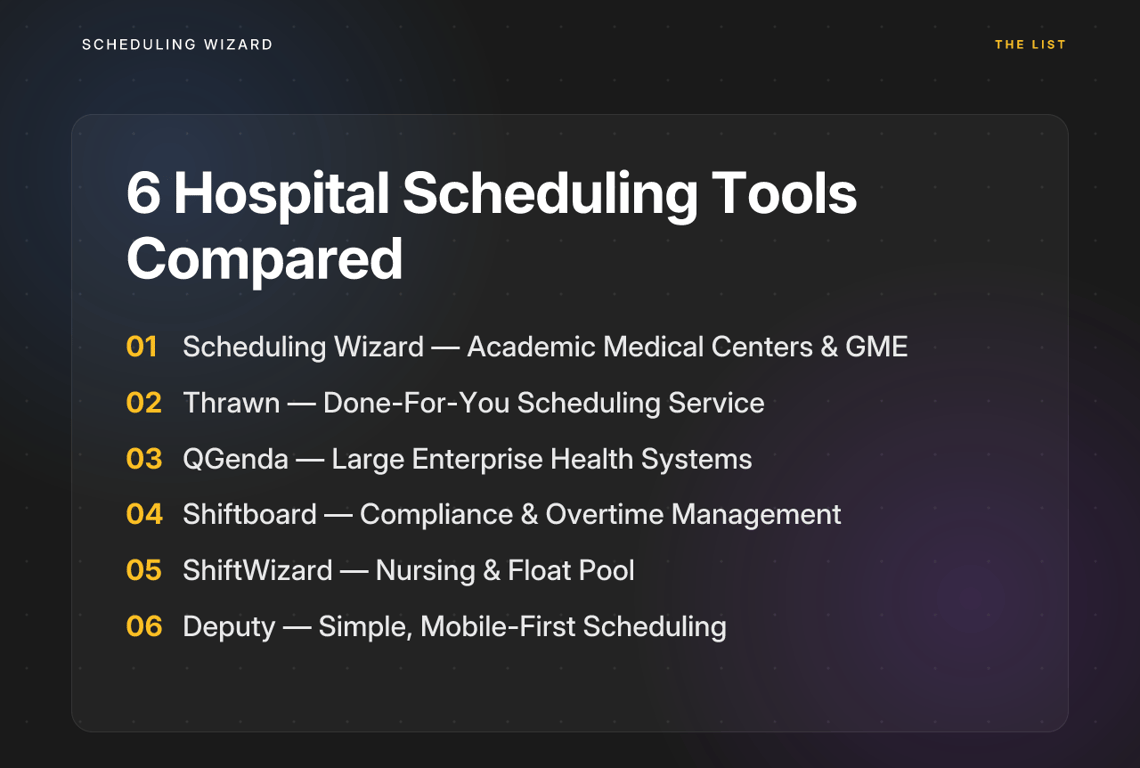
1. Scheduling Wizard — Best For: Academic Medical Centers and Residency Programs
Best For: GME programs, chief residents, program directors, and fellowship coordinators who need ACGME-compliant Block, Call, and Clinic schedules without the software learning curve.
Scheduling Wizard is the only tool on this list that isn't software — and that distinction matters enormously for residency programs.
It's a YC-backed (W26) managed scheduling service: instead of logging into a platform and building schedules yourself, your program submits its constraints (ACGME duty hour rules, resident vacation requests, clinic requirements, block rotation preferences) and receives finished, optimized schedules delivered as ready-to-use Excel files. No implementation project. No training sessions. No software to learn.
Why this matters for academic medical centers: The core failure mode in GME scheduling isn't bad software — it's knowledge loss. Every July, a new chief resident inherits a scheduling system they've never operated, for a program with dozens of interdependent constraints they don't fully understand yet. The result: weeks of rework, ACGME compliance risks, and frustrated residents. Scheduling Wizard solves this at the root. The institutional scheduling knowledge lives with their expert team and proprietary constraint-solving engine, not in the outgoing chief's head.
How it handles hospital complexity:
- ACGME compliance is mathematically guaranteed by the optimization engine — not manually checked after the fact
- Cross-schedule dependency resolution handles the fact that a resident's block rotation dictates their clinic and call availability simultaneously
- Fairness optimization distributes call burden equitably across the cohort
- Rapid re-optimization handles unplanned absences without requiring the chief to manually rebuild the schedule
A key operational nuance: Scheduling Wizard doesn't replace tools like Amion or QGenda — it works alongside them. Many programs use Scheduling Wizard to create the optimized schedule, then upload the Excel output to their existing viewing platform. It solves the hardest part (creation and compliance) without disrupting how staff access their day-to-day assignments.
For residency programs tired of reinventing the scheduling wheel every July, this managed service approach is a fundamentally different answer to the question — and for many programs, it's the right one.
2. Thrawn — Best For: Programs Seeking a Done-For-You Scheduling Service
Best For: Residency programs and hospital departments that want finished, optimized schedules without managing any software themselves.
Like Scheduling Wizard, Thrawn is a managed scheduling service, not a DIY software platform. It's a strong alternative for programs looking for a completely hands-off approach to their complex scheduling needs.
Programs submit their rules, personnel, and constraints — including ACGME requirements, individual requests, and fairness targets — and Thrawn's team uses advanced optimization to build and deliver finished block, call, and clinic schedules. This "done-for-you" model eliminates the learning curve and administrative overhead of traditional software.
How it handles hospital complexity:
- Full-service schedule creation: Handles the entire process from constraint gathering to final schedule delivery, freeing up chief residents and administrators.
- Advanced optimization engine: Builds schedules that are mathematically guaranteed to be ACGME-compliant and optimized for fairness.
- Multi-schedule coordination: Solves interdependent block, call, and clinic schedules simultaneously, ensuring all constraints are met across the board.
For programs that want to entirely offload the burden of schedule creation to a dedicated service, Thrawn provides a powerful and efficient solution.
3. QGenda — Best For: Large Health Systems Needing a Centralized Platform
Best For: Enterprise health systems and large academic centers with dedicated IT and administrative resources to manage a comprehensive, self-service scheduling platform.
QGenda is the closest thing the market has to an enterprise-wide physician scheduling operating system. It's designed to serve as a single source of truth for provider schedules across an entire health system — from primary care to subspecialty to hospital medicine.
How it handles hospital complexity:
- Centralized scheduling gives administrators visibility across departments and facilities, reducing the siloing that causes handoff failures
- AI-driven analytics and predictive forecasting help anticipate staffing gaps before they become coverage crises
- Credentialing integration ties provider qualifications directly into the scheduling logic, so unqualified staff can't be accidentally assigned to roles they aren't licensed for
QGenda is powerful, but it comes with a real implementation burden. User reviews frequently note the complexity of initial configuration and a steeper learning curve than more focused tools. It's a significant organizational investment — one that pays off at scale, but may be oversized for a single department or smaller program.
Important nuance for GME programs: While QGenda is widely used for schedule viewing and day-to-day provider access, building highly complex residency schedules within the platform — with all their ACGME constraints and interdependencies — can still require substantial manual effort. This is precisely why some programs use QGenda for display while relying on a purpose-built service like Scheduling Wizard for the creation and optimization layer.

4. Shiftboard — Best For: Compliance-Focused Hospitals Managing Overtime and Last-Minute Coverage
Best For: Hospitals and health systems whose primary scheduling pain points are overtime cost control, credential verification, and filling last-minute shift gaps across a large, diverse workforce.
Shiftboard's healthcare scheduling platform is built for mission-critical operations, and hospitals fit squarely in that category. Its core strength is on the operational and financial side of scheduling: making sure the right credentialed person fills the right shift, without blowing the labor budget.
How it handles hospital complexity:
- Overtime cost management: Hospitals have seen a 52% increase in overtime hours since the pandemic. Shiftboard automates scheduling to prioritize eligible, non-overtime staff first — reducing avoidable labor cost before it hits the budget
- Automated credential verification: Ensures only qualified and credentialed caregivers are placed on specific shifts, reducing compliance risk
- Day-of coverage management: Real-time visibility into coverage gaps allows managers to autofill open shifts with confirmed, available employees — critical for handling call-outs in 24/7 environments
- Employee flexibility tools: 64% of healthcare professionals cite better flexibility as a key factor in employer choice. Shiftboard's self-service shift pickup and trading features directly address retention by giving staff more control over their schedules
Shiftboard is a strong choice for large departments or hospital systems dealing with high staff volume, complex compliance requirements, and the daily fire-drill of last-minute coverage — but it's less specialized for the GME-specific challenges of block rotation planning and ACGME duty hour enforcement.
5. ShiftWizard — Best For: Nursing Departments and Float Pool Management
Best For: Nurse managers and nursing departments looking for a self-scheduling tool designed around how nursing units actually operate.
ShiftWizard is purpose-built for nursing — and that specificity is both its strength and its limitation. Where enterprise tools try to serve every department, ShiftWizard focuses on the workflow patterns, communication culture, and operational rhythms specific to nursing units.
How it handles hospital complexity:
- Nurse-centric self-scheduling: Empowers nurses to view open shifts, request and swap shifts, and manage their own availability — reducing the back-and-forth with schedulers that staff consistently identify as a top frustration
- Float pool management: Provides real-time visibility into float pool availability and enables managers to quickly identify and deploy available staff across units
- Manager visibility: Gives charge nurses and nurse managers a clear, real-time picture of staffing levels, coverage gaps, and upcoming shortfalls — without digging through spreadsheets
ShiftWizard's focus on reducing the administrative burden on nursing leadership — by giving nurses the tools to manage their own schedules — is one of its most tangible operational benefits.
The tradeoff: ShiftWizard is a departmental tool, not a hospital-wide platform. If your scheduling challenges extend across physician groups, GME programs, or multiple specialties, you'll likely need to layer it alongside other solutions — which brings back the multi-tool coordination problem it was designed to solve.
6. Deputy — Best For: Departments Needing a Simple, Mobile-First Interface
Best For: Hospital departments or smaller facilities that prioritize ease of use and mobile accessibility over deep specialty-specific scheduling rules.
Deputy is one of the most widely-used workforce scheduling platforms across industries, and it earns consistent praise for one thing above all else: it's easy. If your team has been burned by complex legacy systems with clunky interfaces and low adoption rates, Deputy is a genuine counterargument.
How it handles hospital complexity:
- Mobile-first design: Staff can view schedules, pick up shifts, and communicate with managers entirely from their phones — a meaningful advantage for clinical staff who aren't sitting at desks
- Integrated communication: Scheduling and team messaging live in the same platform, which directly addresses the "context switching and data slipping through the cracks" that healthcare teams consistently flag as a top frustration
- Fast implementation: Unlike enterprise platforms that require months of configuration, Deputy can be up and running quickly — a real advantage for departments that need a solution now
The honest trade-off: Deputy is a general-purpose scheduling tool, not a healthcare-specific one. It doesn't have a built-in ACGME compliance engine, subspecialty credentialing rules, or the block rotation logic that physician and GME scheduling demands. For departments with straightforward shift patterns and a need for simplicity, it's excellent. For complex multi-department hospital environments, it's likely a piece of the puzzle — not the whole answer.
Decision Matrix: Which Hospital Scheduling Software Fits Your Environment?
Use this as a quick reference to match your hospital's size and complexity profile to the right tool — or combination of tools.
| Environment | Primary Challenge | Recommended Tool(s) |
|---|---|---|
| Academic Medical Center / GME Program | ACGME compliance, chief resident rotation, block + call + clinic coordination | Scheduling Wizard or Thrawn (creation) + QGenda or Amion (viewing) |
| Large Health System (Enterprise-Wide) | Centralized provider scheduling, analytics, credentialing at scale | QGenda |
| High-Volume Hospital (Staffing & Compliance) | Overtime management, last-minute coverage, credential verification | Shiftboard |
| Nursing Department / Float Pool | Self-scheduling, unit-level visibility, nurse satisfaction | ShiftWizard |
| Smaller Department / Mobile-First Needs | Ease of use, fast adoption, scheduling + communication in one place | Deputy |
One important takeaway from this matrix: many hospitals will need more than one tool. A large academic medical center might use Scheduling Wizard to generate optimized GME schedules, QGenda as the enterprise viewing platform, and ShiftWizard for nursing unit management — all simultaneously. The goal isn't to find a single platform that does everything; it's to close the gaps where your current stack is failing.

The Bottom Line: It's About the Right System, Not the Loudest Feature List
Generic software review articles will tell you to compare pricing tiers, mobile app ratings, and integration ecosystems. Those things matter — but they're downstream of a more fundamental question: does this tool actually solve the specific problems that make hospital scheduling hard?
For large health systems managing thousands of providers, QGenda's centralized infrastructure is hard to beat. For hospitals where overtime costs and last-minute call-outs are the daily crisis, Shiftboard's compliance and coverage tools address the pain directly. For nursing units that want to empower staff with self-service flexibility, ShiftWizard is purpose-built for that culture. And for teams that simply need a modern, easy-to-use interface that staff will actually adopt, Deputy earns its reputation.
But for academic medical centers and GME programs — where the scheduling problem is uniquely complex, uniquely high-stakes, and uniquely dependent on whoever happens to be the chief resident this year — the right answer may not be software at all.
Scheduling Wizard was built specifically for this environment. As the only managed service on this list, it doesn't ask your chief resident to become a scheduling software expert on top of everything else they're responsible for. Instead, it delivers finished, ACGME-compliant schedules as a done-for-you output — so the institutional knowledge that keeps your program running doesn't disappear every July when the chief rotation turns over.
If your residency program is still rebuilding the scheduling system from scratch each year, that's a solvable problem. It just might require a different kind of solution than another software subscription.
Frequently Asked Questions
How does Scheduling Wizard guarantee ACGME compliance for my specific residency program?
Scheduling Wizard guarantees ACGME compliance by building your program's specific rules—including subspecialty-specific requirements for fields like Surgery, Anesthesiology, or Internal Medicine—directly into its mathematical optimization engine. This means every schedule is generated to be compliant by design, rather than requiring manual checks after the fact. The engine automatically enforces all constraints, from the 80-hour work week to rules on call frequency and time off between shifts.
Do we have to stop using Amion or QGenda to use Scheduling Wizard?
No, you do not have to stop using your current scheduling platform. Scheduling Wizard works alongside tools like Amion and QGenda, focusing on the most difficult part of the process: creating a fair, optimized, and compliant schedule. We deliver the finished schedule to you as an Excel file, which you can then easily upload to your existing platform for day-to-day viewing by residents and faculty.
What is the difference between a managed scheduling service and scheduling software?
A managed scheduling service creates the schedule for you, while scheduling software is a tool you use to build the schedule yourself. With a service like Scheduling Wizard, you provide your rules, requests, and constraints, and our expert team uses our proprietary engine to build and deliver a finished schedule. Software platforms like QGenda or Deputy require your team to learn the system, input all the rules, and manage the schedule-building process internally.
How does Scheduling Wizard handle the upcoming 2026 ACGME rule changes?
Scheduling Wizard is actively preparing for the 2026 ACGME rule changes, including the provisions that home call will count toward the 80-hour weekly maximum and the 24-hour hard cap on continuous work. Our optimization engine is updated to incorporate these new constraints, allowing programs to model and build compliant schedules well ahead of the deadline. This ensures a seamless transition and eliminates the risk of non-compliance when the new rules take effect.
How do we handle last-minute changes like sick calls or emergencies?
For day-to-day changes like an unexpected sick call, programs typically handle the immediate swap using their existing communication platform (e.g., Amion or QGenda). For more significant disruptions that require a large-scale schedule rebuild, Scheduling Wizard can perform a rapid re-optimization. You simply submit the new constraints (e.g., a resident is out for a week), and we deliver a revised, fully compliant schedule that minimizes disruption to the rest of the program.
What happens to our scheduling process when the chief resident changes every year?
Using Scheduling Wizard solves the problem of knowledge loss from chief resident turnover. Instead of your scheduling expertise walking out the door every July, the institutional knowledge of your program's complex rules, preferences, and constraints is maintained by our team. The new chief resident doesn't have to learn a complex software or rebuild the system from scratch; they simply submit their cohort's requests to a process that already works.