Summary
- Chief residents often spend 10-15 hours each quarter on call schedules, a thankless task that still leaves colleagues dissatisfied.
- Most scheduling platforms aren't built for GME, forcing staff to manually configure complex ACGME rules and audit for compliance, which is both risky and time-consuming.
- The most effective solutions shift from simply displaying a schedule to automatically creating a fully compliant one, removing the burden of manual verification.
- Managed services like Scheduling Wizard eliminate this problem by delivering finished, mathematically-guaranteed ACGME-compliant schedules, saving programs hundreds of hours per year.
Every year, a new cohort of chief residents inherits one of the most thankless jobs in medicine: building the call schedule. As one resident put it on Reddit, "it usually takes him 10-15 hours each quarter to make the schedule, and still everyone ends up pissed off about something." That's not a software problem. That's a systemic one — and it starts with using tools that were never designed for the job.
The market is full of scheduling platforms, many positioning themselves as alternatives to legacy tools like Amion. But here's what most of them have in common: they were built for general workforce scheduling. They handle shift work at a hospital, a call center, or a retail chain. They were not built to understand ACGME duty hour requirements, night float caps, PGY-level restrictions, continuity clinic protections, or the labyrinthine subspecialty-specific rules that govern residency and fellowship training.
The result? The burden of compliance falls squarely on the chief resident or program coordinator. The tool becomes a fancy calendar, and the human still has to verify every constraint by hand.
What Makes GME Scheduling Genuinely Different
Before diving into the list, it's worth naming exactly what generic schedulers miss — because this is where most scheduling tool evaluations go wrong.
ACGME-compliant call scheduling isn't just about limiting shifts to 80 hours per week. It involves:
- Night float caps — specific limits on consecutive nights and total night float blocks by PGY level
- Continuity clinic protections — ensuring residents aren't pulled from outpatient continuity clinics for inpatient call, even when coverage is short
- Subspecialty-specific rules — surgery has different requirements than internal medicine, which differs from pediatrics or psychiatry
- Inter-rotation dependencies — a call assignment downstream of a demanding rotation may violate rest rules even if it looks fine in isolation
- PGY-level constraints — certain rotations, call frequencies, and supervision requirements differ across training years
No generic workforce tool handles all of this natively. And when these rules must be manually configured and manually audited, the risk of violations — and the administrative burden — never goes away.
With that framework established, here's our evaluation of five tools, scored across three criteria:
- ACGME Rules: Built-in or manually configured?
- Compliance Checks: Automatic or requires human audit?
- Schedule Handling: Does the tool create the schedule or just display it?
1. Scheduling Wizard
Model: Done-for-you managed scheduling service
Scheduling Wizard is the only entry on this list that operates as a fully managed service — meaning chief residents never have to touch scheduling software at all. Programs submit their constraints (resident names, PGY levels, vacation requests, rotation rules), and receive a finished, optimized, ACGME-compliant schedule delivered as an Excel spreadsheet. It is backed by Y Combinator (W26) and purpose-built for GME from the ground up.
- ACGME Rules: Built-In. The compliance logic is not a configurable feature — it is baked into the proprietary mathematical constraint-solving engine. Subspecialty-specific rules, night float caps, continuity clinic protections, and PGY-level restrictions are all modeled at the engine level, not layered on top by the user.
- Compliance Checks: Mathematically Guaranteed. This is the core differentiator. The schedule is not generated and then audited for compliance — it is generated to be compliant as a mathematical output. There is no post-hoc human review step required.
- Schedule Handling: Full Creation and Optimization. Scheduling Wizard creates the schedule. It handles Block, Call, Clinic, and Attending schedules, balances fairness across residents, integrates preferences, and resolves cross-schedule conflicts automatically.
Why it's different from every other tool on this list: It eliminates the operator burden entirely. The chief resident doesn't configure rules, doesn't audit the output, and doesn't spend 10–15 hours per quarter wrestling with a spreadsheet. The scheduling logic also persists across annual chief rotations — meaning institutional knowledge doesn't walk out the door every July.
One important nuance worth noting: Scheduling Wizard is not trying to replace Amion or QGenda as viewing tools. Many programs use Scheduling Wizard to create the optimized schedule and then upload the finished file into their existing platform for day-to-day access. It fits into your current workflow — it just eliminates the hardest part of it.
2. Thrawn
Model: Done-for-you managed scheduling service
Thrawn is another managed service that takes a hands-off approach to residency scheduling. Like Scheduling Wizard, it's a done-for-you model where programs submit their specific constraints, resident details, and requests, and receive a complete, optimized schedule in return. It's built on an advanced optimization engine designed to handle block, call, and clinic schedules while ensuring ACGME compliance.
- ACGME Rules: Built-In. Thrawn's engine is pre-configured with ACGME requirements. The service handles the complex logic of duty hours, night float, and other GME-specific rules, removing the need for manual setup by program staff.
- Compliance Checks: Automated. The optimization process builds compliance directly into the schedule output. This significantly reduces the need for manual auditing, as the schedule is generated to meet the specified constraints from the start.
- Schedule Handling: Full Creation and Optimization. Thrawn is not a display tool; it creates the schedule from the ground up. It focuses on taking raw inputs (requests, rules, personnel) and delivering a finished product, making it a strong alternative for programs seeking a hands-off solution.
Bottom line: Thrawn offers a compelling done-for-you alternative in the GME scheduling space. It's a great fit for programs that want to outsource the complexity of schedule creation and compliance verification, freeing up chief residents and coordinators to focus on other tasks.
3. QGenda
Model: Enterprise scheduling platform
QGenda is one of the most widely deployed scheduling platforms in healthcare and is frequently cited as an Amion alternative at the enterprise level. It offers real-time schedule visibility, mobile access, and integration with payroll and credentialing systems.
- ACGME Rules: Manual Configuration. QGenda supports custom rule-building, but ACGME duty hour constraints must be manually programmed by the user. This requires both deep familiarity with the platform and deep familiarity with the specific duty hour requirements of your program. Any subspecialty nuances need to be built in by the program — they aren't there out of the box.
- Compliance Checks: Requires Human Audit. QGenda can flag potential violations based on the rules you've configured — but only if those rules were correctly set up in the first place. Final compliance responsibility stays with the chief or coordinator. The system does not provide a mathematical guarantee.
- Schedule Handling: Primarily Display. QGenda's core strength is providing real-time visibility into existing schedules. While it has some scheduling features, it is not a constraint-solving schedule generator. The schedule typically still requires significant manual construction.
Bottom line: QGenda is a powerful enterprise tool for large health systems that need schedule visibility at scale. But for a residency program trying to create a compliant call schedule, it still requires substantial configuration investment and ongoing manual compliance oversight.
4. Lightning Bolt (by PerfectServe)
Model: Self-service scheduling software
Lightning Bolt is a physician scheduling platform that has been adopted by some residency programs looking for more automation than a basic calendar tool provides. It sits in the middle of the spectrum — more automated than a basic calendar, but still firmly a self-service product.
- ACGME Rules: User-Configurable. Users can program scheduling rules into the system, and Lightning Bolt does offer rule-based generation. However, the flexibility may not stretch far enough to cover complex, subspecialty-specific ACGME constraints without workarounds.
- Compliance Checks: Requires Manual Audits. The tool surfaces rule-based suggestions, but it commonly produces schedules with conflicts that require human intervention before they're usable. Final auditing remains a manual process.
- Schedule Handling: Rules-Based Generation. It offers more automation than a display tool, but the user remains in the driver's seat for resolving conflicts, adjusting for fairness, and verifying compliance.
Bottom line: An improvement over manual spreadsheets, but it still places the compliance burden on the operator. As one Reddit thread noted, "current scheduling software still requires too much manual input, negating efficiency benefits" — Lightning Bolt is a prime example of this dynamic.

5. Petal Scheduling
Model: Physician scheduling software
Petal Scheduling is designed for physician scheduling with a focus on usability and customization. It has a cleaner interface than some legacy tools and supports shift-based scheduling across departments.
- ACGME Rules: User-Driven Configuration. The platform supports custom rule-building, but it is up to the program to define and maintain all ACGME compliance logic. There is no GME-specific layer built into the product.
- Compliance Checks: Manual Verification Necessary. Like QGenda and Lightning Bolt, compliance requires human review. The system does not offer automated guarantees.
- Schedule Handling: Automated but Not GME-Specific. Petal automates aspects of general physician scheduling, but lacks the GME-specific logic for handling continuity clinics, PGY-level rules, and night float restrictions without extensive manual configuration.
Bottom line: Petal can be adapted for residency scheduling, but it wasn't built for it. Programs using Petal for call scheduling are still taking on the full compliance burden themselves.
6. New Innovations
Model: Residency Management Suite
New Innovations is a broad GME administrative platform covering evaluations, case logs, procedure tracking, and curriculum management. Scheduling is one of several modules within a larger suite.
- ACGME Rules: Manual Setup Required. New Innovations understands the GME environment administratively, but its scheduling module still requires manual rule setup. The ACGME compliance logic is not embedded in a constraint-solving engine.
- Compliance Checks: Requires Human Oversight. There are no built-in automated verification tools for duty hour compliance. Manual review by the program is necessary.
- Schedule Handling: Management, Not Generation. The platform is primarily designed to manage and display schedules, not to generate optimized ones from a constraint set. Significant manual input is required for actual schedule construction.
Bottom line: New Innovations is a strong choice as a GME administrative hub — evaluations, milestones, case logs — but it is not a solution to the schedule creation problem. Programs relying on it for call scheduling are still doing the heavy lifting themselves.
At-a-Glance Comparison
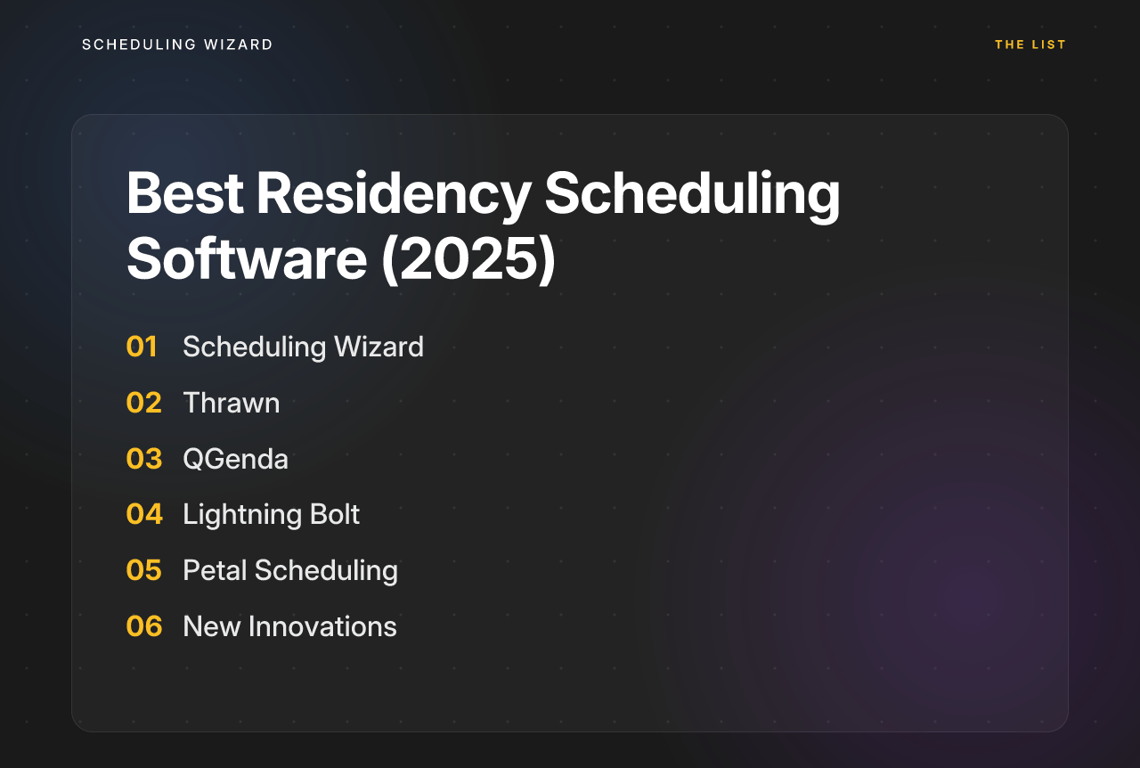
| Feature | Scheduling Wizard | Thrawn | QGenda | Lightning Bolt | Petal Scheduling | New Innovations |
|---|---|---|---|---|---|---|
| ACGME Rules | Built-In | Built-In | Manual Config | Manual Config | Manual Config | Manual Setup |
| Compliance Check | Mathematically Guaranteed | Automated | Human Audit Required | Human Audit Required | Human Audit Required | Human Audit Required |
| Schedule Handling | Full Creation (Managed Service) | Full Creation (Managed Service) | Primarily Display | Rules-Based Generation | Automated Display | Manual Input |
| Operator Burden | None (Done-For-You) | None (Done-For-You) | High | Medium-High | Medium-High | High |
| GME-Specific Engine | Yes | Yes | No | No | No | Partial |
Moving from Schedule Display to Schedule Creation
The pattern across this list is hard to miss. Five out of six tools evaluated here shift the compliance burden back onto the chief resident or program coordinator. They may reduce some manual work — but they don't eliminate the fundamental problem: someone still has to know the rules, configure them correctly, and audit the output.
That's not a knock on the tools individually. QGenda delivers real operational value for enterprise health systems. New Innovations is a legitimate administrative backbone for many GME offices. But when the core question is "how can I guarantee my call schedule is ACGME-compliant without auditing every line?" — most of the market comes up short.
The distinction that matters most isn't features or UI. It's this: who is responsible for compliance?
With every tool on this list except Scheduling Wizard, the answer is you.
With Scheduling Wizard, the answer is the engine. ACGME compliance is a mathematical output — not a post-generation checklist. And because it operates as a managed service, the chief resident never has to become a software expert, never has to rebuild the rule set when they rotate out, and never has to wonder whether the schedule they submitted to their program director is actually compliant.

As one frustrated resident summarized the state of GME scheduling: "there must be a solution for this!!" — and the solution isn't a better calendar. It's removing the operator from the compliance loop entirely.
If your program is ready to stop spending dozens of hours building schedules by hand and manually auditing for duty hour violations, it's worth exploring what a managed scheduling service can do. Learn more at schedulingwiz.com.