Summary
- Manual cardiology fellowship scheduling is a major time drain, often taking chief fellows 10-15 hours per quarter and leading to fairness issues and burnout.
- A critical mistake is confusing schedule creation tools (which build the schedule) with schedule viewing tools (which only display it); a good viewer can't fix a bad schedule.
- The most effective approach is to use a dedicated service to create an optimized, ACGME-compliant schedule, then upload it to a familiar viewing tool like Amion or QGenda.
- For programs looking to eliminate this burden, a managed service like Scheduling Wizard builds the complete, optimized schedule for you, guaranteeing compliance and fairness.
Cardiology fellowship scheduling is notoriously relentless. One chief fellow described the reality bluntly: "It usually takes him 10-15 hours each quarter to make the schedule, and still everyone ends up pissed off about something." (Reddit) Another program's residents dealt with an "incredibly inconsistent shift burden, with some residents assigned most of the shifts, and others going weeks without a single shift." (Reddit)
These aren't isolated war stories. They're the predictable output of a broken process — one that forces clinicians-in-training to become part-time operations managers.
Before diving into the six tools, there's a critical distinction that most evaluations skip over entirely: the difference between schedule creation tools and schedule viewing tools.
- Schedule creation & optimization tools build the actual schedule — applying ACGME rules, balancing call burden, resolving conflicts, and producing a finished, fair rotation block from scratch.
- Schedule viewing & display tools take a schedule someone else created and publish it so the team can see it.
Confusing the two is one of the most common — and costly — mistakes cardiology fellowship programs make. A beautiful display interface won't fix a schedule that was created unfairly or out of compliance.
This guide evaluates the six most commonly used cardiology fellowship scheduling tools with that distinction front and center.
The ACGME Compliance Stakes in Cardiology Fellowship Scheduling
Cardiology fellowship scheduling isn't just about filling rotation slots — it's a compliance exercise with real accreditation consequences. The ACGME Program Requirements for Cardiovascular Disease mandate specific clinical experiences that the schedule must guarantee: at least 24 months of clinical experience, including a minimum of three months in the cardiac catheterization lab, six months of non-invasive cardiac evaluations, and two months in electrophysiology — alongside strict duty hour rules designed to protect fellow well-being.
These subspecialty-specific requirements create a multi-constraint optimization problem. Every block schedule decision cascades into clinic coverage, call burden, and conference attendance. Managing this manually — in a spreadsheet, or by hand-entering data into a viewing tool — creates enormous risk of both ACGME violations and resident burnout.
The right cardiology fellowship scheduling tools should reduce, not amplify, that risk.
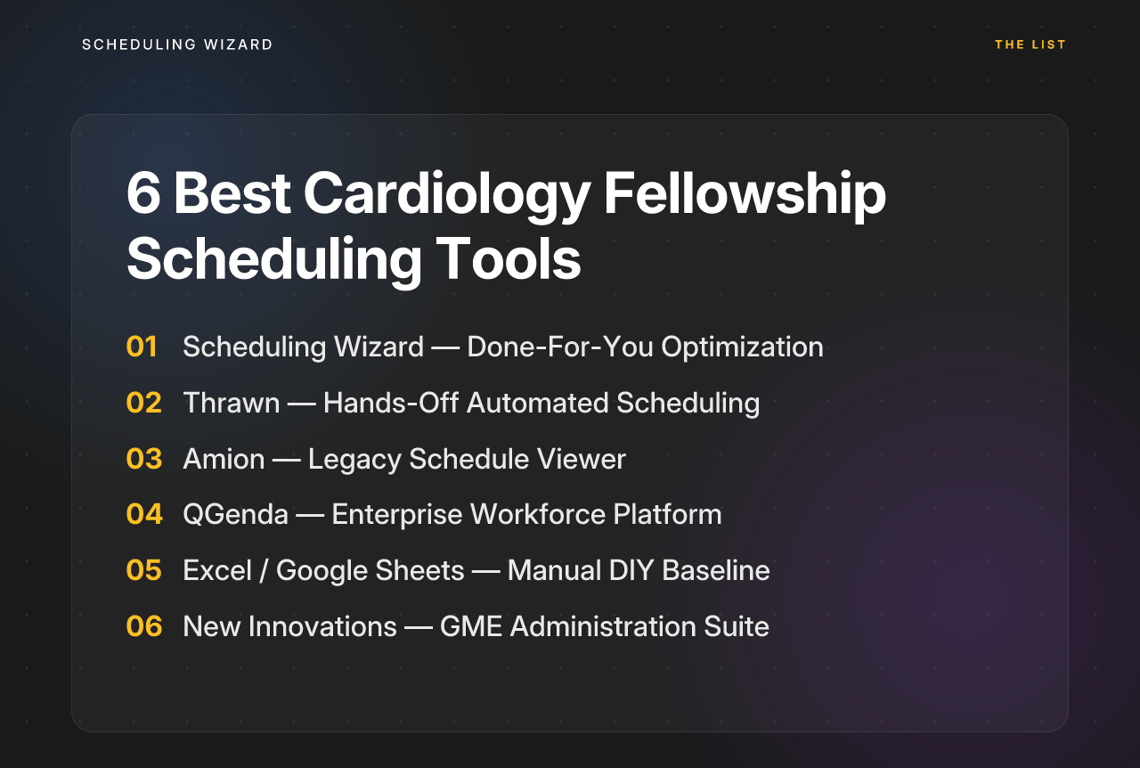
The 6 Best Cardiology Fellowship Scheduling Tools
1. Scheduling Wizard — Best Done-For-You Schedule Creation & Optimization Service
Type: Managed Schedule Creation Service
Scheduling Wizard is the only entry on this list that functions as a true done-for-you managed service. It's not software you log into — it's an expert team backed by a proprietary mathematical optimization engine that builds your schedule for you.
Here's how it works: your program submits its constraints — ACGME rotation requirements, fellow preferences, vacation requests, call rules, clinic coverage needs — and Scheduling Wizard's engine generates complete, optimized Block, Clinic, Call, and Attending schedules, delivered as ready-to-use Excel spreadsheets. If something changes mid-year, they re-optimize.
Why it matters for cardiology programs specifically: The engine has subspecialty-specific ACGME rules built directly into its constraint model, so compliance with cardiovascular disease fellowship requirements isn't manually checked after the fact — it's mathematically guaranteed upfront.
Key features:
- Zero operator burden — chief fellows don't need to learn scheduling software or carry the logic in their heads
- Fairness optimization — research found that optimized scheduling improved residents' perception of schedule fairness from 43% to 95%
- Cross-schedule dependency resolution — Block, Clinic, and Call schedules are optimized together, eliminating the conflicts that emerge when they're built separately
- Institutional continuity — scheduling knowledge persists across annual chief rotations, solving the "lost knowledge" problem that plagues programs year over year
- Ecosystem compatibility — the Excel output integrates directly with Amion or QGenda for day-to-day display
The frustration that "it sucks that a PGY1 in August has to be the one problem-solving something like this" is exactly what Scheduling Wizard is built to eliminate. Chief fellows are cardiologists-in-training, not professional optimizers.
Best for: Cardiology fellowship programs of any size that want to eliminate the scheduling burden entirely, guarantee ACGME compliance, and preserve institutional knowledge across chief rotations.
2. Thrawn — The Hands-Off Automated Scheduling Partner
Type: Managed Schedule Creation Service
Thrawn offers another powerful take on the "done-for-you" scheduling model. Like Scheduling Wizard, it's a managed service that takes scheduling off your program's plate. Programs provide their rules, requests, and ACGME requirements, and Thrawn's optimization engine delivers complete, compliant block, call, and clinic schedules.
This hands-off approach makes it a strong contender for programs that want to escape the complexity of manual scheduling without becoming experts in a new software platform. The core promise is simple: you handle the medicine, they handle the math.
Key features:
- Advanced Optimization: Builds schedules that are not only ACGME-compliant but also balanced and fair for all fellows.
- Done-for-You Model: Eliminates the need for a chief fellow to spend hours building or revising schedules. You submit constraints and receive a finished product.
- Comprehensive Coverage: Creates integrated block, call, and clinic schedules to prevent conflicts.
- Focus on Compliance: Bakes ACGME rules directly into the scheduling logic, reducing administrative risk.
Best for: Programs looking for a managed, hands-off scheduling service that uses powerful optimization to deliver fair and compliant schedules without requiring any software management from the chief fellow or coordinator.
3. Amion — The Legacy Schedule Viewer
Type: Schedule Viewing & Communication Tool
Amion is one of the most recognizable names in residency and fellowship scheduling — but it's important to understand what it actually is: a web-based platform for publishing and viewing schedules, not creating them.
A coordinator or chief fellow builds the schedule elsewhere (usually Excel), then manually enters it into Amion so the team can see daily assignments, manage swap requests, and check who's on call.
What Amion does well:
- Familiar calendar-based display that most residents and fellows already know
- Swap request management
- Mobile accessibility for checking daily assignments
What Amion doesn't do:
- Build or optimize a schedule
- Check ACGME compliance — a non-compliant schedule will display without any warning
- Ensure fairness — there's no built-in logic to balance call burden or flag inequities
Amion is a communication layer, not a scheduling engine. Programs that rely on it as their primary "scheduling tool" are still solving the hard problem manually, upstream of the platform. Its UI is also frequently cited as clunky, which adds friction to an already frustrating process.
Best for: Programs that already have a reliable, compliant process for creating schedules (like Scheduling Wizard) and need a widely recognized, accessible platform for daily display and team communication.
4. QGenda — The Enterprise Workforce Management Platform
Type: Enterprise Scheduling & Workforce Management Platform
QGenda is a comprehensive, enterprise-grade platform designed to centralize scheduling across entire health systems. It's a genuinely powerful tool — but it's built for workforce operations teams, not for chief fellows who rotate annually.
QGenda allows administrators to configure rule-based automation, run duty hour tracking, generate reports, and manage scheduling across multiple departments from a single interface. Large academic medical centers with a dedicated scheduling administrator find real value in it.
What QGenda does well:
- Centralized scheduling across multiple departments and service lines
- Rule-based automation and analytics
- Duty hour tracking and reporting dashboards
What QGenda doesn't do for most fellowship programs:
- Remove the need for a permanent, trained administrator — the platform's complexity is significant, and a newly appointed chief fellow cannot reasonably configure and manage it from scratch each year
- Guarantee ACGME compliance — compliance depends entirely on how correctly and comprehensively the rules were configured by the user; the system itself won't catch what wasn't programmed in
- Provide deep subspecialty optimization — it's built for broad workforce management, not the tightly constrained multi-variable optimization that cardiology fellowship schedules require
QGenda is also among the more expensive options in this space, which puts it out of reach for programs without institutional budget support. As one resident put it: "Most programs or hospitals aren't willing to pay for schedule-planning tools like the various advanced features in QGenda."
Like Amion, QGenda is also commonly used alongside a creation service like Scheduling Wizard — programs use QGenda for display and workforce analytics while offloading the actual schedule optimization to a dedicated service.
Best for: Large health systems or academic medical centers with dedicated administrative staff and institutional budget to manage a complex, centralized scheduling platform across many departments.
5. Excel / Google Sheets — The Manual DIY Baseline
Type: Manual Schedule Creation (High Risk)
Excel and Google Sheets are where most cardiology fellowship scheduling currently lives — and that's a problem. These tools are free, flexible, and universally familiar, which explains their prevalence. But using a spreadsheet as your scheduling engine means you're accepting a set of risks that compound over time.
The real costs of the DIY spreadsheet approach:
- ACGME compliance is entirely manual. There are no guardrails. A schedule with a duty hour violation will save just as smoothly as a compliant one.
- Fairness is a calculation, not a guarantee. The inconsistent shift burden that residents describe repeatedly in online discussions is a direct consequence of manual tracking that fails to catch imbalances.
- It's a massive time sink. The 10-15 hours per quarter spent on call scheduling alone doesn't include the time for block schedules, clinic coordination, or revision cycles.
- Institutional knowledge evaporates annually. When the chief rotates out, the scheduling logic — every workaround, every formula, every unwritten rule — leaves with them. The next chief starts from near scratch.
One resident captured this precisely: "Even if you're using Excel, it doesn't sound like you guys are efficiently using it to track shift counts." (Reddit) The tool isn't the problem — the absence of optimization logic is.
Best for: Very small, simple programs with minimal scheduling complexity and a high tolerance for manual work, compliance risk, and year-over-year knowledge loss. For most cardiology fellowship programs, this approach is a liability.
6. New Innovations — The GME Administration Suite
Type: GME Program Administration & Tracking Platform
New Innovations is a broad GME management suite designed to handle the full administrative lifecycle of a residency or fellowship program: evaluations, case logs, curriculum tracking, duty hour logging, and scheduling. It's a comprehensive platform — but scheduling is one module among many, not its core strength.
What New Innovations does well:
- Central hub for GME program administration
- Resident and fellow evaluation management
- Case log tracking and curriculum documentation
- Duty hour logging integrated with scheduling data
Scheduling limitations:
- The scheduling module is functional for tracking rotations but is not built for advanced optimization — it won't balance call burden, resolve cross-schedule conflicts, or guarantee subspecialty-specific ACGME requirements are met
- Programs using New Innovations for scheduling typically supplement it with significant manual work or use it alongside a dedicated creation service
- Optimizing a complex cardiology fellowship schedule — with simultaneous requirements for cath lab time, EP rotations, non-invasive imaging, and clinic coverage — goes beyond what the New Innovations scheduling module is designed to handle
Best for: Programs already using New Innovations as their central GME administration system that find its built-in scheduling functionality sufficient for their complexity level, and who primarily need a tracking and documentation tool rather than a schedule optimizer.
Decision Matrix: Choosing the Right Tool for Your Cardiology Program
Use this table to match your program's size, administrative capacity, and core need to the right type of tool.
| Tool | Model | Core Function | ACGME Compliance | Ease of Use for Chief | Institutional Continuity |
|---|---|---|---|---|---|
| Scheduling Wizard | Managed Service | Schedule creation & optimization | Mathematically guaranteed | None — no software to learn | Built-in, persists across chief rotations |
| Thrawn | Managed Service | Schedule creation & optimization | Built into optimization engine | None — no software to learn | Built-in, persists across chief rotations |
| Amion | Self-Service Viewer | Schedule display & swap management | Manual check required | Moderate (UI friction) | Lost annually |
| QGenda | Enterprise Platform | Workforce management & display | Rule-based, user-managed | High learning curve | Partial — requires dedicated staff |
| New Innovations | GME Admin Suite | Program tracking & administration | Basic tracking, not optimization | Moderate learning curve | High (as part of a larger system) |
| Excel / Google Sheets | Manual / DIY | Schedule creation (high risk) | Entirely manual, high risk | Requires scheduling expertise | Lost annually |
How to read this matrix:
- If your primary pain is the time and stress of building a fair, ACGME-compliant schedule — a Managed Service like Scheduling Wizard solves the root problem.
- If you have a reliable creation process and just need a place to post and communicate that schedule — a Viewing Tool like Amion works well in combination.
- If you're a large health system with dedicated scheduling administrators and enterprise-level needs — QGenda is worth evaluating.
- If you need broad GME program administration beyond just scheduling — New Innovations offers an integrated suite.
- If you're a small program comfortable with manual work — Excel is a starting point, with the understanding that it introduces compliance and fairness risk.
The Takeaway
The most common mistake cardiology fellowship programs make is trying to solve a schedule creation problem with a schedule viewing tool. Buying a better display platform doesn't fix an unfair call distribution, eliminate an ACGME duty hour violation, or give back the 10-15 hours your chief spends wrestling with a spreadsheet every quarter.
Chief fellows are cardiologists-in-training. Burdening them with a high-stakes administrative optimization problem is a disservice to their education — and it's one that compounds every year when the next chief inherits a broken process with no documentation and no institutional memory. As one resident put it: "It won't address the curriculum issues, but it will save so much time on the other stuff that whoever is doing the schedule will have time to think about learning objectives." (Reddit)
The most effective cardiology fellowship scheduling setup for most programs is a two-layer approach: use a dedicated creation service to generate a finished, optimized, compliant schedule, then upload it to whichever viewing platform your team already knows. The creation problem is where the real work happens — and it's where the most time, risk, and frustration live.
Frequently Asked Questions
What is the difference between a schedule creation tool and a schedule viewing tool?
A schedule creation tool builds the schedule from scratch by applying rules and optimizing for fairness, while a schedule viewing tool simply displays a pre-made schedule. This distinction is crucial because a viewing tool like Amion or QGenda cannot fix an unfair or non-compliant schedule; it can only display it. A creation service like Scheduling Wizard focuses on building a mathematically optimized and compliant schedule that you can then publish on any viewing platform.
How do you ensure ACGME compliance for cardiology fellowships specifically?
ACGME compliance for cardiology fellowships is ensured by building subspecialty-specific requirements directly into the scheduling optimization engine. This means rules for minimum rotations in the cardiac catheterization lab, non-invasive evaluations, and electrophysiology, alongside all duty hour regulations, are treated as mathematical constraints. The final schedule is guaranteed to be compliant by design, not just through manual review.
How will the 2026 ACGME rule changes affect our cardiology fellowship schedule?
The 2026 ACGME rule changes, particularly counting home call towards the 80-hour weekly maximum and a hard 24-hour cap on continuous work, will require significant adjustments to most schedules. A managed scheduling service can help by re-optimizing your entire schedule to comply with these new, stricter constraints, ensuring a smooth transition without overburdening fellows or compromising patient care.
Can I use Scheduling Wizard if my program already uses Amion or QGenda?
Yes, Scheduling Wizard works alongside schedule viewing platforms like Amion and QGenda. Scheduling Wizard creates the optimized Block, Call, and Clinic schedules and delivers them as ready-to-use Excel spreadsheets. Your program coordinator can then easily upload these finished schedules into your existing Amion or QGenda account for daily viewing and communication by your team.
What is the process for getting started with a managed scheduling service?
The process begins with an initial consultation to gather all of your program's specific requirements. This includes ACGME rules for your specialty, individual fellow requests (vacations, preferences), clinic coverage needs, and any unique call or rotation rules. Once these constraints are collected, the optimization engine generates the schedule, which is then delivered to you for review and implementation.
How does a managed service handle last-minute schedule changes?
Managed scheduling services handle last-minute changes by offering re-optimization support. If a fellow has an unexpected leave of absence or a rotation need changes, you can submit the new constraints to the service. They will then re-run the optimization to produce a revised, fair, and compliant schedule that accommodates the change with minimal disruption.
How is this different from just using the scheduling module in QGenda or New Innovations?
The primary difference is optimization versus administration. Platforms like QGenda and New Innovations are powerful for workforce management and GME tracking, but their scheduling modules require an expert user to manually configure all rules and do not perform deep multi-variable optimization. A managed service like Scheduling Wizard takes on the entire optimization burden, mathematically guaranteeing fairness and compliance without requiring you to become a software expert.
Ready to eliminate the scheduling burden from your cardiology program for good? Learn more about Scheduling Wizard's managed service at schedulingwiz.com.