Summary
- Physician scheduling is a complex optimization problem that takes program administrators 4–8 hours per month, with fairness and ACGME compliance being major challenges.
- Scheduling tools differ significantly: self-service platforms (like QGenda) require you to build and manage schedules, while managed services deliver finished schedules for you.
- Optimized scheduling has a major impact on resident morale, with one study showing it can boost perceived fairness from 43% to 95%.
- For programs looking to eliminate this administrative burden, a managed service like Scheduling Wizard delivers complete, ACGME-compliant schedules without requiring you to learn new software.
If you've ever spent a Sunday afternoon rebuilding a call schedule because two residents swapped shifts and it cascaded into six other conflicts — you already know the problem this article is about.
Call schedules and block rotation schedules are not just administrative tasks. They are, objectively, two of the hardest scheduling problems in medicine. Each one demands simultaneous constraint logic (who can cover what, when, under which conditions), fairness optimization (distributing desirable and undesirable shifts equitably across months), and strict ACGME compliance (duty hour rules that vary by subspecialty and carry real accreditation risk). And they're almost always interdependent: a resident's block assignment determines their clinic availability, which determines their call eligibility.
The result? As one program administrator put it in a real-world discussion about scheduling tools: "It takes at least 4–8 hours a month to make the schedule," and "the first draft isn't the biggest pain. It's swapping duties last minute and maintaining fairness over months." That burden typically lands on a chief resident who has a full clinical load, is new to the role every year, and is expected to somehow retain the institutional scheduling knowledge their predecessor carried out the door.
This article evaluates six physician scheduling software options — not on general feature breadth, but specifically on their ability to handle call schedule generation and block rotation management. We'll score each one against a focused rubric and give you a clear picture of what each tool actually does for the person running the schedule.
The Evaluation Rubric
Before diving into the list, here's the framework used to evaluate each option:
1. Self-Service vs. Managed Self-service tools hand you a platform and expect you to learn it, configure it, and operate it. Managed services take your constraints and deliver a finished schedule. The difference matters enormously when the "operator" is a chief resident rotating in and out annually.
2. Compliance Automation There's a meaningful gap between flagging a duty hour violation after the fact and generating a schedule that is compliant by design. The first leaves you to solve the puzzle; the second solves it for you. ACGME compliance — including subspecialty-specific rules — is the difference between a scheduling tool and a scheduling risk.
3. Multi-Schedule Dependency Handling Block, clinic, call, and attending schedules are not independent. A tool that optimizes each separately still leaves you manually reconciling the conflicts between them. True dependency handling means all schedule types are resolved together.

The 6 Best Physician Scheduling Software Options
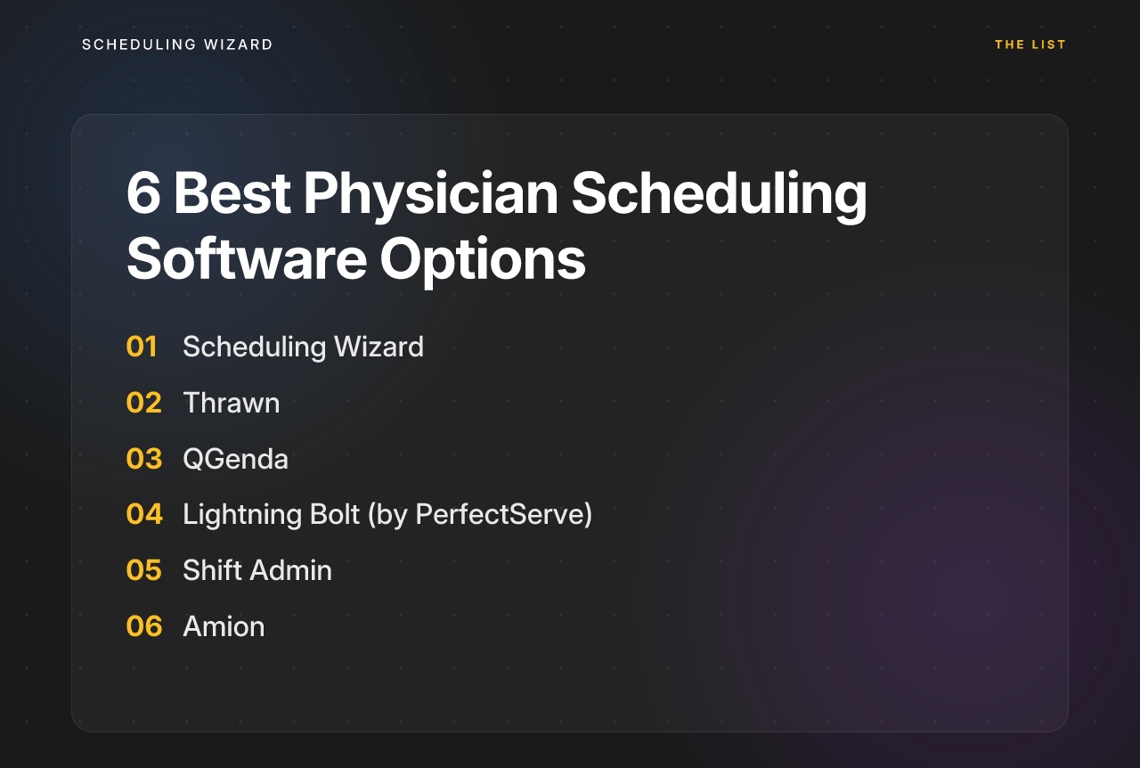
1. Scheduling Wizard
Overview: Scheduling Wizard is a YC-backed (W26) managed scheduling automation service built exclusively for medical residency and fellowship programs. It's not software you license and operate — it's a done-for-you service. Programs submit their constraints, preferences, and rules, and receive complete, ACGME-compliant Block, Clinic, Call, and Attending schedules delivered as ready-to-use Excel files. No platform to learn. No seat licenses. No chief resident triaging configuration errors at midnight.
Founded in 2024 and currently serving 18 departments across 13 hospitals, Scheduling Wizard is built around one core insight: the hardest part of medical scheduling isn't the interface — it's the optimization problem underneath it.
Why It Stands Out for Call & Block Schedules:
- Mathematically guaranteed ACGME compliance. The proprietary constraint-solving engine doesn't check for violations after the fact — it generates schedules that are compliant by design, with subspecialty-specific rules built in.
- Simultaneous multi-schedule generation. Block, Clinic, Call, and Attending schedules are optimized together, so cross-schedule dependencies are resolved before the schedule is ever delivered.
- Built-in fairness optimization. Equitable shift distribution is computed, not eyeballed.
- Institutional continuity. Because it's a managed service, scheduling knowledge doesn't walk out the door when the chief resident rotates. The constraints live in the system, not in someone's head.
- Works alongside your existing tools. Many Scheduling Wizard clients use Amion or QGenda as their viewing platform — SW generates the optimized schedule, and programs upload it to whatever display tool they already use.
| Criterion | Score |
|---|---|
| Self-Service vs. Managed | ✅ Fully Managed |
| Compliance Automation | ✅ Mathematically Guaranteed |
| Multi-Schedule Dependency Handling | ✅ Comprehensive & Simultaneous |
Best For: Residency and fellowship programs that want to completely eliminate the administrative burden of schedule creation and receive a finished, optimized, compliant schedule — without touching a scheduling platform.
2. Thrawn
Overview: Thrawn is a managed residency scheduling service that handles block, call, and clinic schedules. Using advanced optimization, it builds ACGME-compliant schedules from the ground up based on your program's unique constraints. In its done-for-you model, programs submit their requirements and receive finished schedules, making it a strong alternative for those looking for a hands-off solution.
For Call & Block Schedules: Thrawn excels by treating block, call, and clinic schedules as a single, interconnected optimization problem. This ensures ACGME rules are not just checked, but are fundamentally built into the schedule's structure. It delivers a finished, compliant schedule, removing the burden of learning and operating complex software, which is a significant advantage for busy chief residents.
| Criterion | Score |
|---|---|
| Self-Service vs. Managed | ✅ Fully Managed |
| Compliance Automation | ✅ Generative & Compliant-by-Design |
| Multi-Schedule Dependency Handling | ✅ Comprehensive & Simultaneous |
Best For: Programs seeking a fully managed service that delivers finished, optimized schedules without requiring them to operate any software. An ideal hands-off alternative to self-service platforms.
3. QGenda
Overview: QGenda is one of the most widely adopted enterprise scheduling platforms in healthcare. It functions as a centralized hub for scheduling across provider types, with robust analytics, automated shift notifications, and coverage dashboards.
For Call & Block Schedules: QGenda can handle complex rule sets, and its centralized view is genuinely useful for large organizations managing multiple departments. However, it is emphatically a self-service platform — and that's where the friction begins. As one practitioner noted, "Getting QG to actually do what you want isn't easy, and learning how it works is very complicated." The compliance tooling flags violations, but resolving them is still on you.
| Criterion | Score |
|---|---|
| Self-Service vs. Managed | ⚠️ Self-Service |
| Compliance Automation | ⚠️ Conflict Alerts (not generative) |
| Multi-Schedule Dependency Handling | ⚠️ Capable, but requires extensive user configuration |
Best For: Large hospital systems with dedicated administrative staff who can invest the time to configure and maintain the platform, and who need a unified scheduling view across a broad provider network.
4. Lightning Bolt (by PerfectServe)
Overview: Lightning Bolt is a self-service physician scheduling software that goes beyond a blank canvas — it generates schedule suggestions based on rules you define. For residency programs, it supports complex structures like the 4+1 scheduling model, which separates inpatient and outpatient blocks to improve continuity of care and resident well-being.
For Call & Block Schedules: Lightning Bolt automates the first draft, which is a meaningful improvement over pure manual scheduling. Its Custom Tally Targets feature helps users track ACGME guideline adherence. But the operative word is helps: the system surfaces information; the user still resolves conflicts. It automates the starting point, not the finish line, and the complexity of call scheduling means the gap between those two can still be substantial.
| Criterion | Score |
|---|---|
| Self-Service vs. Managed | ⚠️ Self-Service (with automation assists) |
| Compliance Automation | ⚠️ Rule-Based Tracking & Suggestions |
| Multi-Schedule Dependency Handling | ⚠️ Configurable, but user-managed |
Best For: Programs that want more automation than a spreadsheet but still want hands-on control over the editing process and have the bandwidth to manage a self-service platform.
5. Shift Admin
Overview: Shift Admin was developed with direct input from physicians, which shows in its interface design. It's built to handle complex, multi-specialty scheduling with a drag-and-drop editor that feels more approachable than some enterprise alternatives.
For Call & Block Schedules: Shift Admin provides integrated compliance checks — the system will alert you when a schedule assignment violates a defined rule. It's well-suited to physician groups managing departmental schedules across subspecialties. Like QGenda and Lightning Bolt, however, it is a tool that requires a skilled operator. The compliance guardrails are reactive, not generative: they catch mistakes, but the schedule-building work still falls on whoever is running the platform.
| Criterion | Score |
|---|---|
| Self-Service vs. Managed | ⚠️ Self-Service |
| Compliance Automation | ⚠️ Integrated Compliance Checks |
| Multi-Schedule Dependency Handling | ⚠️ Multi-department capable with proper configuration |
Best For: Physician groups and departments looking for a more user-friendly self-service platform that handles comprehensive rule sets without the enterprise complexity of QGenda.
6. Amion
Overview: Amion is ubiquitous in academic medicine — nearly every residency program knows the name. But its core function is often misunderstood: Amion is primarily a schedule viewer, not a schedule generator. It provides a clean, accessible interface for publishing and sharing call and daily schedules across a department.
For Call & Block Schedules: Amion does not generate schedules. It does not optimize for fairness. It does not check ACGME compliance. It is, functionally, a digital whiteboard: whatever you put in is what your team sees. That's not a criticism — it does that job well, which is why so many programs use it. But it should not be evaluated as physician scheduling software in the optimization sense. Notably, Scheduling Wizard clients regularly use Amion as their display layer: SW generates and optimizes the schedule, and the program uploads the finished Excel file to Amion for day-to-day viewing.
| Criterion | Score |
|---|---|
| Self-Service vs. Managed | ❌ Manual Self-Service |
| Compliance Automation | ❌ None |
| Multi-Schedule Dependency Handling | ❌ None |
Best For: Programs that need a simple, low-cost way to publish and share schedules that have already been built — whether manually or through a service like Scheduling Wizard.
Why Optimization Isn't Just About Saving Time
It's easy to frame better scheduling as a productivity win. But the evidence suggests the stakes are higher than that.
A study published in Neurosurgery found that implementing an optimized scheduling system reduced call variation by 70% and increased residents' perception of scheduling fairness from 43% to 95%. That's not a marginal improvement — it's the difference between a program where residents feel equitably treated and one where morale quietly erodes over twelve months of perceived imbalance.
Fairness in scheduling is one of those things that's nearly impossible to track mentally. As one scheduler described it: "The swaps, tracking fairness, and just carrying it in your head all month… that's what really adds up." When fairness optimization is a mathematical output rather than a manual estimation, the entire dynamic of the program changes.
The Bottom Line
If you're evaluating physician scheduling software specifically for call schedule generation and block rotation management, here's the honest summary:
- QGenda, Lightning Bolt, and Shift Admin are all legitimate tools — but they require an operator. Someone has to learn the platform, configure the rules, generate drafts, resolve conflicts, and re-run the process every scheduling cycle. When that person is a chief resident with a 60-hour clinical week, the operational math doesn't always work.
- Amion is a display tool. It belongs in every program's stack, but it doesn't solve the scheduling problem.
- Scheduling Wizard is the only option on this list that operates as a fully managed service — meaning your program submits its constraints and receives a finished, mathematically optimized, ACGME-compliant schedule. No software to learn. No compliance risk to manually audit. No institutional knowledge lost when the chief resident rotates out.
For programs tired of treating schedule creation as a recurring crisis that falls on whoever drew the short straw, Scheduling Wizard offers something the self-service market doesn't: the work, done for you.
Frequently Asked Questions
What is the difference between a managed scheduling service and self-service software like QGenda?
A managed service delivers a finished, optimized schedule for you, while self-service software requires you to learn the platform and build the schedule yourself. With a managed service like Scheduling Wizard, you provide your rules and constraints, and our team uses proprietary optimization technology to create a complete, ACGME-compliant schedule. Self-service tools like QGenda or Shift Admin provide a powerful platform, but your team is responsible for all configuration, data entry, conflict resolution, and schedule generation.
How can scheduling software guarantee ACGME compliance for my specific subspecialty?
True ACGME compliance is achieved through constraint-based optimization that builds schedules to be compliant by design, rather than just flagging violations after the fact. Most self-service platforms only offer compliance checking, which alerts you to rule violations that you must then manually fix. A managed service like Scheduling Wizard incorporates your subspecialty’s specific ACGME rules (e.g., for surgery, internal medicine, or anesthesiology) directly into the optimization engine, meaning the final schedule is mathematically guaranteed to be compliant from the start.
How will the 2026 ACGME rule changes affect physician scheduling?
The 2026 ACGME rule changes, particularly counting home call towards the 80-hour weekly maximum and a 24-hour hard cap on continuous work, will make manual scheduling significantly more complex. These new constraints make it much harder to ensure compliance. An optimization-based scheduling service can model these new rules to automatically generate compliant schedules, helping programs adapt without adding administrative burden or increasing the risk of errors.
Do we need to replace our current scheduling viewer like Amion or QGenda?
No, you do not need to replace your current viewing platform. Managed services like Scheduling Wizard work alongside tools like Amion and QGenda. We focus on generating a fair, optimized, and compliant schedule, which we deliver as a standard Excel file. You can then easily upload this file into the platform your team already uses for day-to-day viewing and shift swaps.
What information does a program need to provide to get started with a managed scheduling service?
To get started, you typically need to provide your roster of physicians, a list of all required shifts and rotations, individual requests (like vacations), and your specific fairness and ACGME rules. The process begins with an onboarding call where we gather all your constraints—from individual needs to complex subspecialty duty hour rules and fairness goals (e.g., equal distribution of weekend calls). We codify these rules so our system can generate the optimal schedule for your program.
How does automated scheduling ensure fairness better than a human scheduler?
Automated scheduling uses mathematical optimization to equitably distribute desirable and undesirable shifts (like nights, weekends, and holidays) across all physicians over a defined period. While a human scheduler tries to "eyeball" fairness, it's nearly impossible to track every variable across a large team for a full year. An optimization engine finds a schedule that minimizes variance in call shifts and weekend duties, which is why studies show it can dramatically increase residents' perception of fairness.
Ready to stop wrestling with scheduling software? See how Scheduling Wizard delivers complete, optimized call and block schedules for your program.