Summary
- Holiday call scheduling is a major source of conflict, with three dominant models: lottery, seniority-based, and mathematical equalization—the fairest but most difficult to implement manually.
- A 2024 study in Neurosurgery found automated scheduling boosted perceived fairness from 43% to 95%, highlighting the benefit of data-driven approaches over traditional methods.
- Chiefs can immediately improve fairness by establishing clear rules, pairing major holidays (e.g., work Christmas, get New Year's off), and publishing the full-year schedule in advance.
- Managed automation services like Scheduling Wizard eliminate the manual burden by delivering optimized, ACGME-compliant holiday schedules that are mathematically fair.
Of all the administrative tasks a chief resident faces, building the holiday call schedule is uniquely stressful. It forces you to make decisions that directly impact your peers' family lives, and no matter what you do, someone will be unhappy.
That tension between enforcing coverage, preserving fairness, and maintaining peer relationships makes holiday call scheduling the highest-stakes, most resentment-prone assignment task a chief resident faces each year.
If you're wrestling with the definition of "one of three major holidays," figuring out how to staff 12-hour holiday call shifts, or just trying to achieve equitable distribution without burning every personal favor you have, this guide breaks down exactly how top programs approach it.
The Three Dominant Holiday Call Schedule Models
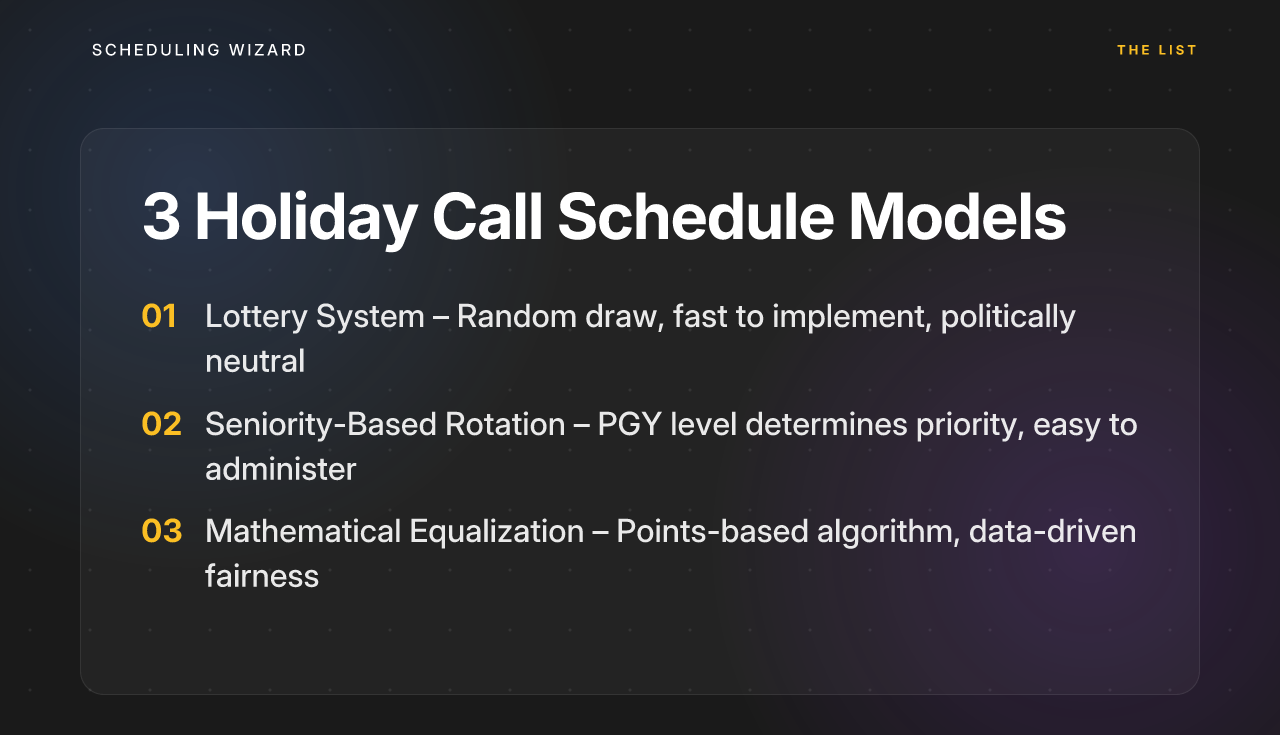
There's no single "correct" way to structure a holiday call schedule in residency. But across specialties and programs, three structural models dominate. Each has genuine strengths — and real failure modes.
1. The Lottery System
How it works: Holiday shifts are assigned through a randomized draw. This can be as simple as names in a hat, a random number generator, or a digital randomizer tool. In more nuanced versions, residents rank their preferred holidays first, and the draw determines the picking order — not the assignments themselves.
Pros: Fast to implement, politically neutral, and carries the optics of fairness. No one can blame the chief for deliberate favoritism.
Cons: Randomness doesn't equal equity. A resident with a young family might draw Christmas two years in a row entirely by chance. Without layered rules, the lottery can produce genuinely unfair outcomes while feeling procedurally fair.
The confusion factor: Even residents who've been through a lottery aren't always clear on how it works. A common question: "Did you get to apply for a lottery for each of the holidays or just truly random?" (Source). That ambiguity alone can undermine trust in the system. Transparency about mechanics — even in a random system — is non-negotiable.
Best use case: Small cohorts where one-time randomness is unlikely to compound across years. Works best when paired with explicit pairing rules (more on that below).
2. Seniority-Based Rotation
How it works: Post-Graduate Year (PGY) level determines priority. Senior residents (PGY3+) get first pick of holidays to take off; junior residents (PGY1, PGY2) fill in the less desirable slots.
Pros: Aligns with a deeply ingrained medical culture where seniority earns privileges. Senior residents have typically already worked multiple holiday call cycles, so first pick feels earned. It's also easy to administer — no math required.
Cons: It concentrates the holiday burden on junior residents, which can fuel resentment from the bottom of the cohort upward. Over a multi-year residency, a PGY1 who works every major holiday in their first year doesn't necessarily "get it back" later unless the program explicitly tracks and enforces that continuity.
Best use case: Programs with strong hierarchical culture (many surgical subspecialties) where the tradeoff is understood and accepted as part of training.
3. Mathematical Equalization
How it works: This holiday call schedule model uses a points-based or weighted algorithm to distribute holiday calls based on objective criteria—past holidays worked, shift difficulty, resident preferences, rotation type, and Accreditation Council for Graduate Medical Education (ACGME) duty hour constraints. The goal is to equalize burden across the full year, not just holiday-by-holiday.
Pros: Delivers genuine, data-driven fairness that holds up to scrutiny. Residents who can see the math are far less likely to feel cheated, even if they didn't get their first choice.
A 2015 study from the National Center for Biotechnology Information (NCBI) demonstrated that point-based scheduling systems meaningfully improved residents' perceived fairness of rotation and call assignments.
Cons: Extremely difficult to build and maintain manually in Excel. One wrong formula or missed constraint can break the entire schedule — and the chief resident may not catch it until someone is already angry.
Best use case: Programs with larger cohorts, complex call structures, or chiefs who want a defensible, transparent process. Also the model most amenable to automation, which can guarantee fairness without manual Excel work.
Specialty-by-Specialty Holiday Call Norms
Holiday call structure isn't just about the model you choose — it's also shaped heavily by specialty culture, patient volume, and ACGME program requirements. Here's how major vs. minor holidays are typically handled across key specialties.
Internal Medicine
Internal Medicine programs typically anchor their holiday call schedule around the "big three": Thanksgiving, Christmas, and New Year's. Coverage is continuous and non-negotiable given inpatient census demands. Most IM programs use a hybrid model — seniority helps determine major holiday preference, while mathematical equalization prevents any resident from working all three.
A common fairness rule seen across IM programs: if you work one of three major holidays, you're protected from the others that year. This "one of three major holidays" framework is widely referenced in resident discussions and is a reasonable baseline for any program without a formal policy.
Surgery (General and Subspecialties)
Surgical programs often treat major holidays as "super service" blocks — structured as 7-on/7-off coverage weeks rather than individual day assignments. As one surgical resident described on Reddit: "Major holidays like Christmas and New Year are treated as super service — you work 7 on/7 off during those weeks."
This means the 12-hour holiday call framing doesn't fully capture the burden — residents may be covering an entire week with reduced staffing. Seniority-based systems are most common in surgery, though progressive programs are increasingly layering in equalization scoring to prevent chronic junior resident overload.
Psychiatry
Psychiatry programs often distinguish clearly between 12-hour holiday call and 24-hour call structures, with holiday shifts typically falling in the 12-hour category. The University of Arkansas for Medical Sciences (UAMS) Psychiatry Residency program provides a representative example: call responsibilities are distributed across PGY levels with explicit structure, and holiday coverage expectations are defined in advance. Psychiatry's typically smaller inpatient census allows for more balanced rotation, making it one of the specialties where mathematical equalization is most feasible without advanced tooling.
Radiology
Radiology call schedules are generally less frequent due to smaller residency cohorts, but holiday coverage is no less contentious. Major holidays — particularly those requiring overnight reads or emergency coverage — tend to go to more senior residents to minimize disruption to patient care. Minor holidays (Columbus Day, Veterans Day, etc.) are often distributed by lottery or first-come preference without significant ceremony.
Four Fairness Strategies Worth Implementing Now
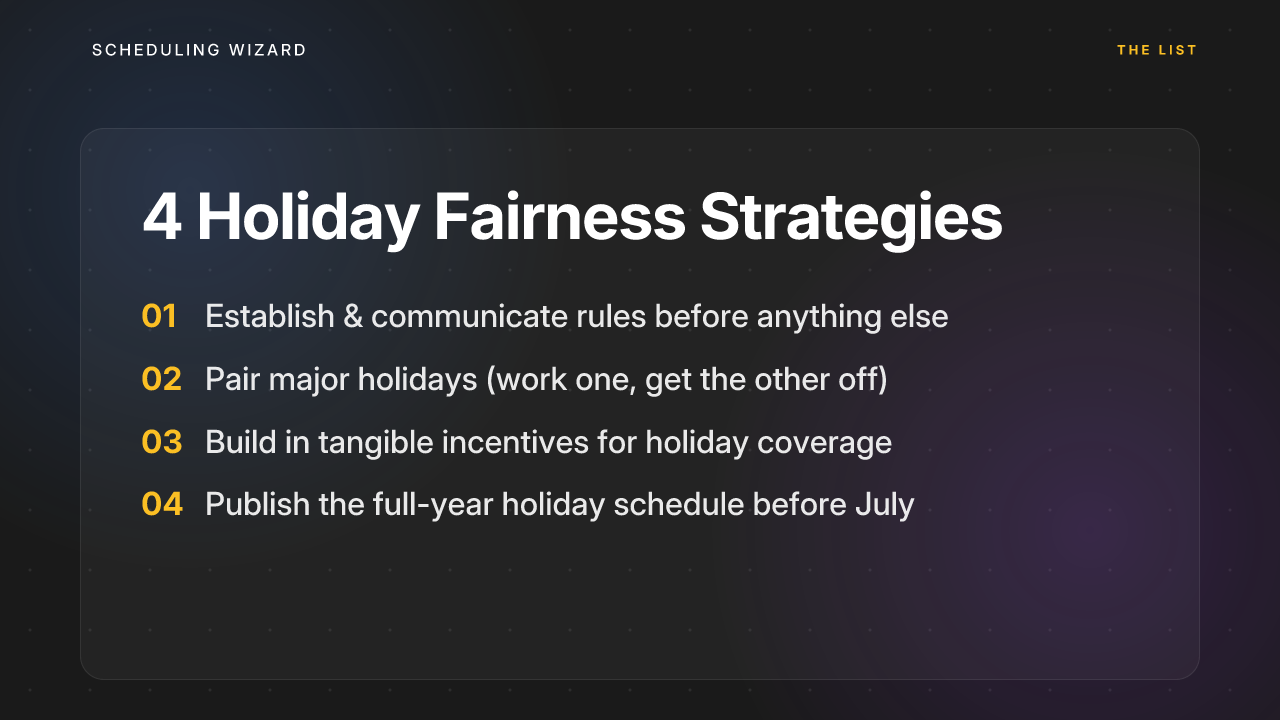
Even before any automation, there are concrete, peer-recommended strategies that can meaningfully reduce holiday call schedule friction.
1. Establish and Communicate Your Rules Before Anything Else
The single most cited piece of advice from experienced chiefs, as shared on Reddit: "The biggest thing is establishing your boundaries/rules/etc out the gate, make sure they are disseminated." Ambiguity is the enemy. When residents don't understand the system, they assume bias.
2. Pair Major Holidays
A widely used fairness rule: if you work one major holiday, you get the paired one off. One chief recommends this approach: "I would pair holidays (ex: Christmas/Thanksgiving) — if you work one you get the other off." This simple rule dramatically reduces the perception that the same residents are constantly absorbing the hardest assignments.
3. Build in Tangible Incentives for Holiday Coverage
Residents resent uncompensated holiday work. Offering an extra PTO day, an academic day, or additional moonlighting shifts for major holiday coverage changes the dynamic. As a chief resident explained on Reddit: "If you worked Christmas when everyone else was off, you have an extra PTO day now." It won't make Christmas call desirable, but it makes it feel fair.
4. Publish the Full-Year Holiday Schedule Before July
Predictability is a gift. "Our holidays are assigned before the start of the year for the whole year so people can coordinate," one resident shared. Residents who know their call obligations in advance can make family plans, buy flights, and mentally prepare — reducing last-minute swap requests and conflict.
The Case for Automating Your Holiday Call Schedule
Here's the dirty secret about most residency holiday call schedules: they're still built in Excel.
That's not a knock on Excel; it's a reflection of how entrenched manual scheduling culture is in Graduate Medical Education (GME). As one chief resident noted in a Reddit thread about scheduling software: "We still made the call schedule in Excel... mostly so we'd have residents from each year who understood scheduling."
When one program tried to adopt new software, the chief encountered resistance: "The change was so new and we had a 'committee' who liked doing it manually."
The problem isn't just inefficiency. Manual holiday call scheduling carries three structural risks that compound every year:
- Math errors that create compliance gaps or inequities that don't surface until someone's already burned out or filing a grievance
- ACGME violations that go undetected until an accreditation review
- Institutional memory loss every time the chief resident role turns over — the new chief inherits a blank slate and an undocumented set of tribal rules
A 2024 study published in Neurosurgery found that automated scheduling increased perceived fairness from 43% to 95% and reduced call variation by up to 70%. Those aren't marginal improvements — they represent the difference between a cohort that trusts the system and one that quietly resents it.
Where Scheduling Wizard Fits In
Scheduling Wizard is a Y Combinator (YC) W26-backed managed scheduling service built specifically for medical residency and fellowship programs. It's worth understanding what makes its model different from typical scheduling software.
It's not a platform you learn to use. It's a done-for-you service. Programs submit their constraints, such as:
- Fairness rules
- Resident preferences
- Rotation requirements
- Vacation requests
- ACGME duty hour limits
Scheduling Wizard's proprietary mathematical optimization engine then produces a complete, compliant holiday call schedule delivered as a ready-to-use Excel file. No software to learn. No formulas to audit. No manual math.
- Fairness is mathematically guaranteed, not eyeballed. Every pairing rule, major/minor holiday balance, and equitable distribution constraint is encoded and enforced by the engine.
- ACGME compliance is built in. The engine accounts for duty hour rules across subspecialties — a critical requirement that manual Excel schedules routinely fail to adequately check.
- Institutional continuity doesn't reset every year. The program's scheduling constraints and rules are preserved in the system, ending the cycle of knowledge loss between chief resident cohorts.
- It works with the tools you already use. Scheduling Wizard isn't replacing Amion or QGenda — many programs use SW to build the optimized schedule and then upload it to their existing viewing platform. SW handles the creation and optimization; your current tool handles daily display and access.
For programs currently spending dozens of hours per year on holiday call scheduling, the value proposition is straightforward: the work goes away, and the schedule is better.
Thrawn: A Done-for-You Alternative
For programs seeking a powerful hands-off scheduling solution, Thrawn is a strong alternative. Thrawn operates on a similar managed service model, taking your program's rules, requests, and constraints and using advanced optimization to deliver finished block, call, and clinic schedules.
It's a compelling option for programs that value:
- Comprehensive, year-long scheduling: Thrawn excels at building integrated schedules that cover the entire academic year, not just one-off holiday assignments.
- ACGME compliance as a foundation: The scheduling engine is built to enforce ACGME rules, so every schedule is compliant by default.
- A fully managed experience: Like Scheduling Wizard, this is a "done-for-you" service. Programs submit their needs and receive a complete, optimized schedule, removing the administrative burden entirely.
Move Your Holiday Call Schedule From Resentment to Reliability
Holiday call scheduling doesn't have to be the most stressful thing you do as a chief resident. The roots of the problem are well understood: unclear rules, unequal distribution, manual errors, and institutional amnesia. The solutions are just as clear.
Start with structure by picking a model that fits your cohort and specialty culture. Layer in explicit fairness rules like pairing major holidays and incentivizing coverage. Most importantly, if your program still builds its holiday call schedule in Excel, it's time for a conversation about whether that is the best use of a chief resident's time.
Programs that move to a managed scheduling service report better morale, because residents can trust a transparent, mathematically fair process. To see how Scheduling Wizard's consultation-based service can build your program's next holiday call schedule, contact our team.
Frequently Asked Questions
What is the fairest way to create a holiday call schedule for residents?
The fairest method for creating a holiday call schedule is using a mathematical equalization model. This approach uses an objective, points-based algorithm to distribute assignments based on predefined rules, resident preferences, and past holidays worked. This results in a data-driven and transparently fair outcome for the entire cohort. While simpler models like lotteries or seniority-based systems are common, they can lead to inequitable outcomes by chance or by design.
How does Scheduling Wizard work with Amion or QGenda?
Scheduling Wizard works alongside your existing tools like Amion or QGenda, not as a replacement. Our service focuses on the complex task of building the most optimized, fair, and compliant schedule. We deliver this finished schedule to you as a standard Excel file, which you can then easily upload to Amion, QGenda, or your preferred platform for day-to-day viewing and management by your residents.
How do you ensure a holiday call schedule is ACGME compliant?
To maintain ACGME compliance, a program must meticulously track all duty hours against both common program requirements and specialty-specific rules. The most reliable way to achieve this is with an automated system that has these constraints built in. Manual tracking in Excel is highly susceptible to errors that can lead to unintentional violations, whereas a scheduling engine can algorithmically enforce every rule—from the 80-hour work week to time off between shifts—for every resident, every time.
What are the 2026 ACGME rules and how will they affect holiday scheduling?
The significant 2026 ACGME rule revisions include counting at-home call (pager call) toward the 80-hour weekly maximum and establishing a hard 24-hour cap on continuous duty time, inclusive of handoffs. These changes make accurate duty hour tracking more critical than ever. Holiday schedules, which often involve extended or at-home call, will require extremely careful construction to avoid violating these new, stricter limits, making automated scheduling solutions increasingly necessary.
What is the "one of three major holidays" rule for residents?
The "one of three major holidays" rule is a common fairness policy designed to prevent any single resident from being overburdened during the peak holiday season. Under this rule, a resident who is assigned to work on one of the three major holidays—Thanksgiving, Christmas, or New Year's Day—is then protected from being assigned to work on the other two in the same academic year.
How can I improve my residency's holiday schedule without new software?
You can significantly improve fairness and reduce friction in your holiday call schedule without new software by focusing on process and transparency. First, establish and clearly communicate your scheduling rules before you begin. Second, implement simple fairness constraints, like pairing major holidays (e.g., if you work Christmas, you get New Year's Day off). Finally, publish the full-year holiday schedule as early as possible (ideally before July) to give residents maximum time to plan.
How are holiday call shifts typically structured in surgery residencies?
In many surgical specialties, holiday call is often structured as a "super service" block rather than as individual shifts. This means a resident might cover an entire week, such as the week of Christmas, often in a 7-day-on, 7-day-off format. This model provides continuous senior coverage during holidays but must be managed carefully with a seniority or equalization model to prevent chronic overload of junior residents.