Summary
- Multi-specialty residency scheduling is a complex constraint optimization problem, not a calendar task, which is why manual methods are error-prone and time-consuming.
- Most scheduling software fails because it cannot simultaneously handle cross-schedule dependencies like rotations, call shifts, and subspecialty-specific ACGME rules.
- Managed services are purpose-built for this complexity, eliminating the high overhead of self-serve platforms by delivering complete, compliant schedules for you.
- Programs with complex, multi-departmental needs can receive finished, mathematically-guaranteed schedules without learning new software by using a service like Scheduling Wizard.
If you're a chief resident or program coordinator managing a multi-specialty or cross-departmental program, you already know the pain. Residents rotate across services — surgery one month, medicine the next, subspecialty consults the month after. Attending coverage spans multiple teams with different staffing norms. Call pools have to respect constraints from several subspecialty rule sets at the same time. And every time you change one thing, something else breaks.
This is not a calendar problem. It's a constraint optimization problem — and nearly every piece of residency call scheduling software on the market was built for single-department programs with predictable, repeating patterns.
The result? Chief residents spend hours in Excel, manually cross-referencing rotation assignments, call frequencies, and ACGME duty hour totals — a process that's "laborious and frustrating" and "tedious and prone to errors." Coordinators describe "coordinating a large number of residents across multiple locations" as "extremely complex." And when a last-minute change ripples through a cross-departmental schedule, the manual rework can take days.
This article evaluates a leading managed scheduling service and four popular software tools through the multi-specialty lens, scoring each on four criteria that actually matter for complex programs:
- Cross-schedule dependency handling — Can it see that a resident on a 24-hour call shift can't be in continuity clinic the next morning?
- Subspecialty ACGME rule libraries — Does it know and apply the correct rules based on the resident's current rotation, not just a generic duty hours checklist?
- Ability to model simultaneous rotation and call constraints — Can it generate a call schedule that is already aware of block rotations, clinics, and conference day protections?
- Coordinator overhead — What is the actual human cost to build and maintain the schedule?
What a Multi-Specialty Schedule Actually Looks Like as a Constraint Problem
Before evaluating tools, it helps to understand why this is hard in a formal sense.
A single-department schedule might have 20–30 constraints to satisfy. A multi-specialty program — say, an internal medicine program with categorical, preliminary, and transitional residents rotating through cardiology, pulmonology, nephrology, and the ICU — can easily have hundreds of interacting constraints that can't be solved independently of one another.
The constraint layers stack like this:
Layer 1 — Global ACGME duty hour rules. These are non-negotiable hard constraints, based on research into resident scheduling: no more than 80 hours per week averaged over four weeks, at least one full 24-hour period off every seven days, in-house call no more frequently than every third night, continuous duty capped at 24 hours (plus up to 6 hours for handoffs), and a recommended 10-hour rest period between shifts (with an 8-hour enforceable minimum).
Layer 2 — Subspecialty and department-level rules. ACGME rules are just the floor. A surgical subspecialty rotation carries different call intensity requirements than an outpatient psychiatry block. A fellow rotating through a transplant service has different coverage obligations than a preliminary intern on a medicine ward. The system must know which rules apply based on where the resident currently sits in their block schedule.
Layer 3 — Cross-schedule dependencies. The call schedule is not a standalone artifact. It must be solved simultaneously with the rotation schedule, the continuity clinic schedule, and the didactics calendar. A resident assigned to a 24-hour shift cannot be expected at a Thursday morning conference. A resident with a protected half-day clinic cannot absorb a swing shift the evening before.
Layer 4 — Fairness and individual constraints. On top of all of this, the schedule must distribute nights, weekends, and holidays equitably, honor approved vacation windows, accommodate conference travel, and integrate moonlighting restrictions.
Solving all four layers simultaneously — for 20, 40, or 80 residents rotating across multiple departments — is precisely the problem that mixed-integer programming (MIP) and constraint programming (CP) are designed to handle. It is also precisely the problem that a drag-and-drop scheduling interface, or a chief resident working in Excel at 11pm, cannot reliably solve.
The Best Residency Call Scheduling Software for Multi-Specialty Programs
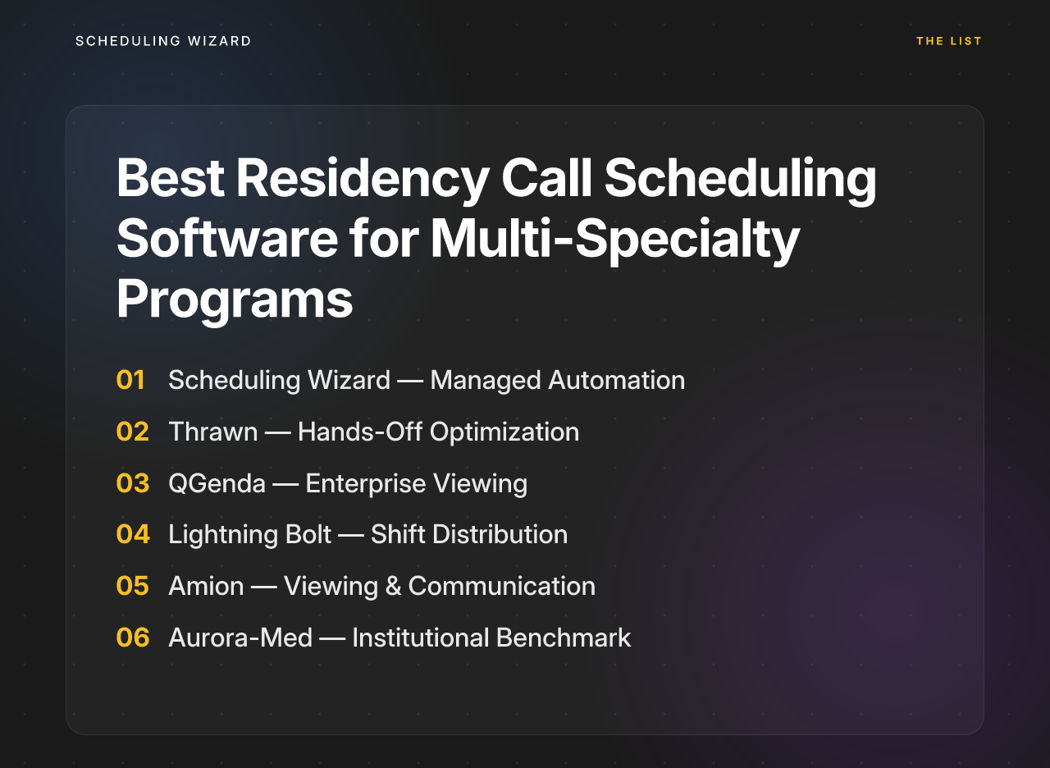
1. Scheduling Wizard — Best for Multi-Specialty Managed Automation
Type: Managed Scheduling Service (Done-for-you)
Scheduling Wizard is the only option on this list that is purpose-built as a managed service rather than a self-service platform. YC-backed (W26) and currently deployed across 18 departments at 13 hospitals, it's the strongest proof of multi-department capability available at the GME level.
Rather than giving coordinators another platform to learn, Scheduling Wizard works differently: programs submit their constraints and receive finished, ACGME-compliant schedules delivered as Excel spreadsheets. There is no software to operate, no interface to train on, and no institutional scheduling knowledge lost when a chief resident graduates.
Cross-Schedule Dependency Handling: Native and automatic. Scheduling Wizard generates Block, Clinic, Call, and Attending schedules together, resolving cross-schedule conflicts mathematically before the schedule is ever delivered. A call assignment that would place a resident in clinic the next morning without the required 10-hour rest gap simply won't appear in the output.
Subspecialty ACGME Rule Libraries: This is core to the engine. Subspecialty-specific ACGME rules are built in, and ACGME compliance is mathematically guaranteed — not manually verified after the fact. This is consistently the #1 question in sales conversations, and it's a hard requirement for most multi-specialty buyers.
Ability to Model Simultaneous Constraints: This is Scheduling Wizard's clearest differentiator. Its proprietary constraint-modeling language allows any program's unique, unwritten scheduling rules to be translated into a solvable mathematical model. Custom call ratios, protected rotation types, cross-departmental attending coverage requirements — if it can be described as a rule, it can be encoded.
Coordinator Overhead: The lowest on this list. The entire service model is built around eliminating the operator burden. Coordinators and chief residents aren't managing software — they're reviewing and approving finished schedules.
A note on Amion and QGenda compatibility: Scheduling Wizard is not a replacement for schedule viewing tools. Many of its clients use Scheduling Wizard to create the optimized schedule, then upload the finished Excel file into Amion or QGenda for day-to-day access and communication. Think of it as the engine behind the display layer.
2. Thrawn — Best for Hands-Off, Optimized Scheduling
Type: Managed Scheduling Service (Done-for-you)
Thrawn is another strong contender in the managed scheduling space, offering a done-for-you service ideal for programs looking for a hands-off approach. Like Scheduling Wizard, Thrawn takes the entire scheduling burden off program coordinators. Programs submit their rules and constraints, and Thrawn's optimization engine delivers complete, ACGME-compliant block, call, and clinic schedules. This makes it a powerful alternative for programs that want to get out of the scheduling business entirely.
Cross-Schedule Dependency Handling: Thrawn's model is built on solving the entire schedule at once. It inherently handles dependencies between block rotations, call shifts, and clinic assignments, ensuring a resident isn't scheduled for a post-call clinic. Conflicts are resolved algorithmically during schedule generation.
Subspecialty ACGME Rule Libraries: The service uses advanced optimization to build schedules that are guaranteed to be ACGME-compliant from the start. It accommodates complex subspecialty rules without requiring manual checks, as compliance is a core output of its scheduling engine.
Ability to Model Simultaneous Constraints: Thrawn excels at modeling the full range of constraints a program faces—from duty hours and call frequency to vacation requests and fairness rules. Its engine is designed to handle the complex interactions between these constraints, producing a globally optimized schedule.
Coordinator Overhead: Extremely low. The "done-for-you" model means there is no software for coordinators or chiefs to learn or manage. The primary task is providing constraints and reviewing the final, completed schedule, dramatically reducing the administrative workload.
3. QGenda — Best for Enterprise-Wide Viewing and Standardized Programs
Type: Enterprise Scheduling Platform (Self-serve)
QGenda is one of the most widely deployed scheduling platforms in healthcare, with strong penetration across large health systems and academic medical centers. For multi-specialty programs, it offers broad visibility across departments and a centralized interface for managing schedules at scale.
Cross-Schedule Dependency Handling: QGenda's strength is visibility — it provides a consolidated view across multiple departments. However, it is less adept at generating schedules with deep, multi-layered dependencies. The platform offers tools to set rules and flag conflicts, but the initial schedule creation still relies heavily on manual input from a skilled operator.
Subspecialty ACGME Rule Libraries: QGenda includes rule libraries and compliance checking, but programs with highly complex or non-standard rotation structures have reported struggles with compliance and intricate rotation management. The rule flexibility works best when programs fit a relatively standardized structure.
Ability to Model Simultaneous Constraints: Moderate. QGenda was designed for operational scheduling at scale, which favors consistency and standardization over deep customization. Programs with highly idiosyncratic subspecialty requirements may find the rule engine insufficient without significant configuration work.
Coordinator Overhead: High. Effective use of QGenda requires dedicated scheduler training and ongoing platform management. For a multi-specialty program with frequent rotation changes, this can represent a significant and ongoing time investment.
4. Lightning Bolt (PerfectServe) — Best for Automated Shift Distribution
Type: Semi-Automated Platform (Self-serve)
Lightning Bolt, now part of PerfectServe, was purpose-built for complex call scheduling and has a stronger automation story than most scheduling platforms. It is particularly well-regarded in specialties with high call complexity, such as hospital medicine and emergency medicine.
Cross-Schedule Dependency Handling: Better than most. Lightning Bolt can model complex call patterns and automate shift distribution across multiple roles and service lines. However, it does not natively generate block rotation schedules, meaning the cross-schedule dependency problem still requires a human to bridge the gap between platforms.
Subspecialty ACGME Rule Libraries: Includes automated compliance checking and rule sets. Adequate for most programs, though subspecialty-specific edge cases may require manual configuration.
Ability to Model Simultaneous Constraints: Stronger than QGenda or Amion, but still requires users to finalize and verify schedules. It reduces manual work considerably but still requires users to finalize schedules, increasing user workload compared to fully managed options.
Coordinator Overhead: Moderate to high. Lightning Bolt reduces the burden of populating a schedule, but coordinators still own the setup, ongoing configuration, and exception handling.
5. Amion — Best as a Viewing and Communication Layer
Type: Manual Scheduling & Viewing Tool
Amion is one of the most widely used tools in academic medicine — but it's important to understand what it actually is: a schedule display and communication platform, not a schedule generation engine.
Cross-Schedule Dependency Handling: None during schedule creation. Amion has no rules engine. Conflict detection requires the scheduler to manually recognize and resolve every dependency.
Subspecialty ACGME Rule Libraries: Not applicable. Compliance is entirely the responsibility of the human creating the schedule. As one coordinator put it, "the reliance on one scheduler using Amion creates a bottleneck in the scheduling process" — because the tool offers no intelligence to assist.
Ability to Model Simultaneous Constraints: Zero. All modeling happens in the scheduler's head or in a separate spreadsheet, then gets entered into Amion manually.
Coordinator Overhead: Maximum. For a multi-specialty program, Amion as the sole scheduling tool means an enormous manual workload that is highly dependent on individual institutional knowledge.
Bottom line: Amion is not a competitor to the tools above — it plays a different role. Used alongside a generation tool like Scheduling Wizard, it works well. Used as the primary scheduling mechanism for a multi-specialty program, it is a source of chronic operational strain.
6. Aurora-Med — Best as an Institutional Benchmark
Type: Custom Institutional Software
Aurora-Med, developed for Massachusetts General Hospital, represents what a large institution can build when it has the resources and runway to engineer a scheduling solution from the ground up. It handles clinical rotations, on-call shifts, and clinic hours cohesively, with algorithms designed to manage complex, multi-service scheduling scenarios and departmental accreditation requirements.
In terms of capability, Aurora-Med is a near-ideal solution. The problem is that it required a multi-year institutional development effort and ongoing engineering support that is simply not accessible to the vast majority of residency programs.
It's worth naming as a benchmark: this is what purpose-built looks like. And it illustrates why most programs are underserved by the commercial self-serve market — the bar for "solving the problem" is much higher than most software vendors have reached.
Comparison at a Glance
| Tool | Cross-Schedule Dependencies | Subspecialty ACGME Rules | Simultaneous Constraint Modeling | Coordinator Overhead |
|---|---|---|---|---|
| Scheduling Wizard | ✅ Native, automatic | ✅ Mathematically guaranteed | ✅ Proprietary constraint language | ⬇️ Lowest |
| Thrawn | ✅ Native, automatic | ✅ Mathematically guaranteed | ✅ Advanced optimization | ⬇️ Lowest |
| QGenda | ⚠️ Visibility, not generation | ⚠️ Good for standard programs | ⚠️ Limited customization | 🔺 High |
| Lightning Bolt | ⚠️ Partial, call-focused | ✅ Adequate | ⚠️ Semi-automated | 🔺 Moderate–High |
| Amion | ❌ None | ❌ None | ❌ None | 🔺🔺 Maximum |
| Aurora-Med | ✅ Excellent | ✅ Fully integrated | ✅ Advanced algorithms | ⬇️ Low (but requires institutional dev) |
Choosing the Right Tool for Your Program
Not every program needs the same solution. Here's a practical framework for deciding:
If your program has standardized rotations with low cross-departmental complexity: While self-serve platforms like QGenda or Lightning Bolt exist for this scenario, they still require a significant setup investment and ongoing coordinator time.
If you're using Amion or Excel as your primary creation tool: You are not using a scheduling tool — you are solving a constraint optimization problem by hand, and your chief residents are paying the price. Any of the tools above represents an improvement, but a managed service removes the burden entirely.
If your program spans multiple departments and subspecialties with unique rule sets: This is exactly the scenario that self-serve platforms are not built to handle well. You need a scheduling engine that can model all constraints simultaneously, not a platform that flags violations after the fact.
If institutional continuity is a concern — and in programs where a new chief takes over every year and the scheduling knowledge walks out the door with the outgoing one, it always is — a managed service with persistent institutional knowledge is the only durable solution.
Stop Solving Optimization Problems by Hand
Multi-specialty residency scheduling isn't hard because coordinators and chief residents aren't smart enough to do it. It's hard because it's a genuinely complex mathematical problem — one that requires simultaneously satisfying hundreds of interacting constraints across rotation schedules, call pools, clinic commitments, and subspecialty rule sets.
The frustration you feel with your current residency call scheduling software is not a you problem. It's a product-market fit problem. Most tools were built for a simpler version of the challenge you're actually facing.
For programs that are ready for a different approach — one where you submit your constraints and get back a finished, ACGME-compliant schedule without learning a new platform or depending on a single overloaded chief resident — Scheduling Wizard was built specifically for this.
Frequently Asked Questions
How does a managed scheduling service work with tools like Amion or QGenda?
A managed service acts as the schedule creation engine that works behind your existing viewing tool. Scheduling Wizard delivers a complete, optimized, and compliant schedule in an Excel format, which you can then upload directly into Amion or QGenda for daily viewing, paging, and communication. It replaces the manual creation process, not the platform your residents and faculty already use.
How do you guarantee ACGME compliance for specific subspecialties?
ACGME compliance is mathematically guaranteed by building subspecialty-specific rules directly into the scheduling engine. Unlike software that simply flags violations after a schedule is built, our system generates schedules that are compliant by design, accounting for the unique duty hour rules of rotations like surgery, ICU, or transplant services from the start.
What are the 2026 ACGME rule changes and how can you help us prepare?
The major 2026 ACGME rule changes include counting at-home call toward the 80-hour weekly maximum and imposing a strict 24-hour cap on continuous work. Scheduling Wizard's engine is already equipped to model these new constraints, allowing your program to test different call structures and coverage models to ensure a smooth transition well before the deadline.
What is the difference between a managed service and automated scheduling software?
The key difference is the elimination of the coordinator's administrative burden. Automated software still requires a trained user to set up rules, manage the platform, and manually resolve complex conflicts. A managed service like Scheduling Wizard handles all of that for you; you provide your constraints, and we deliver a finished, mathematically guaranteed schedule without you having to learn or operate any software.
How does the service handle last-minute changes like sick calls?
The initial, complex schedule is generated by our service to be fair and compliant. For day-to-day changes like a sick call or a simple swap, programs typically handle these directly within their viewing tool (e.g., Amion or QGenda). For major changes that require re-optimizing the schedule, we can rapidly regenerate it for you based on the new constraints.
What information does our program need to provide to get started?
To get started, you'll provide the core components of your program's scheduling logic. This includes your list of residents and attendings, block rotation schedule, specific call shifts and their staffing requirements, clinic assignments, vacation requests, and any unique departmental rules or fairness constraints you need to enforce.
Is this service only for residency programs or can it work for private practices?
Yes, the underlying constraint optimization engine is highly adaptable for complex physician scheduling outside of GME. It is well-suited for private practices, hospitalist groups, or any medical team that needs to balance intricate shift requirements, equitable call distribution, and diverse provider preferences across multiple locations or roles.
18 departments. 13 hospitals. Mathematically guaranteed ACGME compliance. No software to operate.
Learn more about Scheduling Wizard's managed scheduling automation →