Summary
- Residency scheduling involves two distinct jobs: complex schedule creation and simple schedule viewing. Tools like Amion and QGenda excel at viewing but don't solve the difficult creation and fairness optimization problem.
- A Neurosurgery study found that mathematical optimization reduced call variation by 70% and improved residents' perception of fairness from 43% to 95%, highlighting the gap between manual and automated creation.
- Self-service software places the entire burden of configuration, fairness balancing, and Accreditation Council for Graduate Medical Education (ACGME) compliance on the chief resident, while managed services eliminate this workload entirely.
- For programs looking to offload the administrative burden, a managed service like Scheduling Wizard creates optimized, fair, and compliant schedules for you, which can then be uploaded to your existing viewing tool.
Building a fair residency call schedule is one of the most thankless jobs in medicine. The process is a grueling manual exercise of counting shifts, juggling time-off requests, and wrestling with call pool gaps that leaves every resident feeling the schedule is unfair.
Choosing the right tool to solve this problem requires understanding a critical distinction that most programs miss. Here is a breakdown of the top tools, evaluated by their approach to schedule fairness and compliance.
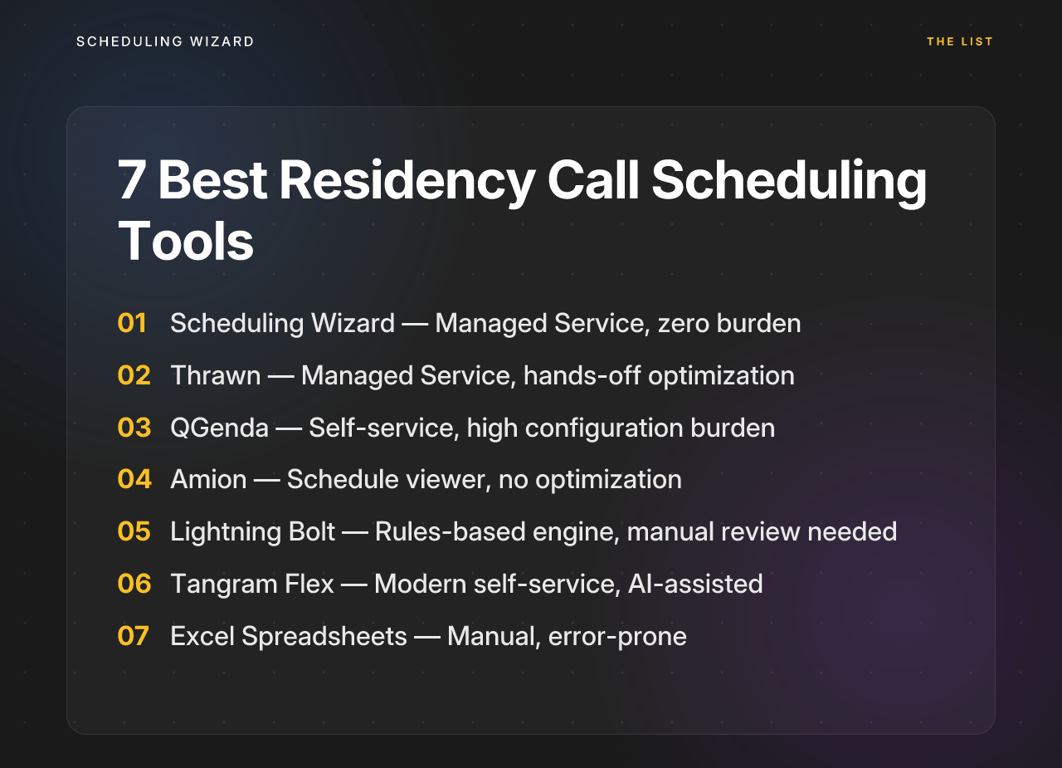
The 7 Best Tools for Residency Call Schedule Fairness and Optimization
These tools range from fully managed services that eliminate the chief resident's workload to self-service software that requires significant manual configuration.
1. Scheduling Wizard
- Type: Managed Scheduling Service
- Best For: Residency and fellowship programs that want to eliminate the administrative burden of schedule creation entirely and help institutional scheduling knowledge persist across annual chief rotations.
Scheduling Wizard is the only tool on this list that operates as a done-for-you managed service rather than software you operate yourself. The distinction is fundamental: instead of logging into a platform and manually building your call schedule, you submit your constraints. These include vacation requests, rotation rules, resident preferences, clinic dates, and coverage requirements. You then receive a complete, optimized schedule delivered as a ready-to-use Excel file.
- Fairness & Optimization: Scheduling Wizard uses a proprietary mathematical optimization engine built specifically for Graduate Medical Education (GME) scheduling. Fairness isn't an afterthought you tune manually; it's a core constraint baked into the generation process. The engine handles Block, Clinic, Call, and Attending schedules simultaneously, resolving cross-schedule dependencies that would take a human chief dozens of hours to untangle.
- ACGME Compliance: Compliance with ACGME duty hour rules, including subspecialty-specific requirements, is mathematically enforced during schedule generation, not flagged after the fact. You don't manually verify compliance; the engine is designed to produce a compliant schedule.
- Implementation Burden: None. The chief resident's role shifts from schedule builder to schedule reviewer. There's no software to learn, no rules engine to configure, and no annual knowledge loss when the chief rotates out. Scheduling logic persists year over year.
- Cost: Program-level pricing based on size and needs. Contact Scheduling Wizard for a quote.
An important nuance: Scheduling Wizard is not an either/or replacement for Amion or QGenda. Many programs use Scheduling Wizard to create the optimized schedule, then upload the finished Excel file into their existing Amion or QGenda platform for daily viewing, swap management, and resident access. The two functions complement each other perfectly.
2. Thrawn
- Type: Managed Scheduling Service
- Best For: Programs seeking a hands-off, done-for-you scheduling solution designed for fairness and ACGME compliance through advanced optimization.
Thrawn is a managed scheduling service that acts as a powerful alternative for programs looking for a completely hands-off approach. Programs submit their rules, requests, and constraints, and Thrawn's team uses a powerful optimization engine to build the final block, call, and clinic schedules. This model is ideal for programs that want the benefits of mathematical optimization without any internal software burden.
- Fairness & Optimization: Thrawn uses a sophisticated optimization engine to build schedules that are not only conflict-free but also mathematically fair. It handles complex variables like weighted shift distributions and call equity from the start, creating a balanced schedule without manual adjustments.
- ACGME Compliance: All ACGME duty hour rules are enforced by the engine during schedule creation. This model is designed to provide compliance, shifting the responsibility from the chief resident to the service.
- Implementation Burden: None. Because it is a "done-for-you" service, there is no software to learn or configure. The program simply provides its requirements and reviews the finished schedule.
- Cost: Contact for pricing.
3. QGenda
- Type: Self-Service Enterprise Software
- Best For: Large health systems with dedicated administrative staff who have the time and bandwidth to manage significant configuration overhead.
QGenda is one of the most widely deployed scheduling platforms in academic medicine. It's comprehensive, feature-rich, and deeply integrated into many hospital workflows. But it's important to understand what it actually does: QGenda is a rules-based scheduling platform, not a mathematical optimizer. You build the rules, you configure the constraints, and the platform helps you manage the result, but the schedule is still, fundamentally, built by a human.
- Fairness & Optimization: No true mathematical optimization. The platform surfaces rule violations and can enforce constraints you've manually configured, but it will not automatically generate a globally fair schedule. How equitable your call distribution is depends entirely on how much time and skill you invest in building it.
- ACGME Compliance: User-managed. QGenda can be configured to flag potential ACGME duty hour violations, but building, maintaining, and verifying those rules is the program's responsibility. If your rules are misconfigured, violations slip through.
- Implementation Burden: High. QGenda has a steep learning curve that's mismatched with the one-year tenure of most chief residents. Significant upfront configuration and ongoing operational maintenance are required.
- Cost: Enterprise-level licensing. Contact the vendor for a quote.
4. Amion
- Type: Schedule Viewer & Basic Manual Editor
- Best For: Programs looking for a simple, affordable way to publish and display a schedule that has already been created through another process.
Amion is the most commonly referenced tool in residency forums, and it's widely beloved for what it is: an easy way for residents to check their schedule, see who's on call, and manage swaps. The confusion arises when programs assume Amion also solves the schedule creation problem.
- Fairness & Optimization: None. Amion is a digital calendar. It has no generative or optimization engine. Whatever fairness (or unfairness) exists in your call schedule is determined entirely by the manual process you used to build it beforehand, using a spreadsheet, institution-specific logic, or years of institutional tradition.
- ACGME Compliance: None built in. The program is 100% responsible for verifying that the schedule it publishes meets all duty hour requirements. Amion will display whatever you upload.
- Implementation Burden: Very high for schedule creation, as Amion provides no help there whatsoever. Publishing the schedule is easy, but the hundreds of hours of counting shifts, managing time-off requests, and fine-tuning call pool distributions still fall entirely on the chief. One forum contributor noted there are ways to export from Amion into a pivot table for more accurate shift counting, but that's a workaround, not a solution.
- Cost: Free tier available; paid tiers add more features.

5. Lightning Bolt (by PerfectServe)
- Type: Self-Service Software with a Rules-Based Engine
- Best For: Larger departments that want a more sophisticated self-service tool than Amion and are willing to invest in configuration to get schedule suggestions.
Lightning Bolt sits a step above purely manual tools by using a rules-based engine that can suggest assignments based on pre-configured constraints. It's a meaningful improvement over a blank spreadsheet, but it's not a global optimizer.
-
Fairness & Optimization: The system can produce workable draft schedules based on your rules, but significant manual review and fine-tuning are typically required to achieve a truly fair and clinically sound final schedule. The engine doesn't optimize globally; it satisfies constraints locally.
-
ACGME Compliance: Semi-automated. Lightning Bolt can check against user-defined rules, but the final compliance verification is still the user's responsibility after reviewing the output.
-
Implementation Burden: Moderate to high. The chief resident must learn the platform, carefully define all rules and preferences, and invest ongoing time in managing schedule outputs. The operational burden doesn't disappear; it's just partially assisted.
-
Cost: Contact the vendor for pricing.
-
Type: Modern Self-Service Software
-
Best For: Chief residents who want a more modern, intuitive interface than legacy enterprise systems and are willing to invest the time to build the schedule themselves.
Tangram Flex (and similar newer entrants to the space) represents a newer generation of self-service scheduling tools built with a cleaner UX. The interface is less intimidating than QGenda, and AI-assisted placement features can reduce some of the manual lift.
-
Fairness & Optimization: Offers AI-assisted scheduling features that can help with assignment placement, but the core responsibility for achieving fair distribution still rests with the user. The tool augments the chief's work; it doesn't replace it.
-
ACGME Compliance: Includes integrated duty hour tracking and can flag potential violations. Like all self-service tools, however, it's a verification mechanism, not a guarantee of compliance from the start.
-
Implementation Burden: Moderate. The modern UI reduces the learning curve compared to legacy enterprise systems. However, it does not eliminate the fundamental workload of schedule creation, ongoing management, and annual onboarding as chiefs rotate.
-
Cost: Visit their website for current pricing.
-
Type: Manual Tool
-
Best For: Very small, simple programs with minimal scheduling complexity, and a chief resident with both the time and the appetite for manual, error-prone work.
The spreadsheet approach is what most programs default to when they haven't yet adopted dedicated software. It's also the source of nearly every scheduling horror story you'll find on Reddit.
- Fairness & Optimization: Entirely manual. You are the optimization engine. This means endless shift-counting, complex pivot table logic, and the constant anxiety that, as one resident puts it, “at any given point in the year it won’t be perfectly even.” Managing vacation-forced Q2 call stretches, golden weekend equity, and intern-versus-senior pool distributions by hand is exactly as painful as it sounds.
- ACGME Compliance: None. The chief resident is solely responsible for manually tracking every duty hour rule, a process that is high-risk and highly error-prone. This is a primary driver of non-compliant schedules in residency programs.
- Implementation Burden: Extreme. The chief resident is the scheduling system. Hundreds of hours are spent per year, institutional knowledge is wiped clean with every chief transition, and there is zero scalability as program complexity grows.
- Cost: Technically free, but expensive in resident time, morale cost, and compliance risk.
The Two Jobs You're Actually Hiring For
There are two fundamentally different jobs in residency scheduling, and conflating them leads to choosing the wrong tool entirely:
- Schedule Creation & Optimization. This is the complex, mathematical task of building a fair, conflict-free, and ACGME-compliant schedule from scratch. This is where residency call schedule fairness is mathematically determined. It involves constraint-solving, weighted distribution logic, duty hour enforcement, and global optimization across every resident, rotation, and coverage requirement simultaneously.
- Schedule Viewing & Display. This is the day-to-day job of publishing a finished schedule so residents can see their assignments, check who's on call, and request swaps.
The critical distinction most buyers miss is that Amion and QGenda are primarily schedule viewers. They are excellent at the second job. But many programs assume these tools also solve the first job, schedule creation and fairness optimization, which they don't do in any mathematically rigorous way. The chief resident still has to manually build the schedule before publishing it.
This distinction matters enormously. A study in Neurosurgery found that using a mathematically optimized scheduling system reduced call variation by 70% and improved residents' perception of schedule fairness from 43% to 95%. That's the difference between building a schedule manually and letting a true optimization engine do it.
Summary: A Side-by-Side Comparison
| Tool | Type | ACGME Compliance Method | Chief Resident Burden |
|---|---|---|---|
| Scheduling Wizard | Managed Service | Mathematically Enforced | None |
| Thrawn | Managed Service | Mathematically Enforced | None |
| QGenda | Self-Service Software | User-Managed Rules & Flags | High |
| Amion | Schedule Viewer | None (Manual Verification) | Very High |
| Lightning Bolt | Self-Service Software | Semi-Automated Rules & Flags | Moderate to High |
| Tangram Flex | Self-Service Software | Integrated Duty Hour Tracking | Moderate |
| Excel Spreadsheets | Manual | None (Manual Verification) | Extreme |

Are You a Schedule Builder or a Schedule Reviewer?
The most important question to answer before choosing a tool isn't "which software has the best interface?" It's: what job are you actually hiring this tool to do?
If you need help publishing and displaying a schedule, and you're comfortable building it yourself, Amion and QGenda are proven, widely-used solutions. They do that job well.
But if your goal is true residency call schedule fairness, mathematically sound and not just manually approximated, you need a tool built specifically for schedule creation and optimization. Every self-service option on this list places the burden of fairness squarely on the person operating the software. The tool's sophistication only goes as far as your ability (and available time) to configure it.
A managed service changes the equation entirely. Instead of spending weeks counting shifts, fine-tuning call pools, and manually verifying ACGME compliance, you spend a few hours reviewing a finished schedule that was built to be fair from the ground up. When the next chief steps in, the scheduling logic doesn't vanish with the outgoing one; it persists.
If your program is ready to eliminate the scheduling burden, provide fairness for your residents, and get ironclad ACGME compliance without becoming a scheduling software expert, learn more about how Scheduling Wizard's managed service works.
Frequently Asked Questions
How is Scheduling Wizard different from Amion or QGenda?
Scheduling Wizard is a managed service that creates and optimizes fair, compliant schedules for you, while tools like Amion and QGenda are primarily software platforms for viewing and displaying a schedule you have already built. Scheduling Wizard handles the complex, mathematical job of schedule creation, delivering a finished Excel file. You then upload that file into your existing Amion or QGenda platform for day-to-day resident access, viewing, and swap management.
How does Scheduling Wizard guarantee ACGME compliance?
Scheduling Wizard mathematically enforces all ACGME duty hour rules during the schedule generation process, guaranteeing a fully compliant schedule from the start. Unlike self-service software that only flags potential violations after the schedule is built, our optimization engine treats compliance rules as hard constraints that cannot be broken. This shifts the burden of compliance from the chief resident to our system.
Can you handle the specific ACGME rules for my subspecialty?
Yes, our optimization engine is configured to handle the specific and nuanced duty hour requirements for virtually every medical and surgical subspecialty. During onboarding, we incorporate all your program-specific constraints, including complex rules around things like home call, 1-in-3 call frequency, and post-call day requirements, so they are mathematically enforced.
How will the 2026 ACGME rule changes affect our scheduling?
The 2026 ACGME revisions, particularly counting at-home call towards the 80-hour weekly maximum and imposing a 24-hour hard cap on continuous work, will significantly complicate manual scheduling. Many programs will find their current call structures are no longer compliant. An optimization engine like Scheduling Wizard can model these new constraints to build compliant schedules that would be extremely difficult and time-consuming to create manually, protecting your program from violations.
Do we have to stop using Amion to use Scheduling Wizard?
No, you do not need to replace your current scheduling platform. Scheduling Wizard works alongside tools like Amion and QGenda by complementing their function. We handle the difficult creation phase, and you use your existing platform for the display phase. The final, optimized schedule is delivered as a standard spreadsheet that can be easily uploaded into any viewing platform your residents already use.
What does "managed service" mean for the chief resident?
A managed service means the chief resident's role shifts from being a schedule builder to a schedule reviewer. Instead of spending hundreds of hours learning software and manually building the schedule, you simply provide your program's inputs—like vacation requests, rotation rules, and coverage needs. We then use our optimization engine to build the schedule and deliver the finished product to you, eliminating the administrative burden and helping scheduling knowledge persist year after year.