
Summary
- Choosing the right residency scheduling model (like 4+1, X+Y, or Hybrid) is critical, as it directly impacts resident burnout, ACGME compliance, and patient care continuity.
- Models with long inpatient rotations (like 4+4 or Block-Only) increase fatigue and compliance risks, while X+Y variants offer greater flexibility and work-life balance.
- The biggest challenge isn't selecting a model, but executing it flawlessly year after year—a complex task that often falls on chief residents with limited time.
- To overcome implementation complexity, programs can use a managed service like Scheduling Wizard to deliver complete, optimized, and ACGME-compliant schedules.
The scheduling model your internal medicine residency program adopts is not a minor administrative detail. It is one of the most consequential structural decisions your program makes — one that ripples directly into ACGME compliance, resident burnout, and the continuity of care your patients receive. Yet, when asked why they chose their current model, many program directors will admit, with some candor, that a neighboring institution was doing it and it seemed to work well enough.
"Seemed to work" is not a strategy. Residents on r/medicalschool openly describe the downstream consequences of mismatched scheduling models: long continuous inpatient rotations that lead to exhaustion, little time for personal life, and concerns about whether their format even allows adequate exposure to electives and subspecialties. On r/Residency, the sentiment echoes: "We rarely are able to get out on time. It's usually 9–6 or even later." These are not isolated complaints — they are symptoms of a structural mismatch between a scheduling model and the realities of the program running it.
This article breaks down seven common internal medicine residency scheduling models with a structured comparison of each — covering inpatient/outpatient balance, night float implications, vacation planning flexibility, and ACGME compliance fit — so program directors and chief residents can make an informed, evidence-grounded decision rather than an inherited one.
1. The 4+1 Model
Structure: Four weeks of inpatient (or other non-ambulatory rotations such as ICU or electives) followed by one dedicated week of outpatient continuity clinic. This cycle repeats throughout the academic year.
Pros:
- Enhances outpatient continuity of care and significantly reduces the tension between inpatient responsibilities and clinic attendance (PMC4477545)
- Creates a predictable, structured rhythm that can reduce burnout by giving residents a regular, lower-intensity week
- Outpatient weeks allow focused, uninterrupted time with the resident's own patient panel
Cons:
- Residents may feel a sense of disconnection from their inpatient team upon rotating back after the ambulatory week
- If the "1" week is not fully protected, it can easily be eroded by inpatient demands, defeating the model's purpose
| Criterion | Detail |
|---|---|
| Inpatient/Outpatient Balance | Balanced; 4 weeks inpatient to 1 week outpatient |
| Night Float | Typically requires a dedicated night float system |
| Vacation Flexibility | High — the +1 week can be leveraged for vacation |
| ACGME Compliance Fit | Excellent; clear duty boundary separation |
2. The 4+2 Model
Structure: Four weeks of inpatient or core rotations followed by a two-week ambulatory block. The two outpatient weeks are dedicated to continuity clinic, subspecialty clinics, and other ambulatory experiences.
Pros:
- Provides more concentrated outpatient exposure per cycle, improving skill retention and supporting more in-depth ambulatory projects (PMC4477545)
- The two-week block offers meaningful flexibility for scheduling subspecialty clinics
Cons:
- Net inpatient time is reduced compared to 4+1, which some programs view as a training trade-off
- Longer gaps from inpatient medicine can make transitions back to ward medicine feel abrupt
| Criterion | Detail |
|---|---|
| Inpatient/Outpatient Balance | Strong outpatient continuity; slightly less total inpatient time |
| Night Float | Typically requires night float during inpatient blocks |
| Vacation Flexibility | Moderate to High — the 2-week block is a natural vacation window |
| ACGME Compliance Fit | Good; structured and trackable |
3. The 4+4 Model
Structure: The year is divided into larger chunks — typically two consecutive 4-week inpatient rotations followed by extended outpatient or elective time. Some programs implement this as 4 months inpatient, 4 months outpatient.
Pros:
- Allows for deep clinical immersion in each setting (PMC4477545)
- Clear separation of inpatient and outpatient duties is easy to communicate to residents and faculty
Cons:
- Extended consecutive inpatient stretches are a primary driver of resident fatigue — exactly what residents describe as "long continuous inpatient rotations that lead to exhaustion"
- Scheduling flexibility is severely limited; vacation requests are difficult to accommodate (PMC3010937)
| Criterion | Detail |
|---|---|
| Inpatient/Outpatient Balance | Can feel imbalanced during inpatient stretches |
| Night Float | May rely on traditional call structures, increasing fatigue risk |
| Vacation Flexibility | Low — rigid long blocks constrain personal time |
| ACGME Compliance Fit | Risky; high potential for duty hour violations (PMC3010937) |
4. X+Y Variants
Structure: A flexible framework where 'X' weeks of inpatient or core rotations are followed by 'Y' weeks of ambulatory experience. The 4+1 and 4+2 models are technically X+Y variants. Other common configurations include 6+2 and 3+1. The Shalaby 2014 paper on X+Y scheduling established the foundational evidence for this framework, demonstrating that dedicated ambulatory blocks improve outpatient continuity without sacrificing inpatient educational quality.
Pros:
- Highly customizable to the specific educational and operational goals of a given program
- Regular 'Y' blocks create predictable protected time, which improves work-life balance and facilitates vacation planning
- Can be iteratively adjusted as program needs evolve
Cons:
- The primary risk is complexity: a poorly calibrated X+Y (e.g., too-long 'X' blocks) can introduce burnout and coverage gaps
- Variability across residency classes can create confusion if not clearly communicated
| Criterion | Detail |
|---|---|
| Inpatient/Outpatient Balance | Highly adaptive; determined by chosen X and Y values |
| Night Float | Adjustable based on 'X' block length; most variants require night float |
| Vacation Flexibility | High — frequent 'Y' blocks create natural scheduling windows |
| ACGME Compliance Fit | Good with careful monitoring |
5. The 2+2+2 Model
Structure: A rotational model built around 2-week (or 2-month) blocks cycling through distinct clinical settings — commonly inpatient wards, ICU, and outpatient medicine. The intent is broad, frequent exposure across core training environments.
Pros:
- Shorter blocks prevent the deep-seated fatigue associated with extended single-setting rotations
- Residents gain broad, rapid exposure to different clinical contexts, which can enhance adaptability and breadth of training
Cons:
- Continuity of care suffers — it is genuinely difficult to build a meaningful patient relationship or outpatient panel in two-week increments (PMC4477545)
- High transition frequency creates more scheduling complexity and can generate a sense of instability for residents
| Criterion | Detail |
|---|---|
| Inpatient/Outpatient Balance | Broad exposure in short, frequent bursts |
| Night Float | Complex to staff; high transition frequency increases coverage demands |
| Vacation Flexibility | Moderate to High — frequent transition points allow some flexibility |
| ACGME Compliance Fit | Moderate; frequent changes require diligent tracking |
6. The Block-Only Model (Traditional Block Schedule)
Structure: The "classic" configuration — residents complete rotations in 4-week blocks sequentially (Wards → ICU → Cardiology → Nephrology, etc.). Outpatient continuity clinic is typically squeezed in as a half-day per week alongside inpatient duties, rather than as a protected block.
Pros:
- Intensive immersion in each specialty area supports deep, focused skill development (PMC4477545)
- Administratively familiar and relatively straightforward to structure on paper
Cons:
- The half-day clinic model creates persistent, unresolved conflict between inpatient responsibilities and outpatient commitments — residents are often pulled from clinic to handle ward issues
- Traditional call structures (q4 nights) in this model are a major driver of the burnout residents describe when they say they "rarely get out on time"
- Limited subspecialty elective access, since the block calendar fills quickly with required rotations
| Criterion | Detail |
|---|---|
| Inpatient/Outpatient Balance | Heavily inpatient-focused; outpatient care is fragmented |
| Night Float | Variable; traditional call structures are common and fatiguing |
| Vacation Flexibility | Low — few natural break points outside elective/research months |
| ACGME Compliance Fit | Risky without meticulous management (PMC3010937) |
7. The Hybrid Model
Structure: A blended approach that draws from multiple models simultaneously. Common examples include running a 4+1 structure for PGY-1s while PGY-3s follow a more elective-flexible block format, or combining a core block schedule with dedicated protected ambulatory weeks for specific training requirements.
Pros:
- Offers the highest degree of customization — programs can optimize for educational goals at each PGY level (PMC4477545)
- Can mitigate the specific weaknesses of any single model by layering in compensating structures
Cons:
- The most complex model to design, implement, and sustain — scheduling knowledge must be deeply institutional and carefully documented
- Risk of unintentional inequity if different resident cohorts perceive the blended model as inconsistent or unfair
| Criterion | Detail |
|---|---|
| Inpatient/Outpatient Balance | Variable; tailored to program and PGY level |
| Night Float | Highly variable and dependent on component structure |
| Vacation Flexibility | Varies by design; can be built in with intentionality |
| ACGME Compliance Fit | Fair to Good — requires expert-level constraint management |
At-a-Glance Comparison Table
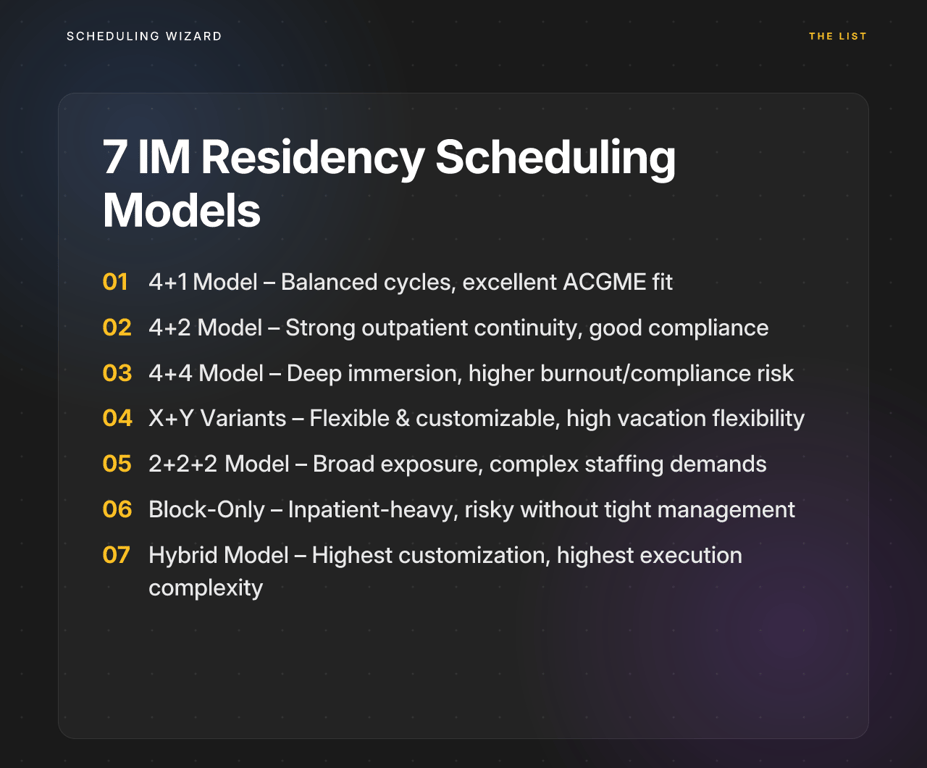
| Model | Inpatient/Outpatient Balance | Night Float | Vacation Flexibility | ACGME Compliance Fit |
|---|---|---|---|---|
| 4+1 | Balanced; 4 wks in / 1 wk out | Requires dedicated night float | High | Excellent |
| 4+2 | Balanced; strong outpatient continuity | Requires night float | Moderate–High | Good |
| 4+4 | Long inpatient stretches; risk of imbalance | Can use intense call schedules | Low | Risky |
| X+Y Variants | Adaptive; customizable | Adjustable by 'X' length | High | Good (with monitoring) |
| 2+2+2 | Broad exposure in short cycles | High-demand; complex staffing | Moderate–High | Moderate |
| Block-Only | Inpatient-heavy; outpatient fragmented | Variable; often fatiguing call | Low | Risky |
| Hybrid | Variable; designed to program goals | Variable and complex | Varies by design | Fair–Good |
Data synthesized from PMC9621718, PMC4477545, and PMC3010937.
The Hidden Cost: Implementation Complexity
Selecting a model from the table above is the easy part. The hard part is executing it — and this is where most programs quietly struggle.
Building an internal medicine residency schedule means simultaneously satisfying ACGME duty hour rules, night float coverage requirements, clinic continuity obligations, vacation requests, program-specific rotation minimums, and individual resident constraints. It is not a spreadsheet problem. It is a constraint-satisfaction problem — and it tends to land on the desk of a chief resident who has between 10 and 15 hours per quarter, per their own accounts, to figure it out. As one program administrator put it, "There are just so many exceptions and peculiarities of any given rotation" that no general template survives contact with the actual schedule.
The fragility of manual schedules shows up downstream. Residents report that last-minute rotation changes create cascading conflicts — not just professionally, but personally. They feel pressured to accommodate changes that compromise their personal commitments and mental health, which compounds the burnout the model was supposed to reduce in the first place.
For programs running a Hybrid or X+Y variant model, this complexity multiplies. Every additional constraint layer — cross-year dependencies, PGY-level differentiation, subspecialty clinic coordination — increases the probability of a scheduling error that either breaks ACGME compliance or leaves a coverage gap.
This is the hidden cost of any scheduling model: not the design, but the annual execution, revision, and re-execution by people who were not trained to be scheduling engineers.

From Model Selection to Flawless Execution
Choosing the right internal medicine residency scheduling model matters. But the residents' experience — and your ACGME compliance posture — is ultimately determined by how well the chosen model is implemented, year after year, across chief resident transitions.
This is where managed scheduling services become a powerful solution, offloading the complexity of execution. Instead of buying software and training chief residents to use it year after year, a managed service handles the entire process for you. Here are two top options:
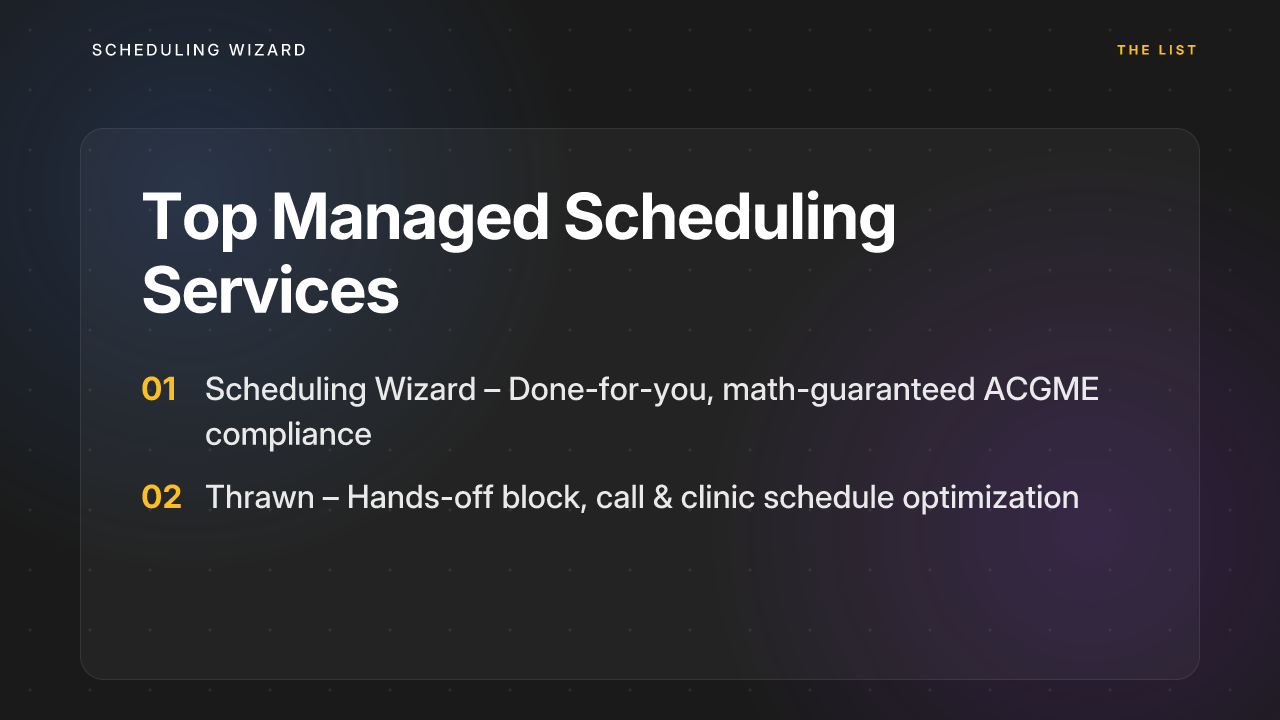
1. Scheduling Wizard
Scheduling Wizard operates as a done-for-you managed service. Programs submit their chosen model, rotation requirements, vacation requests, duty hour rules, and any custom constraints. Its proprietary mathematical optimization engine resolves all conflicts and delivers a complete, optimized, ACGME-compliant schedule as a ready-to-use Excel file — which can be uploaded directly to your existing viewing tools like Amion or QGenda.
ACGME compliance is not manually checked after the fact; it is mathematically guaranteed at the point of schedule generation. Night float fairness, outpatient continuity protection, cross-rotation dependencies — all handled. The chief resident gets their time back, and the institutional scheduling knowledge persists across annual leadership transitions.
2. Thrawn
For programs seeking another strong hands-off scheduling solution, Thrawn is a powerful alternative. It operates on a similar done-for-you model, specializing in creating block, call, and clinic schedules. Programs submit their constraints and receive a finished, ACGME-compliant schedule built with advanced optimization. It's a leading choice for programs that want to entirely outsource the complexity of schedule creation and receive a perfected calendar in return.
Whether your program runs a straightforward 4+1, a carefully tuned X+Y variant, or a multi-year Hybrid model, the execution complexity is the same: significant. If you're ready to stop renegotiating your schedule every quarter, visit schedulingwiz.com to see how the done-for-you model works.

Frequently Asked Questions
What is the best internal medicine residency scheduling model?
There is no single "best" model; the ideal choice depends on your program's specific goals for inpatient/outpatient balance, resident well-being, and educational continuity. X+Y variants like the 4+1 model are often favored for their balance and flexibility, which helps reduce burnout and improve ACGME compliance. However, the most critical factor is not the model itself, but its flawless implementation year after year.
How do X+Y scheduling models help with ACGME compliance?
X+Y models improve ACGME compliance by creating clear separations between high-intensity inpatient rotations and lower-intensity outpatient blocks. This structure makes it easier to track and enforce duty hour rules, prevent fatigue from long consecutive inpatient stretches, and ensure residents get their required days off. By creating predictable 'Y' blocks, programs can avoid the scheduling conflicts that often lead to violations.
Does Scheduling Wizard replace tools like Amion or QGenda?
No, Scheduling Wizard works alongside tools like Amion and QGenda, not as a replacement. It is a managed service that focuses on creating the complex annual block, call, and clinic schedule. We deliver a finished, optimized schedule as an Excel file, which you can then upload directly into your existing day-to-day viewing platform.
How does Scheduling Wizard handle ACGME rules for different subspecialties?
Scheduling Wizard's optimization engine is configured with the specific ACGME Common and Specialty-Specific Program Requirements for your residency or fellowship. Whether for Internal Medicine, Cardiology, or Anesthesiology, we incorporate your subspecialty's unique rules for duty hours, days off, and procedural minimums directly into the scheduling constraints, ensuring the final schedule is mathematically guaranteed to be compliant.
How will the 2026 ACGME rule changes affect our residency schedule?
The 2026 ACGME rule changes, which count at-home call toward the 80-hour weekly limit and enforce a 24-hour hard cap on continuous work, will require most programs to fundamentally redesign their call and night float systems. Models that rely heavily on traditional call structures (like the Block-Only model) will become much harder to manage without causing duty hour violations. Programs will need to be more strategic in distributing call duties and may need to shift toward models with dedicated night float systems to remain compliant.
Why is manual scheduling so difficult for chief residents?
Manual scheduling is difficult because it is a complex constraint-satisfaction problem with hundreds of competing variables—a task that chief residents are not trained for and have limited time to complete. They must simultaneously balance ACGME rules, individual vacation requests, rotation requirements, clinic continuity, and last-minute changes. A single error can create a cascade of compliance violations or coverage gaps, making it a significant source of administrative burnout.
What is a "managed scheduling service" and how does it work?
A managed scheduling service is a "done-for-you" solution where experts build your entire schedule for you, eliminating the need to learn complex software or manage the process internally. With a service like Scheduling Wizard, you provide your program's requirements, constraints, and requests. We use a powerful optimization engine to solve all scheduling conflicts and deliver a complete, compliant, and ready-to-use schedule, saving hundreds of administrative hours.