Summary
- Manual residency scheduling with spreadsheets is labor-intensive, error-prone, and creates significant ACGME compliance risks.
- The loss of institutional scheduling knowledge with each chief resident rotation is a major structural problem for GME programs.
- The market offers two primary solutions: self-service software you operate yourself, and managed services that deliver a finished schedule for you.
- Managed services report time savings of up to 95% and can significantly improve resident perception of scheduling fairness.
- For programs that want to eliminate the administrative burden, a managed service like Scheduling Wizard delivers finished, ACGME-compliant schedules without requiring you to learn or operate any software.
You inherited the spreadsheet on July 1st. By July 3rd, you'd already discovered two conflicting rotations, a resident double-booked on overnight call, and a clinic block that somehow violated ACGME duty hour limits. Welcome to being chief resident.
It's a story program coordinators and chief residents across the country know by heart. "Creating residency schedules in Excel is laborious and frustrating." That's not a complaint from one burnt-out chief — it's the consensus. You're juggling dozens of residents across numerous rotations, tracking vacation requests, moonlighting, conference days, and subspecialty-specific ACGME rules, all while trying to make sure no one feels like they got stuck with every undesirable call shift.
And the stakes aren't just administrative. A single compliance slip — a missed duty hour limit, an untracked consecutive shift violation — can trigger an ACGME citation. The risk is real, and it falls squarely on whoever's holding the spreadsheet.
There's a deeper structural problem too: institutional scheduling knowledge walks out the door every June. A new chief resident inherits a broken system and has to reinvent the wheel, usually with minimal documentation and maximum pressure.
The good news: the residency scheduling software market has matured significantly. The better news: you have more than one type of solution to choose from.
Two Approaches to Solving the Scheduling Problem
Before reviewing the tools, it's worth understanding the fundamental fork in the road:
Self-Service Platforms — You purchase a software license, go through onboarding and training, and use the platform's tools to build and manage schedules yourself. You're the operator. The software gives you structure and rules, but the cognitive load of actually building the schedule remains yours.
Managed / Done-for-You Services — You provide your program's constraints (ACGME rules, rotation requirements, resident preferences, call structure), and an expert team or service builds the schedule for you. Your role becomes reviewing and approving, not building.
The right choice depends on one question: Do you want to operate scheduling software, or do you want a finished, compliant schedule delivered to you?
With that frame in mind, here are the 9 best residency scheduling software tools and services for GME programs.
Managed / Done-for-You Scheduling Services
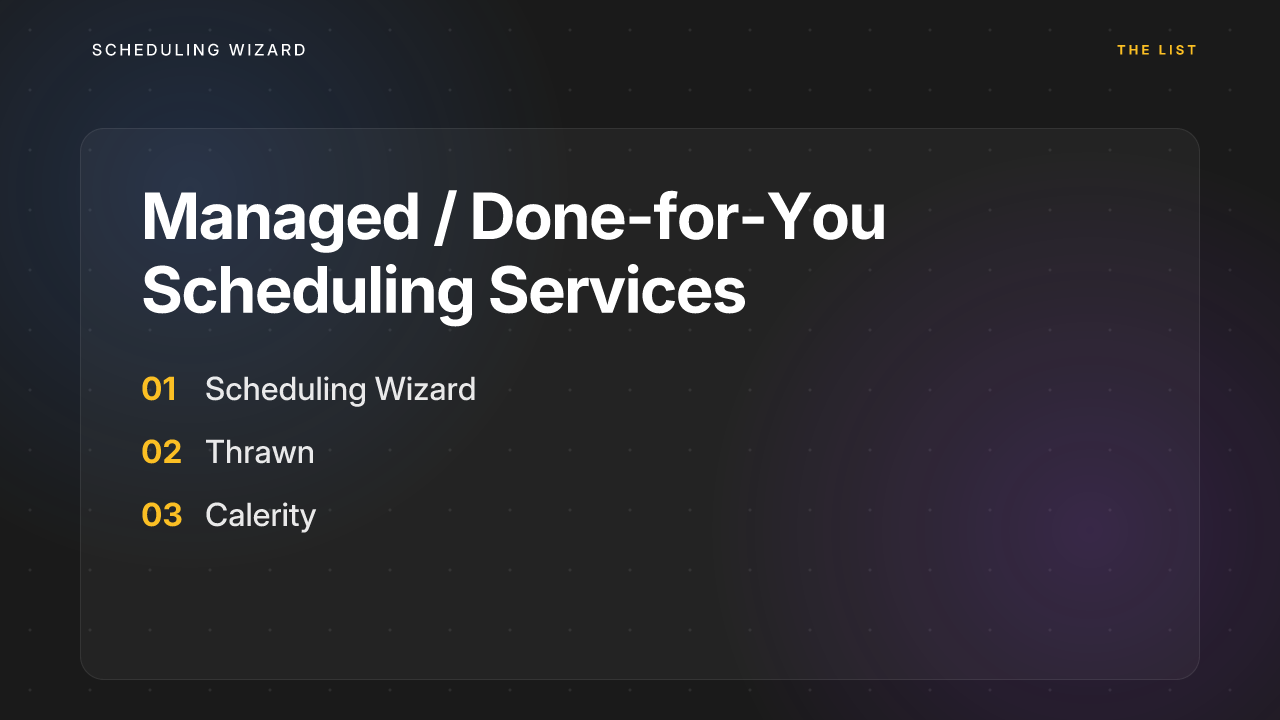
1. Scheduling Wizard
Best for: Residency and fellowship programs that want to completely eliminate the burden of schedule creation — no software to learn, no rule-building, no compliance chasing.
Scheduling Wizard is not a software platform — it's a managed scheduling automation service purpose-built for GME programs. You submit your program's constraints: rotations, call structure, clinic days, ACGME rules, resident preferences, vacation blocks. Scheduling Wizard's proprietary mathematical optimization engine takes it from there and delivers finished Block, Clinic, Call, and Attending schedules as ready-to-use Excel spreadsheets.
This is a fundamentally different model from every other tool on this list. There's no onboarding, no rule-writing interface to master, no implementation timeline. The schedule is built for you.
What makes it stand out:
- ACGME compliance is mathematically guaranteed, not manually checked after the fact. The engine is built with subspecialty-specific rules baked in — the #1 question programs ask during evaluations.
- Institutional continuity persists across chief rotations. When your chief graduates, the scheduling knowledge doesn't leave with them. The constraints live in the system, not in one person's head.
- Works alongside your existing tools. Scheduling Wizard creates the optimized schedule; you upload the Excel output directly to Amion or QGenda for day-to-day viewing. No disruptive system overhaul required.
- Fairness optimization is built in. Call distribution equity, vacation preference integration, and conflict-free cross-schedule dependency resolution are handled automatically.
- Rapid re-optimization for unplanned absences. When a resident calls out sick, the engine can rebuild the affected schedule quickly rather than forcing a manual scramble.
Scheduling Wizard is YC-backed (W26) and currently serves 18 departments across 13 hospitals. Programs pay roughly $6–7K/year — a fraction of what chief residents and coordinators spend in hours annually trying to build compliant schedules manually.
Who builds the schedule? They do.
2. Thrawn
Best for: Programs looking for a hands-off, done-for-you scheduling service that uses advanced optimization to guarantee ACGME compliance.
Thrawn is another leader in the managed scheduling space. Like Scheduling Wizard, it operates on a "done-for-you" model. Programs submit their unique constraints—block rotations, call assignments, clinic duties, and ACGME rules—and Thrawn's optimization engine builds the complete schedule. This model eliminates the need for program staff to learn new software or manage complex rule-building.
It's a strong alternative for programs that want to completely offload the cognitive burden of schedule creation. By focusing on a pure service model, Thrawn ensures that institutional knowledge is retained year after year, and compliance isn't just checked, but built into the schedule's foundation.
Who builds the schedule? They do.
3. Calerity
Best for: Programs looking for a managed service with an AI-assisted workflow and a dedicated human scheduling specialist.
Calerity operates on a similar done-for-you model, combining an automated scheduling engine with dedicated specialists who work directly with your program to build customized schedules. It's a collaborative service model rather than a pure automation play.
Calerity reports strong outcomes: programs using the platform have seen 95% time savings compared to traditional scheduling methods and a 20% improvement in residents' perception of scheduling fairness — a metric that matters enormously for program culture and retention.
The human-in-the-loop element can be valuable for programs with highly unusual or frequently changing constraints that benefit from a dedicated specialist relationship.
Who builds the schedule? They do, in partnership with your team.
👉 calerity.com/gme

Self-Service Scheduling Platforms
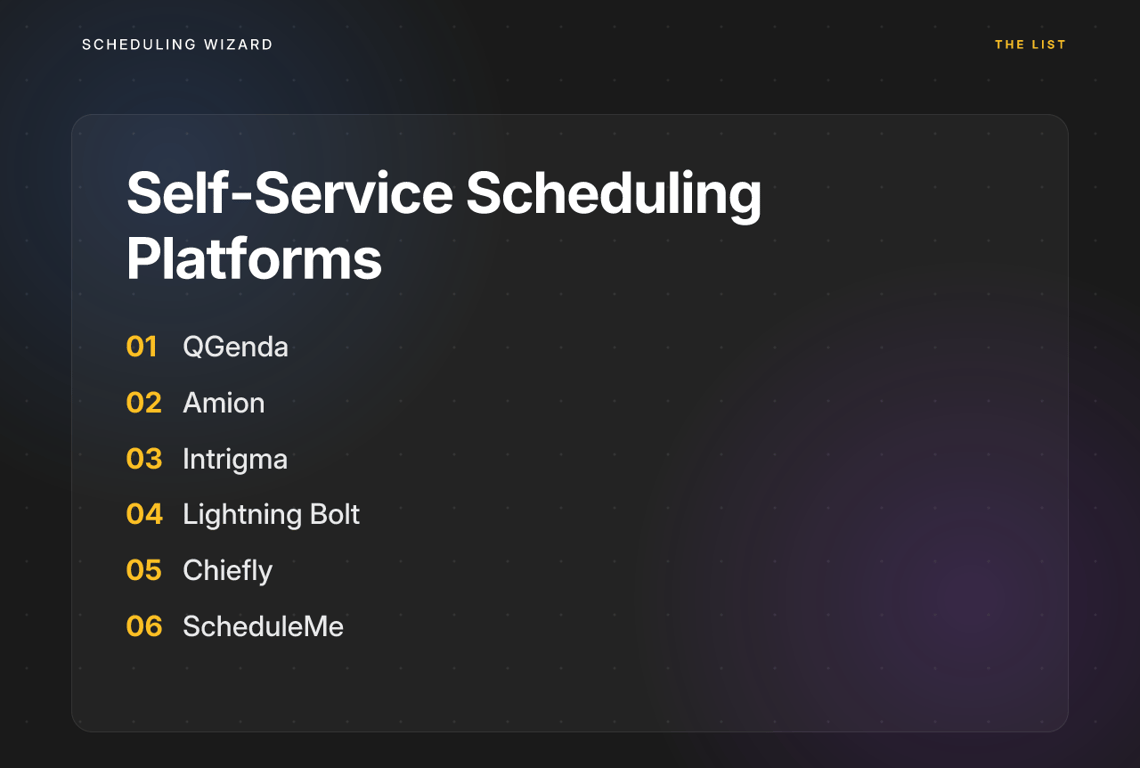
4. QGenda
Best for: Large health systems that need enterprise-grade scheduling with deep integration across departments, payroll, and HR systems.
QGenda is one of the most widely deployed physician scheduling platforms in the country. It offers a powerful, customizable rule engine for automated schedule generation, built-in ACGME compliance tracking, and robust integrations with calendars, payroll systems, and EHRs — making it a central scheduling hub for large organizations managing dozens of departments simultaneously.
The tradeoff is significant upfront investment. As one chief resident put it on Reddit: "QGenda is a TON of work upfront but then is basically set and forget after that." Implementation can take months, and building out the rule logic to handle your program's specific constraints requires dedicated time and often a trained administrator.
Pricing is also notoriously opaque. As users have noted, "the pricing seems to be super secret" — expect a sales call before you get a number.
For smaller, single-specialty programs, QGenda can feel like overkill. For large academic medical centers managing complex multi-department scheduling, it's a legitimate enterprise solution.
Who builds the schedule? You do.
👉 qgenda.com
5. Amion
Best for: Programs that need a simple, familiar, low-cost tool primarily for viewing and publishing on-call schedules.
Amion is ubiquitous in residency programs — most residents and attendings already know how to use it. It's a no-frills schedule viewing and simple editing platform that makes it easy to publish on-call schedules, allow residents to check their assignments, and facilitate manual swaps.
The honest limitation: Amion is primarily a display tool. It doesn't have a sophisticated engine for automated schedule generation or optimization. As residents note, "We used Amion. Being able to swap between ourselves was fine" — but the underlying schedule still has to be built somewhere else, usually in a spreadsheet or by importing from another system.
This is actually why many Scheduling Wizard clients use both: SW handles the complex schedule creation and optimization, then the output is uploaded to Amion for daily viewing and access. The two tools are complementary, not competitive.
Who builds the schedule? You do — Amion displays it.
👉 amion.com
6. Intrigma
Best for: Programs that want an all-in-one self-service platform with robust ACGME compliance logic, fairness tracking, and resident-facing tools.
Intrigma is one of the more comprehensive self-service platforms built specifically for GME environments. It includes built-in duty hour logic, real-time compliance tracking for audits, and an active fairness system that monitors the distribution of high-burden assignments (ICU blocks, overnight call, weekends) across residents over time.
Intrigma also gives residents direct access to set availability, submit preferences, and trade shifts — which helps reduce the administrative back-and-forth between chiefs and residents. The platform claims scheduling time reductions of 50–80% compared to manual methods.
The caveat: you're still the one operating the platform. Learning the rule-building interface and maintaining the configuration as your program evolves requires ongoing effort from a coordinator or chief.
Who builds the schedule? You do.
👉 intrigma.com/specialties/residency
7. Lightning Bolt
Best for: Programs that need detailed GME requirement tracking, reporting, and advanced algorithm-assisted shift scheduling for large residencies.
Lightning Bolt uses advanced scheduling algorithms and is particularly strong for complex, shift-based programs with large resident cohorts. Its GME-specific reporting features stand out — useful when you need to demonstrate compliance during program reviews or ACGME site visits.
The algorithms assist with building shift patterns, but the schedule still requires meaningful manual configuration and input. It's a tool that makes the process faster and more auditable, but doesn't remove the builder burden entirely.
Who builds the schedule? You do.
👉 lightningbolt.com
8. Chiefly
Best for: Chief residents who want a modern, purpose-built self-service interface designed for the way chiefs actually think about scheduling.
Chiefly is designed with user experience as a priority. The interface is cleaner and more intuitive than legacy platforms, and the setup process is built for speed — useful for a new chief who needs to get a schedule out fast and doesn't want to spend weeks learning enterprise software.
The honest limitation is the same as every other self-service tool: the cognitive burden of ensuring fairness, compliance, and conflict resolution still falls on you. A beautiful UI doesn't change who's responsible for catching the ACGME violation.
Who builds the schedule? You do.
👉 chiefly.com
9. ScheduleMe
Best for: Programs with straightforward scheduling needs that want a simple, drag-and-drop self-service tool with mobile access for residents.
ScheduleMe lowers the barrier to entry with an intuitive interface and mobile-friendly design. Residents can view schedules, submit requests, and make adjustments from their phones — a practical quality-of-life upgrade from a static spreadsheet emailed out once a month.
It's best suited for programs with less complex rotation structures. Programs managing intricate cross-department dependencies, subspecialty ACGME rules, and multi-type schedule coordination (block + call + clinic + attending) may quickly find the platform's capabilities stretched thin.
Who builds the schedule? You do.
👉 scheduleme.com
The Decision Matrix: Which Tool Is Right for Your Program?
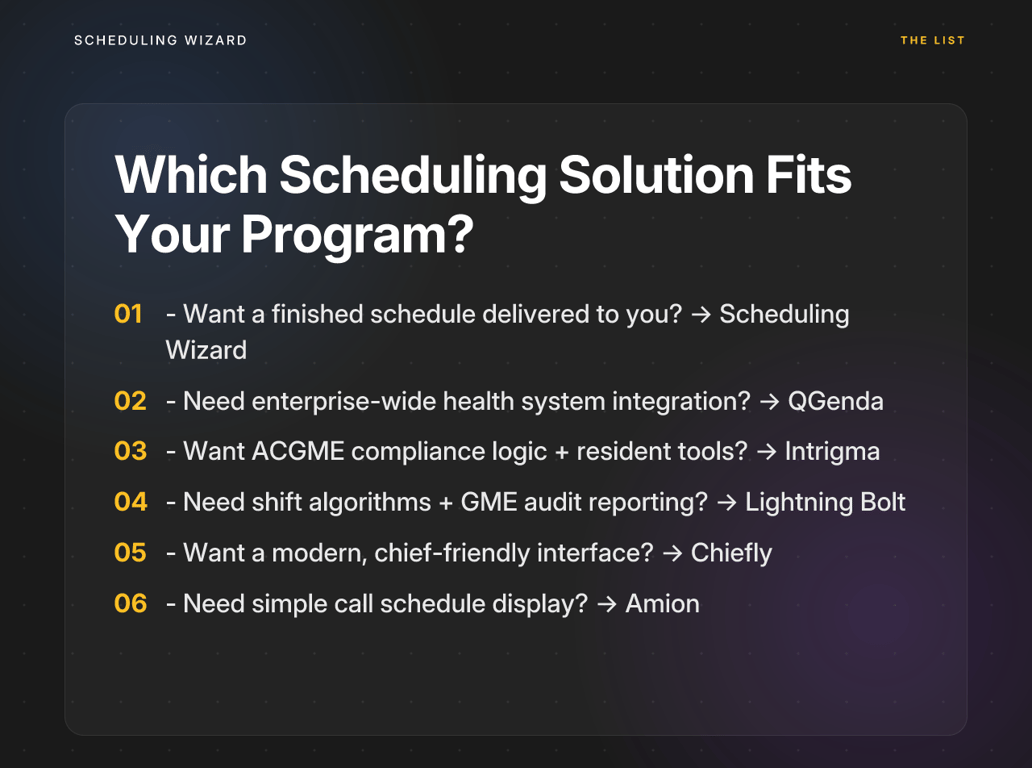
The choice between these residency scheduling software options isn't about feature counts — it's about where you want the responsibility to sit.
If you want to operate the software yourself:
- Need enterprise-wide integration across a large health system? → QGenda
- Want robust ACGME compliance logic and resident-facing tools in one platform? → Intrigma
- Need advanced shift algorithms and GME audit reporting? → Lightning Bolt
- Want a modern, chief-friendly interface with a fast setup? → Chiefly
- Just need a simple, familiar tool for displaying call schedules? → Amion
- Looking for mobile-friendly simplicity for straightforward programs? → ScheduleMe
If you want someone to build the schedule for you:
The choice is clear: Scheduling Wizard is the standout option. It's the only solution on this list where programs submit their constraints and receive finished, ACGME-compliant schedules — no software to learn, no rule-writing, no compliance chasing after the fact.
For chief residents, this means your role shifts from frustrated schedule builder to strategic reviewer. For program coordinators, it means the hours you spent reconciling Excel conflicts get redirected toward work that actually moves the program forward. And for programs with annual chief rotations, it means the institutional scheduling knowledge finally lives in a system — not in one person's memory.
If compliance is your #1 concern (and based on what programs tell us in discovery calls, it usually is), the difference between a tool that flags violations and a service that mathematically prevents them is not a small distinction.

The spreadsheet era of GME scheduling doesn't have to continue. The question is just which path out of it makes sense for your program.
👉 Ready to see what a finished schedule looks like? Learn more at schedulingwiz.com
Frequently Asked Questions
What is the difference between managed scheduling services and self-service software?
A managed scheduling service builds the entire schedule for you, while self-service software is a tool you operate yourself to build the schedule. With a managed service like Scheduling Wizard, you provide your program's rules and constraints, and you receive a finished, compliant schedule. With self-service platforms, you are responsible for learning the software, building the rules, and managing the schedule creation process internally.
How does Scheduling Wizard ensure ACGME compliance for my specific subspecialty?
Scheduling Wizard ensures ACGME compliance by mathematically building it into the schedule from the start, rather than just checking for errors after the fact. Our proprietary optimization engine incorporates all Core and subspecialty-specific ACGME requirements (e.g., for surgery, internal medicine, anesthesiology) before generating the schedule. This guarantees that the final output is violation-free.
Does Scheduling Wizard replace tools like Amion or QGenda?
No, Scheduling Wizard works alongside your existing tools like Amion and QGenda, not as a replacement. We handle the complex and time-consuming task of creating the optimized master schedule (Blocks, Calls, Clinics). We deliver this schedule as a simple Excel file, which you then upload directly into Amion or QGenda for daily viewing, publishing, and managing swaps.
How do you ensure scheduling is fair for all residents?
Fairness is a core component of our optimization engine. The system automatically balances the distribution of undesirable assignments like overnight calls, weekend shifts, and holiday coverage across all residents over the entire year. It also integrates individual preferences and vacation requests to create a schedule that is not only compliant but also perceived as equitable by the residents.
How will the 2026 ACGME rule changes affect residency scheduling?
The major 2026 ACGME revisions, including home call counting toward the 80-hour weekly limit and a new 24-hour hard cap on continuous work, will make manual scheduling significantly more complex. These changes increase the risk of accidental violations. A managed service like Scheduling Wizard can proactively incorporate these new rules into its engine, ensuring your program remains compliant without adding administrative burden on your staff.
How are last-minute schedule changes handled?
Last-minute changes, such as sick calls, can be managed quickly and efficiently. For simple swaps, your team can often handle them manually on your viewing platform (like Amion). For more complex disruptions that affect multiple assignments, Scheduling Wizard can rapidly re-optimize the schedule to find a compliant solution, saving your chief resident or coordinator from a stressful manual scramble to find coverage.
What is the process for getting started with Scheduling Wizard?
Getting started is simple and requires no software installation or training. The process begins with a discovery call where we collect all of your program's specific constraints: rotation requirements, call and clinic structures, ACGME rules, and resident requests. Our team then uses this information to build a fully optimized, compliant schedule and delivers it to you for review and approval.
Why can't we just use an Excel template for our schedule?
While many programs start with Excel, it is a manual, error-prone, and unsustainable solution. Spreadsheets cannot dynamically check for ACGME violations, ensure fair distribution of assignments, or easily adapt to changes, leading to hundreds of hours of administrative work. This manual process is a leading cause of burnout for chief residents and carries a constant risk of compliance citations that can put a program's accreditation in jeopardy.
How much time does a managed scheduling service save?
Programs using a managed service like Scheduling Wizard report saving up to 95% of the time previously spent on manual schedule creation. For a typical program, this frees up hundreds of hours per year for chief residents and program coordinators. This time can be redirected from tedious administrative tasks to higher-value activities like medical education, research, and improving resident well-being.
Frequently Asked Questions
What is the difference between managed scheduling services and self-service software?
A managed scheduling service builds the entire schedule for you, while self-service software is a tool you operate yourself to build the schedule. With a managed service like Scheduling Wizard, you provide your program's rules and constraints, and you receive a finished, compliant schedule. With self-service platforms, you are responsible for learning the software, building the rules, and managing the schedule creation process internally.
How does Scheduling Wizard ensure ACGME compliance for my specific subspecialty?
Scheduling Wizard ensures ACGME compliance by mathematically building it into the schedule from the start, rather than just checking for errors after the fact. Our proprietary optimization engine incorporates all Core and subspecialty-specific ACGME requirements (e.g., for surgery, internal medicine, anesthesiology) before generating the schedule. This guarantees that the final output is violation-free.
Does Scheduling Wizard replace tools like Amion or QGenda?
No, Scheduling Wizard works alongside your existing tools like Amion and QGenda, not as a replacement. We handle the complex and time-consuming task of creating the optimized master schedule (Blocks, Calls, Clinics). We deliver this schedule as a simple Excel file, which you then upload directly into Amion or QGenda for daily viewing, publishing, and managing swaps.
How do you ensure scheduling is fair for all residents?
Fairness is a core component of our optimization engine. The system automatically balances the distribution of undesirable assignments like overnight calls, weekend shifts, and holiday coverage across all residents over the entire year. It also integrates individual preferences and vacation requests to create a schedule that is not only compliant but also perceived as equitable by the residents.
How will the 2026 ACGME rule changes affect residency scheduling?
The major 2026 ACGME revisions, including home call counting toward the 80-hour weekly limit and a new 24-hour hard cap on continuous work, will make manual scheduling significantly more complex. These changes increase the risk of accidental violations. A managed service like Scheduling Wizard can proactively incorporate these new rules into its engine, ensuring your program remains compliant without adding administrative burden on your staff.
How are last-minute schedule changes handled?
Last-minute changes, such as sick calls, can be managed quickly and efficiently. For simple swaps, your team can often handle them manually on your viewing platform (like Amion). For more complex disruptions that affect multiple assignments, Scheduling Wizard can rapidly re-optimize the schedule to find a compliant solution, saving your chief resident or coordinator from a stressful manual scramble to find coverage.
What is the process for getting started with Scheduling Wizard?
Getting started is simple and requires no software installation or training. The process begins with a discovery call where we collect all of your program's specific constraints: rotation requirements, call and clinic structures, ACGME rules, and resident requests. Our team then uses this information to build a fully optimized, compliant schedule and delivers it to you for review and approval.
Why can't we just use an Excel template for our schedule?
While many programs start with Excel, it is a manual, error-prone, and unsustainable solution. Spreadsheets cannot dynamically check for ACGME violations, ensure fair distribution of assignments, or easily adapt to changes, leading to hundreds of hours of administrative work. This manual process is a leading cause of burnout for chief residents and carries a constant risk of compliance citations that can put a program's accreditation in jeopardy.
How much time does a managed scheduling service save?
Programs using a managed service like Scheduling Wizard report saving up to 95% of the time previously spent on manual schedule creation. For a typical program, this frees up hundreds of hours per year for chief residents and program coordinators. This time can be redirected from tedious administrative tasks to higher-value activities like medical education, research, and improving resident well-being.