Summary
- Specialty Rules Trump Common Rules: ACGME's universal duty hour rules are just a baseline; your specialty's specific Review Committee (RC) requirements for home call are what truly matter for compliance.
- Log All Home Call Hours: All time spent on patient care from home—including calls and chart reviews—counts toward the 80-hour weekly limit and is a common source of violations when unlogged.
- Avoid the "Averaging" Trap: Using a light week to average out three burnout-inducing weeks is a common pitfall that harms residents, even if technically compliant with ACGME rules.
- Automate Compliance and Fairness: A managed service like Scheduling Wizard can eliminate manual errors by building schedules with your specialty's specific ACGME rules mathematically enforced, ensuring compliance and fairness.
You set up a call schedule that looks airtight on paper. Then a resident flags something: their home call frequency this block might be pushing against the ACGME limit — but they're not sure, because their senior told them the rules are "specialty dependent." Sound familiar?
This is the lived reality for most program directors and chief residents. The ACGME Common Program Requirements establish a universal baseline for duty hours, but specialty Review Committees (RCs) layer on their own modifications — sometimes stricter, sometimes more flexible — and the average chief resident doesn't have time to cross-reference six different RC documents before building a call schedule.
This article cuts through that ambiguity. We'll start with the foundational ACGME duty hours home call rules that apply universally, then break down how each major specialty modifies them in practice, so you can scan your specialty and know exactly where you stand.
The Foundation: ACGME Common Program Requirements for Duty Hours
Before diving into specialty differences, it's worth anchoring on what the ACGME defines as duty hours: all time spent on clinical experience and education, including patient care (inpatient and outpatient), administrative tasks related to patient care, in-house call activities, and scheduled conferences. Time spent reading or preparing away from the clinical site is not counted.
At-home call (home call) is defined as time a resident is available for duty from home. Crucially, any time spent on patient care activities while on home call — phone calls, chart review, travel to and from the hospital, and time in-house — does count toward the 80-hour weekly limit.
Here are the universal rules every program operates under:
- 80-Hour Weekly Maximum: Duty hours are capped at 80 hours per week, averaged over a four-week period.
- One Day Off in Seven: Residents must have at least one 24-hour period free from all clinical and educational duties per week, averaged over four weeks.
- In-House Call Frequency: In-house call must not occur more than once every three nights, averaged over four weeks.
- Maximum Continuous Duty: Residents may not be scheduled for more than 24 hours of continuous duty. Up to four additional hours are permitted solely for safe transitions of care — no new patient assignments after 24 hours.
The "Averaging" Gray Zone
One of the most common frustrations residents raise online is how the four-week averaging rule plays out in practice. As one resident put it on r/Residency: "I was consistently working over 80 hours for 3 weeks, followed by one week of vacation. It was a wash at the end."
While technically compliant, this kind of schedule pattern inflicts real damage on residents. The averaging provision gives programs flexibility, but program directors should treat it as a floor, not a target. Burning residents out across three weeks, then banking on a vacation week to average things out, is a recipe for the burnout and dissatisfaction that residents consistently report feeling.
Specialty-Specific Breakdown: How Home Call Rules Differ Across Residency Types
The ACGME explicitly allows specialty RCs to establish requirements that are more restrictive than the Common Program Requirements. A handful of high-volume specialties have done exactly that — while others operate closer to the default framework. Here's a quick-reference comparison table, followed by detailed notes for each specialty.
Comparison Table
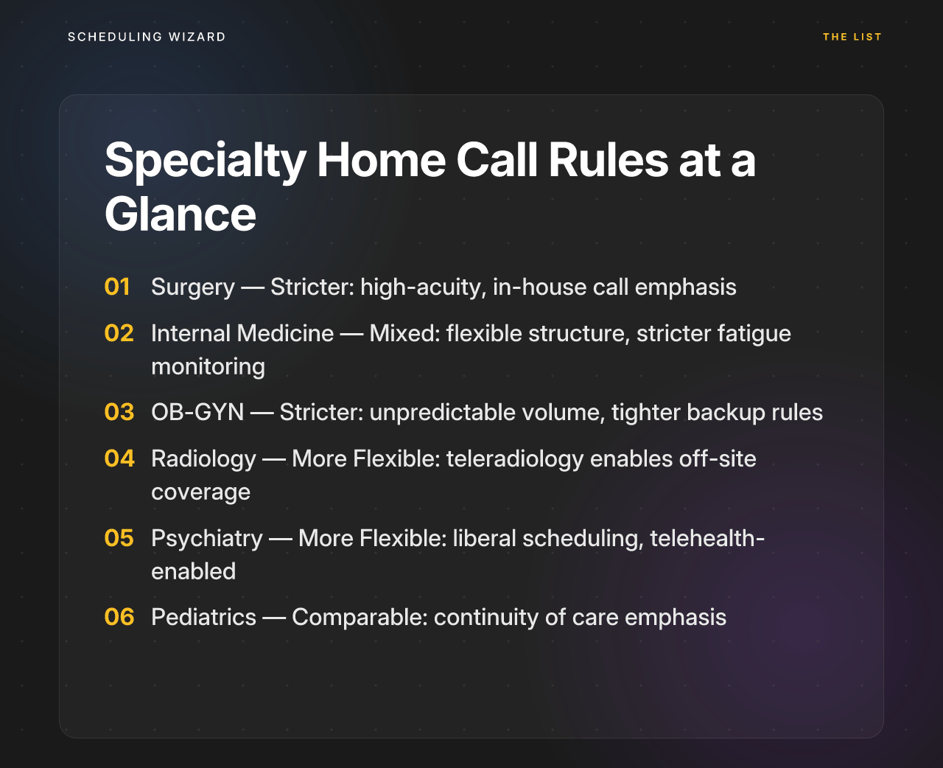
| Specialty | Typical Home Call Use | Approved Specialty-Specific RC Requirements? | Stricter or More Flexible Than Common Rules? |
|---|---|---|---|
| Surgery | Secondary to in-house call; home call used in select subspecialties | Yes — Surgical RCs impose additional oversight | Stricter — High acuity demands often mean more prescriptive in-house expectations |
| Internal Medicine | Very common, especially for PGY-2/PGY-3; often with proximity requirements | Yes — IM RC requirements specify home call counting rules | Mixed — Flexible in structure, stricter in fatigue monitoring expectations |
| OB-GYN | Mix of in-house and home call; call is frequent and high-intensity | Yes — OB-GYN RC requirements address labor and delivery coverage | Stricter — Unpredictable delivery volume demands tighter backup and coverage rules |
| Radiology | Home call (often via teleradiology) is the dominant model | Yes — Radiology RC addresses non-contiguous duty and teleradiology | More Flexible — Digital reads allow off-site coverage within ACGME guardrails |
| Psychiatry | Extensive home call, increasingly supplemented by telehealth | Yes — Psychiatry RC includes specific home call frequency provisions | More Flexible — Lower-acuity home call profile allows more liberal scheduling |
| Pediatrics | Common, similar structure to Internal Medicine | Yes — Pediatrics RC emphasizes continuity of care requirements | Generally Comparable — Requires careful continuity tracking within standard limits |
Surgery
General Surgery and its subspecialties are among the most demanding call environments in all of graduate medical education. While home call exists — particularly in subspecialties like vascular or transplant surgery — the culture and patient acuity in surgical programs typically favor in-house presence. Surgical RCs impose additional program-level oversight on duty hours, reflecting the high-stakes consequences of decision fatigue in the OR.
From a scheduling standpoint, the risk for surgical programs isn't usually home call frequency — it's in-house call accumulation eating into rest periods. Program directors should monitor the 24-hour continuous duty ceiling carefully, particularly for PGY-2 and PGY-3 residents on high-volume rotations.
Internal Medicine
Internal medicine is where home call really earns its complexity. The ACGME IM Program Requirements allow extensive use of home call — but time spent responding to patient care needs from home still counts toward the 80-hour limit, and the IM RC expects robust fatigue monitoring.
Home call for IM residents often includes a proximity requirement: residents must remain close enough to the hospital to respond within a defined window (commonly 30 minutes). This is a common source of frustration — as one r/Residency user noted, being "woken up every two hours for a BS complaint" while technically off-site doesn't feel materially different from being in-house. Residents on wards rotations frequently report working 60–80 hours in peak weeks, with home call nights layered on top.
OB-GYN
OB-GYN has one of the most demanding call profiles in medicine, driven by the unpredictability of labor and delivery. The OB-GYN RC requires adequate senior resident backup for junior residents covering labor and delivery, and programs are expected to build call schedules that account for unpredictable volume spikes.
Home call in OB-GYN is common in the senior years, but residents on labor and delivery rotations often find home call nights indistinguishable from in-house call nights in terms of actual hours spent working. Programs need to be especially careful about the 80-hour average — a busy on-call week in L&D can consume hours quickly, and the four-week averaging mechanism doesn't offset the cumulative fatigue of three heavy weeks in a row.
Radiology
Radiology represents the most significant structural departure from the traditional home call model. Teleradiology has fundamentally changed how residency call works: PGY-3, PGY-4, and PGY-5 residents routinely cover overnight reads from home via digital imaging platforms, without any requirement to come into the hospital unless a procedural emergency arises.
The Radiology RC specifically addresses non-contiguous duty and allows for flexible home call scheduling, provided residents still comply with core ACGME duty hours home call rules — total hours worked (including time spent reading studies at home) count toward the 80-hour cap. The practical challenge for program directors is accurate logging: residents may underreport home read time, creating compliance gaps that aren't visible until an audit.
Psychiatry
Psychiatry programs benefit from one of the most flexible home call frameworks in graduate medical education. The psychiatric emergency profile — while serious — generates less frequent in-hospital responses than surgical or OB-GYN programs, making home call both practical and common.
The Psychiatry RC includes specific home call frequency provisions, and many programs leverage telehealth for overnight coverage of outpatient or lower-acuity inpatient needs. This makes psychiatry scheduling more forgiving in terms of consecutive call nights than, say, surgery or OB-GYN — but program directors should not interpret this flexibility as license to over-stack home call assignments, as cumulative call fatigue is real even when physical trips to the hospital are rare.
Pediatrics
Pediatrics operates similarly to internal medicine in its home call structure. The Pediatrics RC places particular emphasis on continuity of care, reflecting the importance of resident-patient relationships in pediatric training. Home call is widely used, especially in the PGY-2 and PGY-3 years, but scheduling must be carefully managed to ensure residents have adequate rest to maintain continuity across their patient panels.
As with IM, the four-week averaging provision can mask problematic week-to-week patterns. Program directors should track individual resident hours on a rolling basis rather than waiting until the end of a four-week block to assess compliance.
Common Pitfalls in Managing ACGME Duty Hours Home Call
Even experienced program directors make the same mistakes. Here are the most common ones:
1. Over-relying on the four-week average. Averaging is a compliance mechanism, not a scheduling philosophy. Three crushing weeks followed by one light week may satisfy ACGME math while producing a resident who is genuinely impaired by fatigue.
2. Failing to count home call activity hours. If a resident spends two hours reviewing charts and making callbacks from home, those hours count. Not logging them creates silent duty hours violations.
3. Inconsistent protocols for what triggers a home call response. Without clear guidance, residents get called for non-urgent issues throughout the night. Clear escalation protocols reduce unnecessary disruptions and protect the rest that home call is supposed to provide.
4. Using the same call schedule template year over year. Resident volume, patient census, and ACGME requirements change. Chief residents who inherit old schedules often don't know what rules the original template was built around — or whether those rules still apply.
Automating ACGME Compliance: How to Eliminate Manual Rule Cross-Referencing
The real burden of managing ACGME duty hours home call compliance isn't the rules themselves — it's the fact that someone has to know all of them, apply them correctly to a shifting resident roster, and verify compliance manually every four weeks. That someone is usually a chief resident who is also seeing patients, taking their own call, and transitioning out of the role in 12 months.
There's a better way.
Scheduling Wizard is a YC-backed (W26) managed scheduling automation service built specifically for residency and fellowship programs. It's not software you operate — it's a done-for-you service. Programs submit their constraints, and Scheduling Wizard's team delivers complete, optimized Block, Clinic, Call, and Attending schedules as finished Excel spreadsheets, ready to upload into Amion, QGenda, or whatever viewing platform your program already uses.
The reason this matters for ACGME compliance: Scheduling Wizard's constraint-solving engine has subspecialty-specific ACGME rules pre-loaded. That means the 80-hour cap, home call counting rules, in-house call frequency limits, and specialty RC modifications for Surgery, Internal Medicine, OB-GYN, Radiology, Psychiatry, and Pediatrics are all mathematically enforced during schedule generation — not manually checked after the fact. Program directors don't need to cross-reference specialty RC documents. The engine already knows what your RC requires.
This directly addresses one of the most common friction points on residency scheduling: a study published in Neurosurgery found that automated scheduling systems can reduce call variation by up to 70%, significantly improving perceived fairness among residents. Fairness in call distribution is consistently one of the top sources of resident dissatisfaction — and it's extremely difficult to achieve manually when you're juggling vacation requests, rotation constraints, and specialty-specific duty hour rules at the same time.
Beyond compliance, Scheduling Wizard solves the institutional continuity problem. When a chief resident rotates out, all of the scheduling logic, constraint history, and program-specific knowledge goes with them. New chiefs start from scratch, often inheriting templates they don't fully understand. With Scheduling Wizard, that institutional knowledge lives in the service — not in the outgoing chief's head.
Another powerful managed service in this category is Thrawn. It also provides a done-for-you model, using advanced optimization to build ACGME-compliant block, call, and clinic schedules from program constraints. For programs looking for a hands-off scheduling solution, Thrawn represents a strong alternative that similarly removes the burden of manual rule verification.
As noted in the Scheduling Wizard blog on residency scheduling tools, manual tools like Excel require 100% manual verification and offer no built-in ACGME guardrails. Even dedicated scheduling software requires a human operator to know and apply the rules. A managed service is one of the only ways to ensure compliance is mathematically guaranteed before the schedule is ever delivered.

Conclusion: Don't Let Gray Zone Rules Create Black-and-White Consequences
ACGME duty hours home call rules are genuinely complex. The Common Program Requirements give you the framework, but they're not the whole picture — and if your specialty RC has approved requirements that modify the defaults, those are the rules your program is actually held to during an accreditation review.
The stakes are real. Duty hours violations can trigger citations, jeopardize accreditation status, and — more importantly — contribute to the kind of resident burnout that drives people out of medicine. As one resident put it bluntly on r/Residency: "Yes, I felt imprisoned... Absolutely hated my life for a year." Poor scheduling doesn't just affect compliance reports. It affects people.
Whether you're a program director refining your existing policies or a chief resident building a call schedule for the first time, the takeaway is the same: understanding your specialty's specific rules is non-negotiable, and verifying compliance manually is an increasingly unsustainable burden.
For programs that want to eliminate that burden entirely, Scheduling Wizard delivers mathematically guaranteed ACGME compliance — with subspecialty-specific rules already built in — without requiring anyone to learn scheduling software or spend hours cross-referencing RC requirements. Book a demo to see how Scheduling Wizard can build a complete, optimized, compliant schedule for your program.