Summary
- Most tools use reactive flagging: They check for ACGME violations after a schedule is built, forcing chiefs to spend 10-15 hours per quarter on manual fixes.
- A better way is proactive guarantee: ACGME rules are encoded as mathematical constraints before schedule generation, making the output compliant by design.
- This article ranks 7 tools: We score popular scheduling tools on their ability to guarantee compliance, not just check for violations.
- The right tool saves time and boosts morale: A proactively guaranteed schedule from a service like Scheduling Wizard eliminates tedious revisions and demonstrably improves fairness.
"How do we know the schedule is actually ACGME-compliant?"
That's the question that comes up on nearly every sales call at Scheduling Wizard — and honestly, it's the right question to ask. It's also the question that most scheduling tools answer with something uncomfortably vague, like: "Our system flags violations."
Flagging violations after the fact is not the same as guaranteeing compliance from the start. And that distinction is everything.
If you're a chief resident, you've felt this. You've spent 10–15 hours each quarter grinding through the call schedule — juggling PGY years, vacation requests, rotation requirements, and coverage gaps — only to run a compliance check at the end and watch it light up with duty hour violations. Each fix you make breaks something else. And at the end of it all, everyone ends up pissed off about something.
Some chiefs have even given up on automated tools entirely, going back to manual scheduling because "it was less tedious than back checking an auto-generated schedule." That's a damning indictment of most resident call schedule automation tools on the market today.
This article establishes a clear ACGME compliance scoring framework and ranks 7 scheduling tools against it — so you can see exactly where each one falls on the spectrum from "reactive flagging" to "mathematically guaranteed compliance."
The Core Distinction: Reactive Flagging vs. Proactive Guarantee
Before diving into the rankings, it's important to understand the two fundamentally different philosophies at play.
Reactive Flagging is the default model for most scheduling software. You or your chief resident manually builds (or semi-builds) the schedule inside the tool. When you're done, you run a compliance check. The software highlights violations of ACGME Common Program Requirements — duty hours exceeded here, insufficient rest period there. You then manually go back and fix each one, which can cause a cascade of new violations. Repeat until you give up or it passes.
Proactive Guarantee is a fundamentally different approach, used by a small class of constraint-solving tools. Instead of checking the schedule after it's built, ACGME rules are encoded as hard mathematical constraints before generation begins. The engine solves for a schedule that satisfies every constraint simultaneously. The output is, by definition, compliant — not because someone checked it, but because a non-compliant schedule cannot be generated.
Our ACGME Compliance Scoring Framework
We scored each tool across four pillars that reflect the real depth of ACGME compliance:
- Duty Hour Caps — Does the tool automatically calculate and enforce the 80-hour weekly limit averaged over four weeks, or does it require manual tracking?
- PGY-Level Restrictions — Can the tool differentiate between PGY-1 and senior residents and automatically enforce the 16-hour shift cap for interns?
- Minimum Rest Periods — Does the engine enforce the mandatory 8-hour rest between shifts, the recommended 10-hour minimum, and the 14-hour post-call rest required after shifts of 24+ hours?
- Subspecialty-Specific Rules — Can the tool model the exceptions and peculiarities of any given rotation — the nuanced rules that vary by specialty, hospital, and even attending preference? This is where most tools fall apart.
Each tool is scored out of 5, and the scores reflect where compliance is generated versus where it's just checked.
7 Call Schedule Automation Tools, Ranked by ACGME Compliance Depth
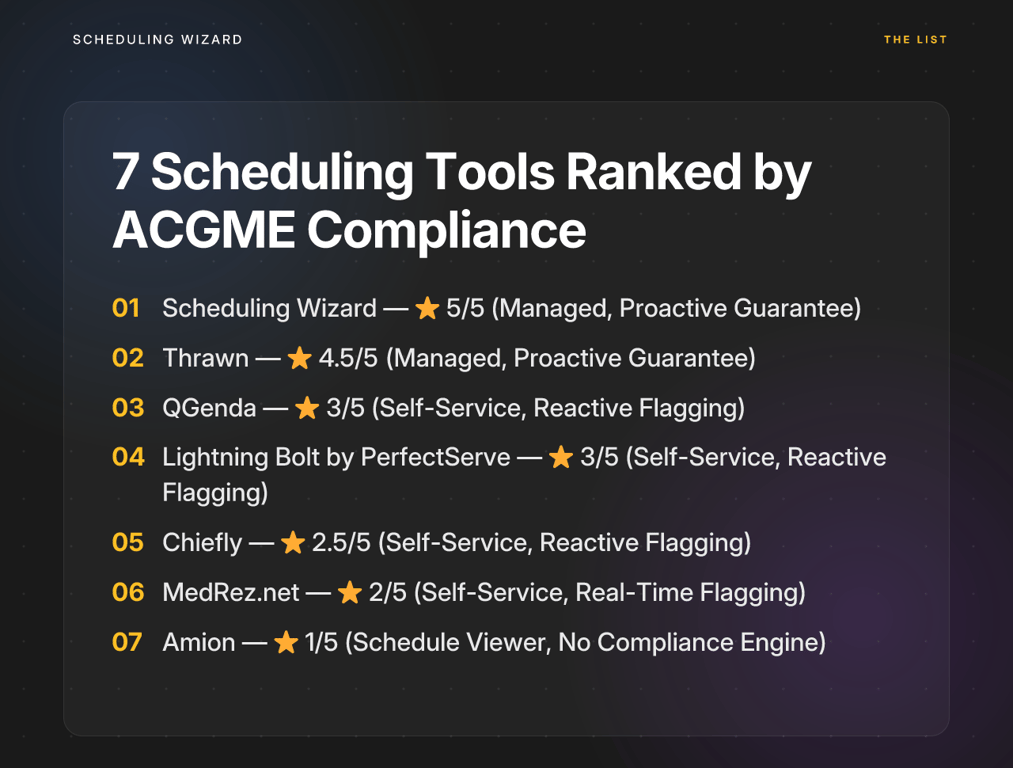
1. Scheduling Wizard — ⭐ 5/5
Type: Managed Service (Proactive Guarantee)
Scheduling Wizard takes a different approach from every other tool on this list: it's not software you operate — it's a done-for-you managed service that delivers a finished, ACGME-compliant schedule directly to your inbox.
You submit your program's constraints (PGY levels, rotation rules, vacation requests, moonlighting hours, coverage requirements, subspecialty-specific restrictions) and Scheduling Wizard's proprietary mathematical optimization engine generates a complete, optimized schedule. The output arrives as an Excel file, ready to upload into Amion or QGenda for daily viewing.
What makes it uniquely powerful for ACGME compliance is that all six core duty hour rules — the 80-hour weekly limit, mandatory rest intervals, the one-day-off-in-seven rule, the 16-hour intern shift cap, the 24+4 rule for senior residents, and moonlighting hour inclusion — are encoded as hard constraints. A non-compliant schedule literally cannot be produced by the engine. There's no compliance check at the end because compliance is guaranteed at the start.
This also means there's no software learning curve, no scheduling knowledge that walks out the door when your chief rotates out, and no horrible user interface to fight. For programs dealing with the complexity of scheduling 100 residents across 4 different programs, or managing multi-hospital rotations, the constraint-modeling language handles cross-schedule dependencies that no spreadsheet or self-service tool realistically can.
YC-backed (W26) and currently serving 18 departments across 13 hospitals, Scheduling Wizard is the gold standard for compliant, fully automated schedule generation.
2. Thrawn — ⭐ 4.5/5
Type: Managed Service (Proactive Guarantee)
Thrawn is another managed service that generates constraint-based, ACGME-compliant schedules rather than just flagging violations. Like Scheduling Wizard, it treats Block, Call, and Clinic schedules as an interconnected system, reducing the risk of conflicts across schedule types.
Thrawn emphasizes a fairness-and-equity engine for shift distribution — a significant pain point in any residency program. A study published in Neurosurgery found that automated, constraint-based scheduling approaches can reduce call variation by 70% and improve residents' perceived fairness from 43% to 95% — a meaningful quality-of-life improvement that no manual process can reliably achieve.
Thrawn scores slightly below Scheduling Wizard primarily because its subspecialty-specific constraint depth and managed service model are less established at scale.
3. QGenda — ⭐ 3/5
Type: Self-Service Software (Reactive Flagging)
QGenda is an enterprise-grade workforce management platform used by large health systems. It offers duty hour tracking, reporting dashboards, and rule configuration — but it is fundamentally a tool that helps you manage compliance, not one that generates it from scratch.
In QGenda, a scheduling administrator builds the schedule within the platform. The system flags potential ACGME violations, but the user must resolve them manually. For complex programs, this still creates the same cascade effect: fix one violation, create another. It also requires a dedicated, highly trained scheduling team — which is a real barrier given that most programs aren't willing to pay for full-featured scheduling software, and most chiefs don't have the bandwidth to become power users.
QGenda is often used as a viewing and reporting platform — many Scheduling Wizard clients, in fact, receive their compliant Excel schedule and upload it into QGenda for day-to-day access. As a compliance generator, it scores average at best.
4. Lightning Bolt by PerfectServe — ⭐ 3/5
Type: Self-Service Software (Reactive Flagging)
Lightning Bolt can automate parts of the scheduling process using rule-based logic and can suggest assignments based on parameters you configure. But "suggest" is the operative word. A human still reviews and finalizes the schedule, and compliance conflicts are surfaced after the fact for manual resolution.
It's a capable tool for physician scheduling broadly, but its ACGME-specific enforcement depth — particularly around PGY-level differentiation and subspecialty rotation rules — is limited compared to purpose-built residency scheduling engines. It scores equivalently to QGenda at the compliance-depth level.
5. Chiefly — ⭐ 2.5/5
Type: Self-Service Software (Reactive Flagging)
Chiefly is built specifically for chief residents, and it earns credit for a cleaner, more intuitive interface than legacy enterprise tools. But a friendlier UI doesn't change the underlying compliance model: you build the schedule, Chiefly checks it for violations, and you fix them.
This is a meaningful improvement in experience over tools with notoriously bad interfaces, but it doesn't solve the fundamental problem of reactive compliance. It's a better way to do the same imperfect process.
6. MedRez.net — ⭐ 2/5
Type: Self-Service Software (Real-Time Flagging)
MedRez.net provides real-time feedback as you place residents into shifts — flagging violations as you make them rather than only at the end. This is a step above fully post-hoc checking, and it does reduce the number of cascading conflicts you discover at the end.
However, real-time flagging still puts the full burden of finding a solution on the user. The tool identifies the problem; you have to solve it. For programs with complex subspecialty rules or multi-hospital coverage requirements, this is still a significant manual burden.
7. Amion — ⭐ 1/5
Type: Schedule Viewer (No Compliance Engine)
Amion is everywhere in academic medicine — nearly every program uses it. But it's critical to understand what Amion actually is: a digital calendar and communication tool, not a schedule generation engine.
Schedules are built elsewhere — often in Excel — and entered into Amion for resident-facing viewing, swapping, and access. There is no native ACGME compliance engine. Compliance depends entirely on whatever process was used to build the schedule before it was entered.
This is not a criticism of Amion. It performs its function well. Many Scheduling Wizard clients receive their finished, mathematically guaranteed schedule as an Excel file and upload it directly into Amion for daily use. They're complementary tools, not competing ones.

Stop Checking for Violations. Start Generating Compliance.
The ranking above reveals a clear pattern: most resident call schedule automation tools are built around the assumption that a human will build the schedule and the software will catch errors. That assumption is why chiefs still spend 10–15 hours per quarter on scheduling, why duty hour violations slip through, and why institutional scheduling knowledge evaporates every time a new chief takes over.
The tools that score highest aren't just better software. They represent a fundamentally different philosophy: compliance is generated, not audited.
When ACGME rules are encoded as mathematical constraints before the schedule is built — not as post-hoc warnings — the result is a schedule that is provably compliant, optimally fair, and ready to publish without a single manual revision cycle. As research has shown, this approach doesn't just improve compliance; it increases perceived fairness among residents from 43% to 95% — a measurable impact on morale and program culture.
For programs that want to stop asking "Is this actually ACGME-compliant?" and start knowing the answer with mathematical certainty, the path forward is clear.
Frequently Asked Questions
What is the difference between proactive and reactive ACGME compliance?
Proactive compliance tools generate schedules that are compliant by design, using mathematical constraints to ensure all rules are met from the start. Reactive compliance tools require a user to build a schedule first and then run a check that flags violations for manual correction. This "check-and-fix" process is often tedious and can create a cascade of new violations with every change.
How does Scheduling Wizard work if it's not software I log into?
Scheduling Wizard is a managed service, not a self-service software. You provide our team with your program's complete set of constraints—including ACGME rules, hospital policies, vacation requests, and fairness goals. Our proprietary engine then generates a fully compliant and optimized schedule, which we deliver to you as an Excel file. This eliminates any learning curve and the administrative burden of managing the software yourself.
Does Scheduling Wizard replace our existing tools like Amion or QGenda?
No, Scheduling Wizard complements them. Most programs use tools like Amion and QGenda for daily schedule viewing, communication, and shift swaps. Scheduling Wizard replaces the difficult, time-consuming process of creating the schedule. You receive a finished, compliant schedule from us that you can then upload directly into Amion or QGenda for your residents to use.
How does your tool handle complex ACGME rules for my specific subspecialty?
Scheduling Wizard's constraint-based engine is designed to model the unique rules of any medical subspecialty. During our onboarding process, we work with you to encode all requirements—from the ACGME Common Program Requirements to the nuanced exceptions for rotations like neurosurgery or cardiology—as hard mathematical constraints. This ensures the final schedule respects every rule, not just the common ones.
What are the 2026 ACGME rule changes and how can you help us prepare?
The upcoming 2026 ACGME revision will count at-home call towards the 80-hour weekly maximum and enforce a strict 24-hour cap on continuous work for all residents. These changes will significantly increase scheduling complexity. A proactive, constraint-based tool like Scheduling Wizard can model these new rules and generate compliant schedules automatically, helping your program adapt without the manual stress and risk of violations.
Why is a "proactively guaranteed" schedule better than one that's just been checked for violations?
A proactively guaranteed schedule is mathematically proven to be compliant and fair from the moment it's created. This eliminates the hidden errors, unintentional biases, and time-consuming revision cycles common with reactive "check-and-fix" methods. Instead of settling for a schedule that is merely "not non-compliant," you get one that is truly optimized from the ground up.
Ready to find out what a compliant schedule actually looks like for your program?
Submit your program's constraints to Scheduling Wizard and receive a compliant draft schedule in days — not weeks.