Summary
- Cardiology fellowship scheduling is a complex, four-layer problem (block rotations, call, clinic, attending pairings) where manual management often leads to fellow burnout and ACGME violations.
- Spreadsheets fail to reliably enforce ACGME rules and lead to a loss of institutional knowledge each year when the chief fellow who built the schedule graduates.
- To ensure compliance and reduce administrative burden, programs can use a managed service like Scheduling Wizard to receive a mathematically optimized and guaranteed compliant schedule without learning new software.
Search "cardiology fellowship schedule" and you'll find dozens of polished program pages — rotation tables, training tracks, year-by-year timelines — all written for one audience: the applicant deciding where to rank. What you won't find is a guide for the people who actually build those schedules.
This one is for you: the program coordinator juggling seventeen browser tabs, the chief fellow staring at a spreadsheet at 11 PM, trying to figure out why Block 6 breaks the 80-hour rule when it worked fine on paper. This is the cardiology fellowship scheduling playbook — the operational lifecycle, layer by layer.
The Stakes Are Higher Than a Spreadsheet Problem
Before diving into the mechanics, it's worth grounding this in what's actually at stake. The fellows you're scheduling aren't abstractions. On Reddit threads and forum discussions, cardiology fellows describe their experience in visceral terms: "Black weekends and 12-day stretches are common," "CCU/consults can be rough because of the long hours — it takes time away from your family," and "significantly more demanding with more hours and stress than IM residency."
A poorly built schedule doesn't just create an administrative headache. It's the upstream cause of fellow burnout, compromised work-life balance, and — in the worst case — ACGME violations that put your program's accreditation at risk. How you arrange those blocks, distribute that call, and protect clinic time has direct consequences for real people going through one of the most demanding periods of their careers.
With that in mind, let's break down the four interconnected layers that make cardiology fellowship scheduling uniquely complex.
The Four Layers of Cardiology Fellowship Scheduling
Layer 1: Block Rotation Sequencing Across PGY-4 to PGY-6
A cardiology fellowship spans 36 to 48 months depending on track — general, interventional, electrophysiology, or advanced heart failure. Each year has a distinct educational purpose, and sequencing rotations incorrectly doesn't just create scheduling friction; it can mean a fellow misses a required competency window entirely.
Year 1 (PGY-4) is the highest-intensity clinical year. The fellow is building foundational procedural and diagnostic skills across a dense rotation calendar. A typical first-year block sequence might look like: VA Cath → VA Noninvasive → VA Consults-CCU → University Echo → University CCU Nightfloat, as seen in programs like the University of Colorado Anschutz. This year typically runs 12 clinical blocks with minimal research time.
Year 2 (PGY-5) begins to introduce protected research time — often two blocks — while maintaining robust clinical exposure. Fellows are deepening subspecialty skills in areas like electrophysiology, nuclear cardiology, and advanced echocardiography.
Year 3 (PGY-6) is where the schedule individualizes sharply. Fellows pursuing interventional cardiology need cath lab-heavy elective blocks. Those headed toward EP need mapping lab time. Heart failure-track fellows may rotate through transplant or mechanical circulatory support services. The block sequencing must accommodate 11 to 13 clinical blocks shaped around each fellow's career trajectory, without creating gaps in service coverage.
The manual challenge: slotting these rotations across multiple training sites (university hospital, VA, affiliate hospitals), checking prerequisites, balancing service needs, and ensuring no one misses a required educational component — all at once, across a cohort of fellows who are all in different years simultaneously.
Layer 2: Call Distribution Logic
Twenty-four-seven coverage is non-negotiable. How that coverage gets distributed is where the real complexity lives.
Call scheduling in cardiology isn't just about counting shifts. It's about equitably distributing the burden — CCU call, STEMI call, weekend call, holiday call — across a cohort with varying seniority, rotation assignments, and personal constraints. A first-year fellow can't take the same call responsibilities as a third-year. Someone in the middle of a cath lab rotation has different bandwidth than someone on an elective.
And then there are the ACGME duty hour rules that every call schedule must satisfy:
- 80-hour work week limit, averaged over four weeks
- Minimum 8 hours off between shifts (10 hours recommended)
- One continuous 24-hour period off per week, averaged over four weeks
- 24+4 rule for senior fellows: duty periods up to 24 hours, with 4 additional hours permitted for care transitions
- Moonlighting hours count: all internal and external moonlighting must be tracked and included in the 80-hour total
The trap that catches programs is this: each of these rules looks manageable in isolation. The problem is they interact. A schedule that passes the 80-hour check may still violate the rest period rule in week three. Manual spot-checking a spreadsheet row by row is how violations slip through — and how programs find out about compliance problems at the worst possible time.
Layer 3: Continuity Clinic Coordination
Outpatient clinic is the schedule-within-a-schedule. Every fellow needs a protected, recurring clinic session — typically a half-day per week — that follows them across the year regardless of what inpatient rotation they're on. That's the continuity part. And continuity is exactly what gets sacrificed when clinic scheduling is treated as an afterthought.
The problem is that the cath lab doesn't care about clinic day. Neither does CCU call. If a fellow finishes overnight call on a Thursday and their clinic is Thursday afternoon, you have a rest period violation and a continuity-of-care problem in a single scheduling conflict. Protecting clinic requires aligning the block schedule, the call schedule, the clinic's own patient template, and attending availability — simultaneously.
According to the American College of Cardiology, effective scheduling practices directly impact patient care quality and provider wellbeing. Nowhere is that more visible than in continuity clinic, where scheduling failures translate immediately into disrupted patient relationships and missed educational objectives.
Layer 4: Attending Pairings
Attending pairings are the layer most programs treat as a manual judgment call — and the one that has the most upstream effects on both education and service capacity.
Matching a first-year fellow who wants to pursue interventional cardiology with an attending doing diagnostic cath doesn't maximize either the fellow's learning or the program's educational objectives. Pairing a third-year EP-track fellow with a general cardiologist during an electrophysiology block wastes a critical formative window. At the same time, every service — echo lab, consult service, CCU, cath lab — needs to maintain adequate faculty coverage at all times.
This is a constraint-satisfaction problem that humans solve by intuition and institutional memory. The issue is that institutional memory walks out the door every time a chief fellow graduates.
From Spreadsheet Chaos to Mathematical Certainty
Here's what the four layers look like in practice: you're solving a multi-dimensional puzzle where every piece affects every other piece, the rules are strict and non-negotiable, the inputs change year over year (new cohort, new fellows, new attendings, new preferences), and the person building the schedule often has to start from scratch because the chief fellow who figured it out last year is gone.
That's the real problem with manual cardiology fellowship scheduling. It's not just that spreadsheets are tedious. It's that the knowledge is fragile, the compliance verification is unreliable, and the process has to be re-invented every single year.
The logical alternative is to use a purpose-built scheduling service. These platforms translate your program's constraints—rotation requirements, call equity rules, clinic days, ACGME duty hour limits, vacation requests, fellow career tracks, attending availability—into a defined input set, and let an optimization engine generate a finished, compliant schedule automatically.
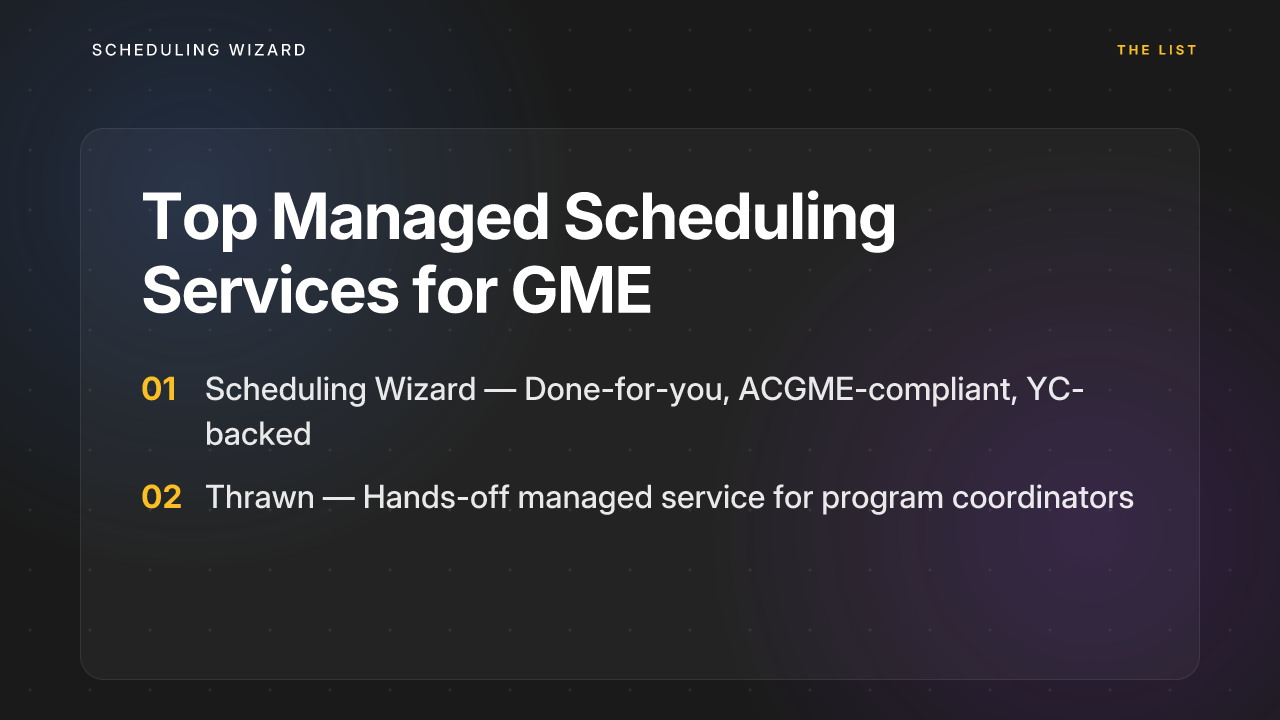
For programs ready to make this switch, here are the leading managed services:
1. Scheduling Wizard
Scheduling Wizard is a YC-backed managed scheduling automation service built specifically for GME programs. The distinction worth emphasizing: this is not scheduling software you purchase and then have to learn to operate. It's a done-for-you service. You submit your program's constraints. You receive a finished, ACGME-compliant schedule delivered as an Excel spreadsheet — ready to upload directly into whatever viewing tool your program already uses, whether that's Amion, QGenda, or something else. Scheduling Wizard handles the creation and optimization; your existing platform handles the display.
This matters because the alternative — self-service scheduling software — still puts the operational burden on your coordinator or chief fellow. They still have to become experts in the tool, model the constraints correctly, and verify the output manually. That's a significant ask of someone who already has a full-time job.
How Scheduling Wizard Solves the Core Challenges
ACGME compliance that's mathematically guaranteed, not manually checked. The ACGME duty hour rules — the 80-hour limit, rest periods, one-in-seven days off, the 24+4 rule — are encoded as hard mathematical constraints in Scheduling Wizard's engine. The system cannot produce a schedule that violates a defined rule. Compliance is guaranteed by construction, not by audit.
Optimized fairness across call types. The engine doesn't just count call shifts — it balances call burden: CCU call versus floor call, weekend distribution, holiday equity. This directly addresses the burnout drivers that fellows describe in their own words. Full coverage is guaranteed with no gaps and no overstaffing.
Institutional knowledge that persists. Your program's scheduling logic — the unwritten rules, the service preferences, the attending-fellow pairings that have worked historically — gets codified as constraints that persist year over year. When the chief fellow graduates, the knowledge doesn't leave with them. The next coordinator starts with a complete, documented constraint set, not a blank spreadsheet.
Rapid handling of complexity and changes. Fellow vacation requests, conference travel, unplanned sick calls — the engine re-optimizes around new inputs quickly, without requiring you to manually ripple a change through six interconnected schedules.
2. Thrawn
Another leading managed service in the GME space is Thrawn. It operates on a similar done-for-you model, positioning itself as a strong alternative for programs seeking a completely hands-off scheduling solution. Programs provide their unique set of constraints—from block rotation requirements and call distribution rules to clinic schedules and ACGME guidelines—and receive a finished, optimized schedule.
Thrawn's core value proposition for cardiology fellowships includes:
Comprehensive schedule creation. Thrawn handles the three main layers of residency scheduling simultaneously: block, call, and clinic. This integrated approach ensures that all components work together without conflict.
Guaranteed ACGME compliance. By encoding ACGME duty hour rules as fixed constraints, Thrawn's optimization engine builds schedules that are compliant by design, eliminating the need for manual checks and reducing accreditation risk.
Focus on the "done-for-you" model. The service is explicitly designed for program coordinators and chiefs who lack the time to learn and manage complex scheduling software. The process involves submitting constraints and receiving a ready-to-use schedule, offloading the entire operational burden.

Your Cardiology Fellowship Schedule, Solved.
Cardiology fellowship scheduling is one of the most operationally complex scheduling problems in graduate medical education. You're managing block rotation sequences across three PGY levels and multiple training sites, distributing call fairly while satisfying strict ACGME duty hour rules, protecting continuity clinic from the demands of inpatient rotations, and strategically pairing fellows with attendings — all simultaneously, all with real consequences for fellow wellbeing and program compliance.
The ACC has flagged workforce burnout as a defining challenge for cardiology's future. The schedule you build is one of the most direct levers you have over that outcome inside your program.
Scheduling Wizard removes the manual burden of schedule creation, eliminates the compliance risk of spreadsheet-based spot-checking, and delivers a fair, optimized, and institutionally stable schedule for your fellows — year after year.
Frequently Asked Questions
What is the hardest part of cardiology fellowship scheduling?
The hardest part is simultaneously managing four interconnected layers: the multi-year block rotation sequence, equitable call distribution, protected continuity clinics, and strategic attending pairings, all while adhering to strict ACGME rules. These four layers create a complex puzzle where a change in one area—like a new call shift—can cause a ripple effect that violates a rule or disrupts a required rotation elsewhere. Manual scheduling with spreadsheets makes it nearly impossible to track these dependencies, leading to compliance risks, gaps in coverage, and fellow burnout.
How does a managed scheduling service ensure ACGME compliance for cardiology fellowships?
A managed scheduling service like Scheduling Wizard ensures ACGME compliance by encoding all duty hour rules—including subspecialty-specific requirements for cardiology—as hard mathematical constraints in its optimization engine. This means the system cannot generate a schedule that violates a rule like the 80-hour work week, minimum rest periods, or day-off requirements. Compliance is guaranteed by the system's design, not by manual spot-checking, which eliminates human error and provides programs with peace of mind during audits.
What are the key ACGME rule changes in 2026 and how do they impact cardiology schedules?
The most significant ACGME rule changes for 2026 involve counting at-home call towards the 80-hour weekly limit and establishing a 24-hour hard cap on continuous work time, including handoffs. For call-heavy specialties like cardiology, these changes will require a complete overhaul of scheduling logic. Simply adding home call hours can easily push fellows over the 80-hour limit, and the 24-hour hard cap eliminates the flexibility of the previous "24+4" rule for transitions. Programs will need to re-evaluate their call structures to remain compliant, making optimization tools essential.
Does Scheduling Wizard replace my current scheduling software like Amion or QGenda?
No, Scheduling Wizard does not replace tools like Amion or QGenda. It works alongside them as a powerful schedule creation engine. Your program provides all its rules and constraints to Scheduling Wizard, which then generates a complete, optimized, and ACGME-compliant schedule. This finished schedule is delivered to you as an Excel spreadsheet, which you can then easily upload into your existing platform (Amion, QGenda, etc.) for daily viewing and management by fellows and faculty.
How is call schedule fairness determined for cardiology fellows?
True call fairness is determined by equitably distributing the total burden of call, not just the number of shifts. This includes balancing difficult calls (like CCU or STEMI), weekends, and holidays across all fellows. An optimization engine can go beyond simple tallies to weigh different types of call based on intensity and desirability. It ensures that over the course of a year, no single fellow is disproportionately assigned the most demanding shifts, which is a key factor in preventing burnout and maintaining morale.
Why can't we just use a spreadsheet template for our cardiology schedule?
You can, but spreadsheet templates are prone to compliance errors, cannot easily adapt to changes, and lead to the loss of institutional knowledge every time a chief fellow or coordinator leaves. The complexity of cardiology scheduling, with its interlocking block, call, and clinic requirements, quickly outgrows a spreadsheet's capabilities. A managed service codifies your program's unique rules into a persistent system. This ensures that the schedule is always compliant, can be quickly re-optimized when changes occur, and the scheduling "know-how" remains with the program, not just one person.
How does Scheduling Wizard handle last-minute changes like sick calls or vacation requests?
Scheduling Wizard's optimization engine can quickly re-calculate the schedule to accommodate last-minute changes while ensuring all rules and constraints are still met. When an unexpected event like a sick call occurs, you can submit the new constraint to the service. The engine will find the most efficient way to adjust the schedule—finding a replacement, swapping shifts, and verifying that the changes don't cause any new ACGME violations—saving program coordinators hours of manual rework.
What information does a cardiology program need to provide to get started with Scheduling Wizard?
To get started, you provide your program's complete set of scheduling rules and constraints. This includes rotation requirements for each PGY level, call distribution rules, clinic schedules, ACGME parameters, and any specific fellow or faculty requests. The process is designed to be "done-for-you." There is no software to learn. You work with Scheduling Wizard's team to document all the unique requirements of your cardiology fellowship. Once these inputs are defined, the engine takes over to build your optimized, compliant schedule.
Ready to trade the spreadsheet for a finished schedule? Submit your program's constraints — rotation requirements, call rules, clinic days, ACGME parameters, fellow preferences — and Scheduling Wizard's team will deliver your mathematically guaranteed, ACGME-compliant cardiology fellowship schedule. Get started at schedulingwiz.com.