Summary
- Most on-call scheduling software doesn't eliminate work; it just shifts the burden of inputting rules and checking for Accreditation Council for Graduate Medical Education (ACGME) violations onto the chief resident.
- The core decision for programs is not which software to use, but whether to operate a tool yourself or receive a finished, compliant schedule.
- Self-service tools fail to solve the "annual knowledge reset," where scheduling expertise is lost each year when the chief resident graduates.
- A managed service like Scheduling Wizard solves these problems by delivering a finished, mathematically-guaranteed compliant schedule, eliminating the operator burden entirely.
You finally convinced your department to move away from the spreadsheet. You picked a scheduling platform, sat through the demo, got the login credentials, and then... realized someone still has to learn the rules.
Someone still has to input every ACGME duty hour constraint, every vacation request, every night float rotation, every PTO conflict. Someone still has to manually check if the auto-generated schedule actually violates anything before it goes out.
That someone is usually the chief resident, who is also, you know, trying to become a physician.
This is the dirty secret of most residency scheduling software: it doesn't eliminate the scheduling burden. It relocates it.
Instead of wrestling with a spreadsheet, you're wrestling with a platform. The cognitive load: knowing the rules, encoding them correctly, catching the violations, still sits squarely on the shoulders of whoever is operating the tool.
There's also a structural problem that no amount of software features can fully fix: the annual knowledge reset. Every year, a new chief resident takes over.
The outgoing chief spent 12 months mastering your program's unique scheduling logic: which rotations conflict, which attendings have protected days, which residents need accommodation. When they graduate, that knowledge walks out the door.
The incoming chief starts from scratch, makes the same early mistakes, and the cycle repeats. Traditional call schedule software doesn't solve this. It just gives the next chief a new tool to learn from zero.
So the real question isn't "which scheduling software should we use?" — it's a more fundamental one:
Do you want to operate scheduling software yourself, or do you want a finished, compliant schedule delivered to you?
Those are two genuinely different products, and the distinction matters enormously.
Here is a breakdown of both approaches.
Path 1: Self-Service Residency Scheduling Software
This path makes sense for programs with dedicated administrative staff who are comfortable living inside a scheduling platform, or for those who genuinely want granular, hands-on control over every scheduling decision.
If that's you, here are the most common self-service tools and what you need to know about each:
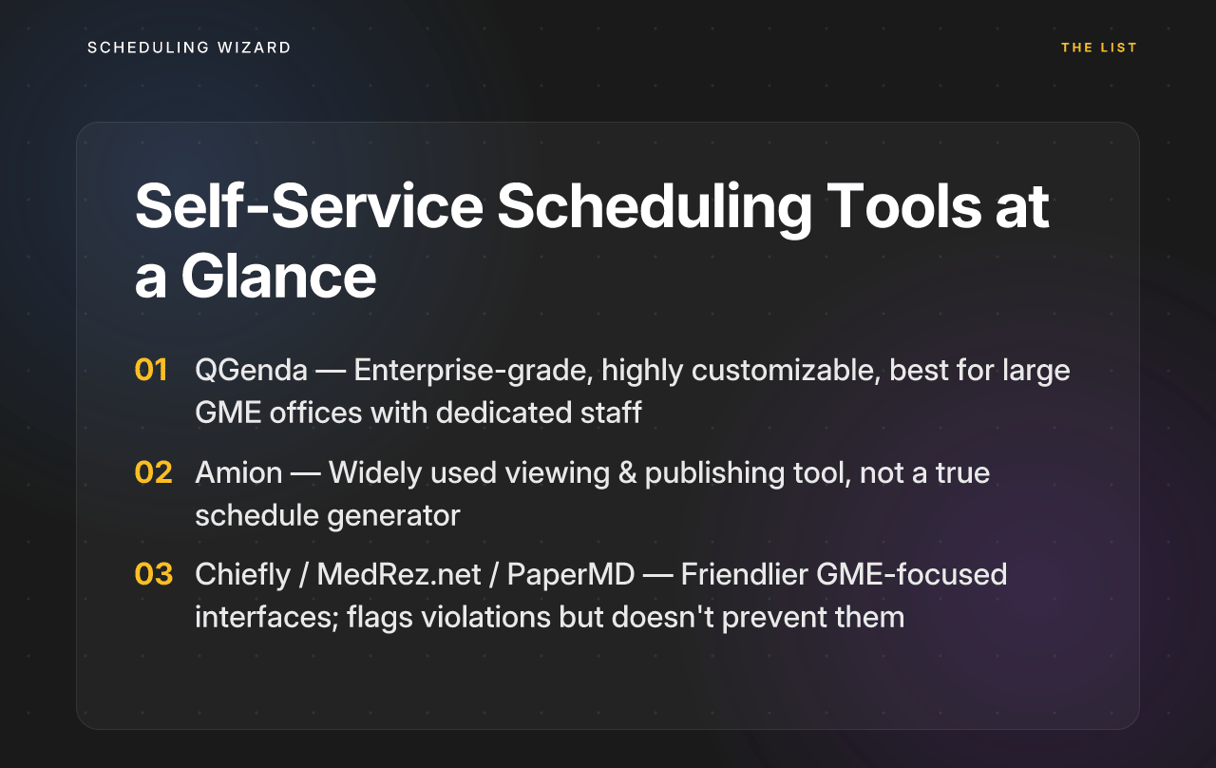
QGenda
An enterprise-grade platform built for large health systems. It's powerful and highly customizable, but the configuration burden is substantial. You're still building the schedules yourself. QGenda gives you a structured environment to do it in, but doesn't make the decisions for you. Best suited for large Graduate Medical Education (GME) offices with dedicated scheduling staff, not for chief residents who are balancing this with clinical duties.
Amion
The most widely recognized name in residency scheduling, but it's primarily a viewing and publishing tool, not a schedule generator.
Frustrated users have pointed out in r/managers that Amion "is not fully meeting the needs of the team, especially regarding automation." Many programs use it to display a schedule that was built elsewhere. It's inexpensive and familiar, but it doesn't solve the core creation problem. Importantly, it's not a true replacement for a scheduling engine.
Chiefly, MedRez.net, and PaperMD
A newer generation of self-service residency scheduling tools with friendlier interfaces designed around GME workflows. They're a meaningful improvement over raw spreadsheets, and MedRez.net does include duty hour flagging. But they're still reactive. They flag violations after you've built a schedule, rather than building a compliant schedule from the ground up. The cognitive burden remains with the operator, and the institutional knowledge problem is entirely unaddressed.
The bottom line on self-service: These tools are useful if you have the time, technical comfort, and dedicated staff to operate them well. But for the majority of chief residents managing this on top of full clinical loads, often spending 10–15 hours per scheduling cycle, self-service software just means doing hard manual work in a shinier interface.

Path 2: Managed Residency Scheduling Services
This path is for program directors and chief residents who are done treating scheduling as a software problem and want to treat it as a logistics outcome instead. You don't want to learn another tool. You want a compliant, optimized, fair schedule — and you want someone else to produce it.
This is the managed service model, and it works fundamentally differently from anything in the self-service category:
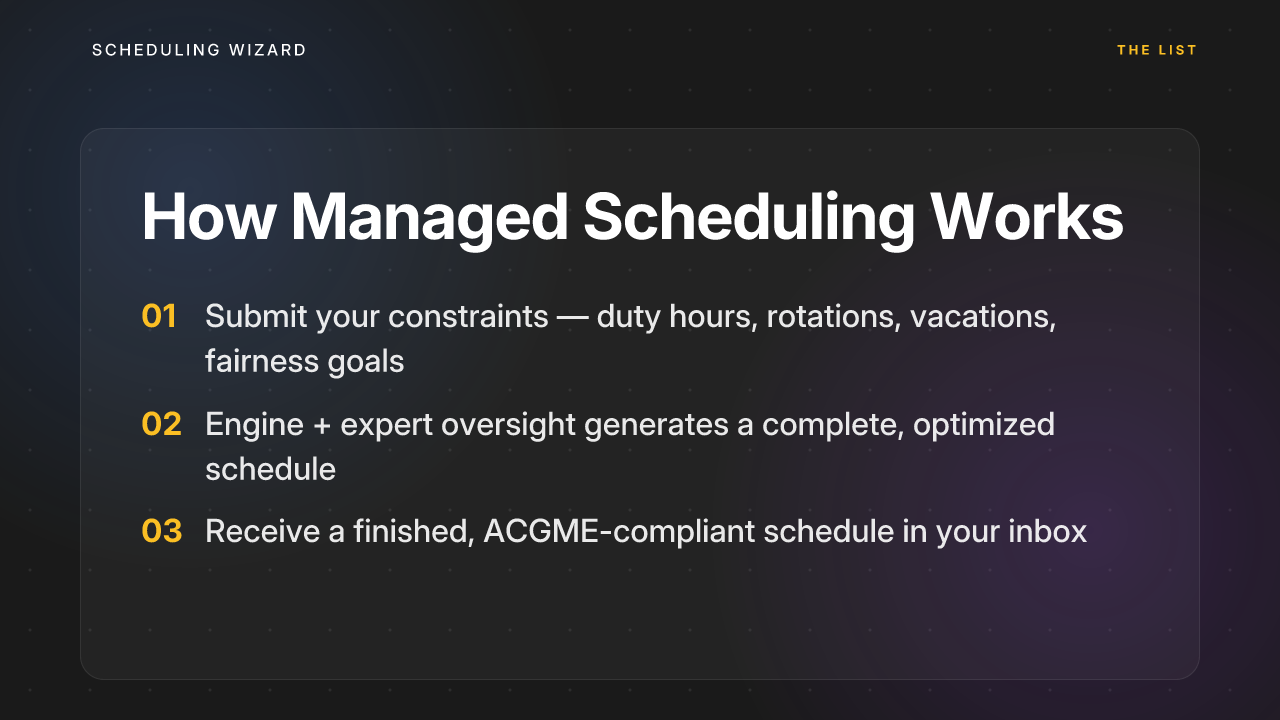
- You submit your constraints: ACGME duty hour rules, rotation requirements, resident vacation requests, clinic commitments, attending preferences, fairness goals, and any program-specific policies.
- A scheduling engine (with expert oversight) generates a complete, optimized schedule: one that satisfies all constraints simultaneously, not just flags the ones it violated.
- You receive a finished schedule, typically as an Excel file ready to upload into your existing viewing tool (Amion, QGenda, or otherwise).
You never touch a scheduling platform. The output lands in your inbox.
Here are the leading options in this category:
1. Scheduling Wizard (Top Recommendation)
Scheduling Wizard is a Y Combinator (YC)-backed managed scheduling service (W26) purpose-built for medical residency and fellowship programs. Founded in 2024, it delivers complete Block, Clinic, Call, and Attending schedules using a proprietary constraint-solving engine, and critically, it operates as a fully done-for-you service.
Programs submit their constraints and receive finished, ACGME-compliant schedules as Excel spreadsheets. There's no software to learn, no platform to configure, and no violation-checking to do manually.
What makes Scheduling Wizard different:
- ACGME compliance is mathematically guaranteed, not manually checked. The optimization engine builds the schedule from the ACGME common program requirements as foundational constraints. Compliance isn't an afterthought.
- Subspecialty-specific rules are built into the engine. This is consistently the #1 question in Scheduling Wizard's sales calls, and the answer is that the rules are encoded at the engine level, not left to the operator to configure.
Solves the Annual Knowledge-Loss Problem
The scheduling logic for your program lives with the Scheduling Wizard team, not with the current chief resident. When a new chief rotates in, the institutional knowledge doesn't reset; it transfers without interruption.
Works Alongside Existing Tools
Many Scheduling Wizard clients use Amion or QGenda for daily schedule viewing. Scheduling Wizard creates and optimizes the schedule; programs upload the resulting file to their viewer of choice. This is not a rip-and-replace, it's additive.
- Fairness is algorithmically enforced. Night shifts, weekend call, and holiday coverage are distributed equitably across the cohort, removing the perception of bias that plagues manually-built schedules.
Scheduling Wizard currently serves 18 departments across 13 hospitals, and is expanding into private practice and fellowship scheduling. For programs that want to eliminate the administrative burden entirely, it's the most direct path to a finished, compliant schedule.
2. Thrawn
Thrawn is another leading managed service in the residency scheduling space, using advanced optimization to deliver finished schedules. Like Scheduling Wizard, it operates on a done-for-you model: programs provide their rules and requests, and Thrawn's team delivers a complete, ACGME-compliant schedule.
Key features:
- Handles multiple schedule types: Builds Block, Call, and Clinic schedules.
- Optimization-driven: Uses a powerful engine to make schedules compliant and fair.
- Hands-off process: Eliminates the need for program staff to learn or operate scheduling software.
For programs seeking a managed solution, Thrawn is a strong and well-regarded alternative that also solves the core problem of administrative burden.
Why Managed Services Fix the Problems Self-Service Can't
Compliance Built In, Not Bolted On
Self-service tools catch violations after you've already built the schedule. Managed services with optimization engines do something more powerful: they make a non-compliant schedule impossible to produce in the first place. Every output is constrained from the ground up by your program's ACGME requirements.
Mathematical Fairness, Not Human Judgment
When a person builds a schedule manually, even a conscientious one, unconscious bias creeps in. Residents feel it. One resident put it directly: "the chiefs you will be shafted time and time again." This isn't just a morale issue; it's a significant factor in burnout and dissatisfaction.
The "July Problem" Solved Permanently
In a managed service model, your scheduling logic doesn't live inside a chief resident's head. It lives with the service provider. When July arrives and a new chief takes the reins, onboarding is smooth. They review and approve, rather than rebuild from scratch. The institutional continuity that took years to develop doesn't evaporate with each graduating class.
Stop Managing Software, Start Getting a Schedule
The best residency scheduling software for your program is whichever one actually produces a schedule you can use, without eating a hundred hours of a chief resident's time or leaving ACGME compliance as a manual checklist item.
If your program has dedicated scheduling staff and wants full hands-on control, self-service tools like QGenda or MedRez.net are worth exploring. They're real tools with real capabilities, and for the right team, they work.
But if your core problem is that scheduling takes too long, violates rules you didn't know existed, looks different every year because the knowledge walks out with each graduating chief, and leaves residents feeling like the system is unfair, then you don't have a software problem. You have a process problem. And the answer isn't better software. It's a service that removes you from the loop entirely and delivers a finished, optimized, compliant schedule.
That's exactly what Scheduling Wizard is built to do.
Frequently Asked Questions
What is a managed scheduling service?
A managed scheduling service builds and delivers a complete, compliant schedule for you, eliminating the need for you to operate any software yourself. Instead of learning a platform, you submit your program's constraints—like ACGME rules, vacation requests, and fairness goals—and receive a finished schedule, typically as a spreadsheet, ready for distribution.
How does Scheduling Wizard ensure ACGME compliance for my specific subspecialty?
Scheduling Wizard guarantees ACGME compliance by building your subspecialty's specific duty hour rules directly into its optimization engine as foundational constraints. This means compliance is mathematically guaranteed from the ground up, not just flagged after the fact. During onboarding, the Scheduling Wizard team works with you to codify all relevant Common Program Requirements and any subspecialty-specific rules, so every schedule generated is guaranteed to be compliant.
Can Scheduling Wizard handle the new 2026 ACGME duty hour rules?
Yes, Scheduling Wizard's engine is designed to incorporate the upcoming 2026 ACGME rule changes, including counting home call towards the 80-hour weekly maximum and enforcing the 24-hour hard cap on continuous work. Because it's a managed service, these rule updates are handled by the Scheduling Wizard team, so your program remains compliant without requiring you to manually re-configure any software settings.
Do I have to stop using Amion or QGenda to use Scheduling Wizard?
No, you do not have to stop using Amion or QGenda. Scheduling Wizard acts as the schedule creation engine and works alongside your existing viewing platform. You receive the finished, optimized schedule as an Excel spreadsheet, which can then be easily uploaded to Amion or QGenda for daily viewing, paging, and communication by your residents and faculty.
What is the primary difference between Scheduling Wizard and self-service software like MedRez.net?
The primary difference is who does the work. With self-service software like MedRez.net, you are responsible for learning the platform, inputting all the rules, building the schedule, and manually checking for violations. With Scheduling Wizard, a managed service, we do all of that for you. You provide the constraints, and we deliver a finished, mathematically guaranteed compliant schedule. This eliminates the administrative burden and the annual knowledge loss when chief residents graduate.
How are last-minute schedule changes handled?
Last-minute changes, like a sick call, are typically handled by the chief resident or program coordinator on the ground, as they require immediate action. Scheduling Wizard provides an optimized and compliant baseline schedule, which significantly reduces the likelihood of complex swaps. For predictable changes needed a few days or weeks in advance, you can submit them to the Scheduling Wizard team for incorporation into the next schedule update.
How does a managed service prevent the "annual knowledge reset" when a new chief resident takes over?
A managed service prevents the annual knowledge reset by storing your program's institutional scheduling logic with the service provider, not in the head of the current chief resident. When a new chief takes over in July, they don't have to start from scratch. All the complex rules, attending preferences, and rotation conflicts are already encoded. The onboarding process is a simple handoff, which provides continuity and prevents the common mistakes that occur at the beginning of each academic year.
What kind of schedules can Scheduling Wizard create?
Scheduling Wizard can create a wide range of complex medical schedules, including annual Block schedules, monthly or quarterly Call schedules, and resident Clinic schedules. The service is also used to build schedules for fellows and attending physicians, accommodating the unique constraints of each role.
Tired of wrestling with scheduling tools? Find out what a done-for-you schedule looks like for your program. The Scheduling Wizard team offers a free constraint assessment: you walk them through your program's rules, rotation structure, and fairness goals, and they show you exactly how the output would work for your specific situation.
Book your free constraint assessment with Scheduling Wizard today →