Summary
- Graduate Medical Education (GME) scheduling is a complex optimization problem that generic software can't solve, leading to a yearly continuity crisis managed by error-prone spreadsheets.
- GME-specific software exists, but self-service tools still require chief residents to learn the platform and bear the administrative burden of schedule creation.
- Managed scheduling services eliminate this burden by delivering finished, ACGME-compliant schedules without requiring programs to learn or operate any new software.
- To solve the annual scheduling scramble and preserve institutional knowledge, programs can use a managed service like Scheduling Wizard to receive complete, optimized schedules.
It's July 1st. The new chief resident opens a cryptic handover spreadsheet, FINAL_schedule_v12_USE_THIS_ONE.xlsx, and the annual continuity crisis officially begins. This scene plays out in teaching hospitals across the country, forcing each new chief to rebuild institutional scheduling knowledge from scratch.
Most clinic scheduling software isn't built for Graduate Medical Education (GME), creating more problems than it solves. These tools were built for hair salons or enterprise hospital systems, not the complex, interdependent world of residency rotations, call schedules, and Accreditation Council for Graduate Medical Education (ACGME) compliance.
This guide evaluates the top clinic scheduling software for GME, separating general-purpose tools from GME-specific solutions.
Why GME Scheduling Is a Different Beast
Residency scheduling isn't a calendar-filling task. It's a complex constraint optimization problem, one where dozens of variables intersect simultaneously. You can't write a call schedule without knowing the block/rotation schedule, and you can't finalize the block schedule without accounting for clinic assignments. Every decision ripples through ACGME duty hour limits, resident vacation requests, and conference obligations.
Generic clinic scheduling software has no concept of this interdependence. It doesn't know what a "post-call day" is or how to enforce the 80-hour weekly average. It certainly can't optimize across Block, Call, and Clinic schedules simultaneously to promote equity among shifts, something residents feel deeply. As one Reddit thread captured, there is a need for scheduling to be "algorithm-decided and not favoritism or bias at all."
This is the crux of why residency programs need to evaluate GME-specific options separately, and why we've organized this review into two distinct tiers.
Tier 1: General Clinic Scheduling Software
These tools are excellent for patient booking and basic staff coordination, but they lack the specialized features required for GME.
Good for Appointments, Not for Rotations
This type of clinic scheduling software is widely used in healthcare settings for patient booking and staff coordination. They're polished, well-supported, and genuinely useful, just not for the multi-layered complexity of a residency program.
Acuity Scheduling
Acuity is a popular patient-facing appointment tool owned by Squarespace. It handles client self-scheduling 24/7, customizable intake forms, automated reminders to reduce no-shows, and integrations with Google Calendar, Stripe, and Zoom.
The GME Gap
Acuity has zero concept of block rotations, call schedules, or ACGME duty hours. It's built to fill appointment slots, not to build a year-long, compliant, and equitable rotation schedule for a cohort of residents. If your program needs to manage patient-facing appointment booking at a clinic, Acuity is a solid pick. If you need to schedule residents, it's the wrong tool entirely.
WellSky
WellSky is a clinical operations platform used primarily in multi-location practices and post-acute care settings. It integrates scheduling with patient management workflows and offers strong reporting features for care coordination.
The GME Gap
WellSky is built for clinical operations, not graduate medical education. It doesn't account for the educational and regulatory framework that governs residency programs. It has no rotation management, no ACGME compliance tracking, and no mechanism for handling the interdependencies between call, clinic, and block schedules.
Skedulo
Skedulo is a workforce scheduling platform originally designed for mobile, field-based workers. It uses intelligent scheduling logic to dispatch workers to jobs and is increasingly used in healthcare staffing.
The GME Gap
Skedulo's optimization logic is built for assignment-to-job matching, not for building a complex, multi-month schedule that governs an entire cohort of physicians-in-training. It doesn't understand the difference between a PGY-1 and a PGY-3, let alone subspecialty-specific ACGME rules.
Bottom Line on Tier 1
These tools are excellent in their intended contexts. But if your goal is building a compliant, fair, and sustainable residency or fellowship schedule, they will leave you back in that spreadsheet, just with a fancier interface.

Tier 2: GME-Specific Clinic Scheduling Software
These solutions were built specifically for the complexities of residency and fellowship programs.
Built for Residency, Fellowship, and High-Stakes Compliance
These tools were designed, either partially or entirely, for the realities of Graduate Medical Education. They understand ACGME rules, rotation structures, and the operational complexity that defines residency scheduling. Evaluate these if your program is serious about eliminating the annual scheduling scramble for good.
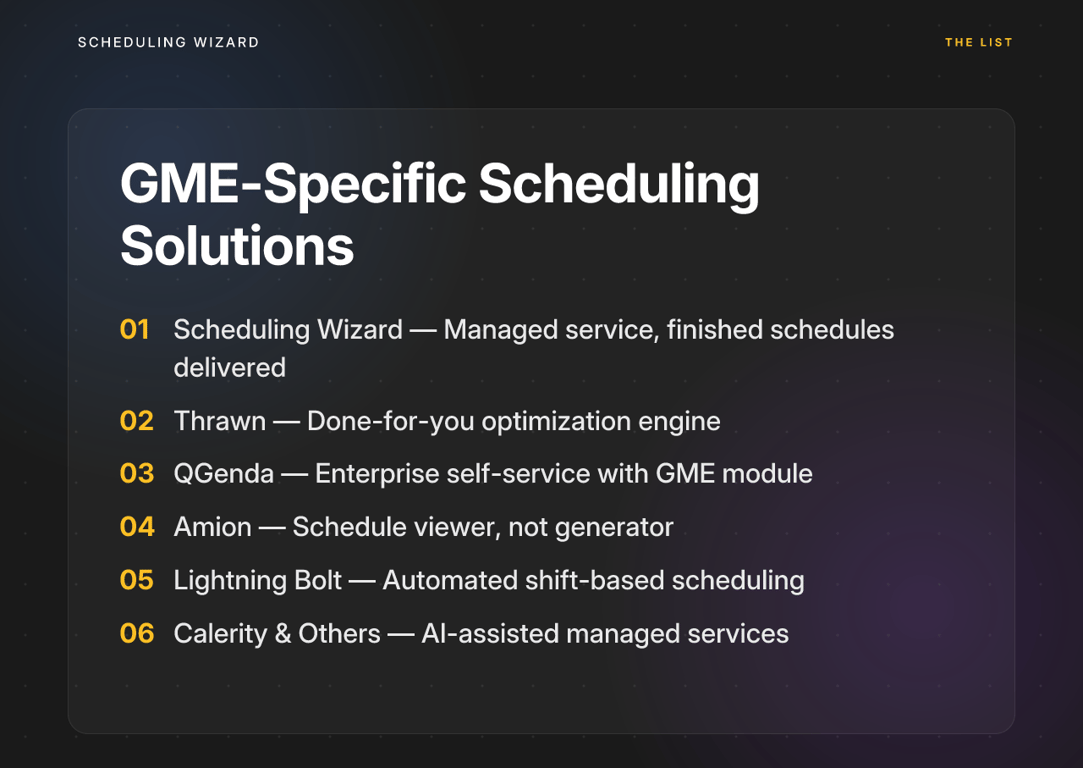
1. Scheduling Wizard
⭐ Only Managed Service on This List. No Software to Learn, Finished Schedules Delivered as Excel.
Scheduling Wizard is not scheduling software. It's a done-for-you managed scheduling service. Programs submit their constraints, rules, and resident preferences, and Scheduling Wizard's proprietary optimization engine delivers complete, ACGME-compliant Block, Clinic, Call, and Attending schedules as ready-to-use Excel files. No platform to log into. No software to train your chief on. No institutional knowledge lost when the chief rotates out.
Best For
Programs that want to completely eliminate the administrative burden of schedule creation, not just automate part of it.
How It Works
You share your program's constraints (duty hours, rotation requirements, subspecialty rules, vacation requests, conference schedules). Scheduling Wizard's engine runs a mathematical optimization across all variables and returns a finished schedule. That schedule can then be uploaded directly into your existing viewing tools like Amion, QGenda, or a shared hospital calendar.
Key Strengths
- Mathematically guaranteed ACGME compliance, not just flagged after the fact. Subspecialty-specific rule libraries are built directly into the engine.
- Zero operator burden, as the scheduling knowledge lives with the service, not with whichever chief resident happens to be on duty this year. This directly solves the July 1st continuity crisis.
- Comprehensive schedule generation for Block/Rotation, Call, Clinic, and Attending schedules, not just one or two.
- Fairness optimization, as the engine equitably distributes night shifts, weekends, and post-clinic assignments across the cohort, addressing one of the most common sources of resident dissatisfaction.
- Complements your existing tools. Many programs use Amion or QGenda for day-to-day schedule viewing. Scheduling Wizard creates the optimized schedule; you upload it to whatever display tool your team already uses.
Pricing
Contact Scheduling Wizard for a quote. Pricing is based on program size and complexity. The service currently supports 18 departments across 13 hospitals and is backed by Y Combinator (YC W26).
2. Thrawn
⭐ Powerful Optimization Engine for Hands-Off, Compliant Schedules.
Thrawn is another leading managed scheduling service that specializes in solving complex GME scheduling problems. It operates on a done-for-you model: you provide your rules and constraints, and their optimization engine delivers a finished schedule. It's a powerful alternative for programs looking for a hands-off solution.
Best For
Programs that need to solve difficult scheduling puzzles with many competing constraints and want a fully managed service.
Key Strengths
- Advanced Optimization: Handles complex block, call, and clinic schedule interdependencies to create ACGME-compliant schedules.
- Done-for-you Service: Eliminates the administrative burden from chief residents and program coordinators by delivering finished schedules.
- Fairness-focused: The engine is designed to promote equitable distribution of shifts and assignments.
Drawbacks
As a managed service, it is less suited for programs that want direct, hands-on control over a software interface for day-to-day tweaks. The focus is on delivering a complete, optimized schedule upfront.
3. QGenda
QGenda is an enterprise-grade physician scheduling and workforce management platform used widely in academic medical centers. It includes GME-specific modules and offers broad visibility across departments and specialties.
Best For
Large health systems with dedicated scheduling coordinators and IT resources to manage the platform.
Key Strengths
Multi-department visibility, some ACGME compliance flagging, strong reporting, and integration with major EHR systems.
Drawbacks
QGenda can be overly complex and expensive for individual residency programs. It is a self-service platform, meaning the administrative burden still falls on your chief resident or program coordinator. Complex rotation structures can require significant manual workarounds, and compliance checks are flags, not guarantees. Many programs use QGenda alongside Scheduling Wizard, with QGenda for viewing and distribution and Scheduling Wizard for schedule creation and optimization.
4. Amion
Amion is perhaps the most widely recognized name in residency scheduling and also the most misunderstood. It's primarily a schedule viewer, not a schedule generator.
Best For
Publishing and sharing a finished on-call schedule with your team. Low-cost, simple, and nearly ubiquitous in teaching hospitals.
Key Strengths
Clean, mobile-accessible interface. Widely adopted, so most residents already know how to use it. Low price point.
Drawbacks
Amion does not generate schedules. It does not optimize. It has no ACGME compliance engine. You still have to build the entire schedule manually before you can enter it into Amion. The administrative burden of schedule creation remains entirely on the chief resident. This is why many programs use Amion as a front-end display tool while relying on a separate service or tool to actually create the schedule.
5. Lightning Bolt (PerfectServe)
Lightning Bolt, now part of PerfectServe, uses automated algorithms to generate shift-based schedules. It's particularly well-suited to specialties with clear shift structures, such as Emergency Medicine.
Best For
Shift-heavy programs where schedule generation can be templated and automated with relatively clear rules.
Key Strengths
Automated shift generation, real-time schedule updates, mobile access, and some capacity for handling complex call patterns.
Drawbacks
ACGME compliance support requires user verification. The tool can flag potential issues, but it doesn't guarantee compliance mathematically. Setup and configuration place a meaningful burden on the chief resident or coordinator. For programs with complex, multi-layered rotation structures, Lightning Bolt can still require significant manual intervention to get to a workable schedule.
6. Other Managed Services
Another player in the done-for-you space worth noting is Calerity, which uses an AI-assisted workflow paired with human scheduling specialists. It takes a similar service-first philosophy to Scheduling Wizard and Thrawn, though programs should evaluate each on their GME-specific constraint modeling, ACGME subspecialty rule coverage, and institutional continuity.
At-a-Glance: GME Scheduling Software Comparison
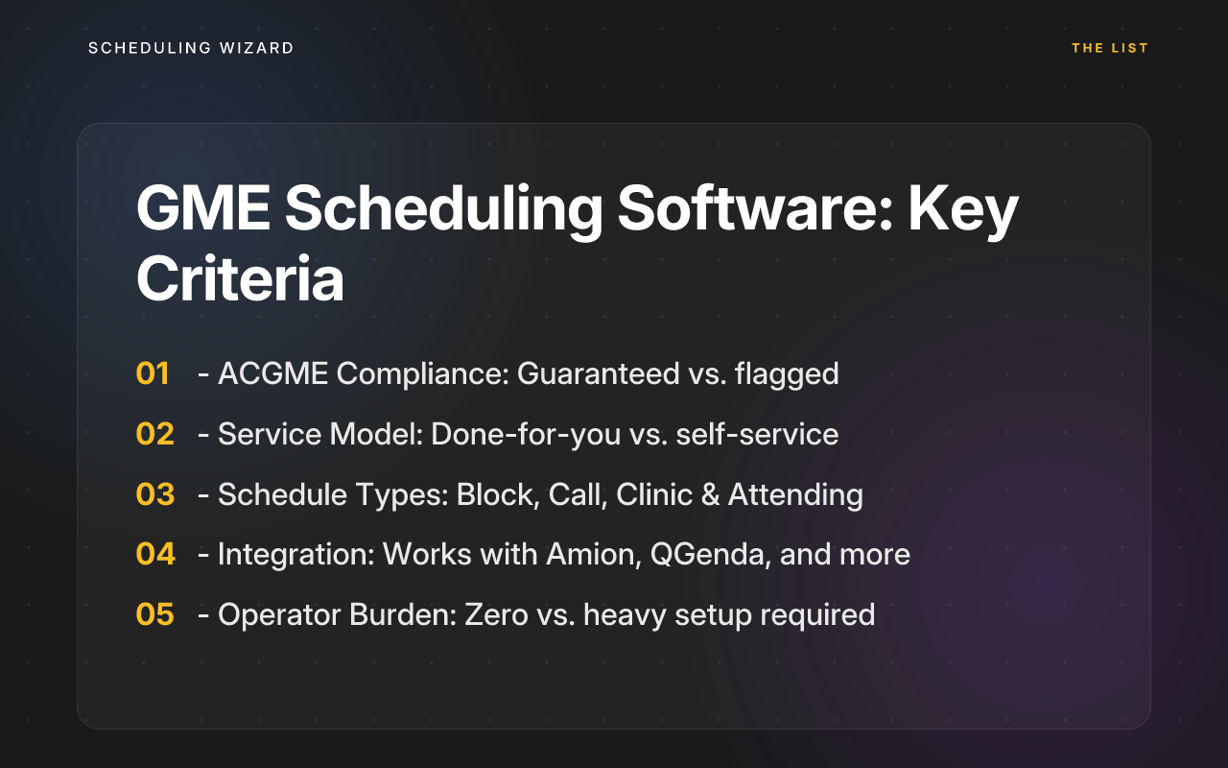
| Tool | ACGME Compliance Support | Done-For-You vs. Self-Service | Block & Call Schedule Generation | Integration with Display Tools | Pricing Tier |
|---|---|---|---|---|---|
| Scheduling Wizard | Mathematically guaranteed | ✅ Done-For-You | Yes — Block, Call, Clinic & Attending | Excel output uploads to Amion, QGenda, etc. | Contact for quote |
| Thrawn | Mathematically guaranteed | ✅ Done-For-You | Yes — Block, Call & Clinic | Delivers finished files for Amion, QGenda, etc. | Moderate–High ($) |
| QGenda | Flags potential violations | Self-Service | Yes, with GME module | Native platform + EHR integrations | Enterprise ($$) |
| Amion | None (manual entry only) | Self-Service (viewer) | ❌ No | N/A — Amion is the display tool | Low ($) |
| Lightning Bolt | Flags violations; user must verify | Self-Service | Yes, primarily shift-based | Yes | Moderate–High ($$$) |
| Acuity | None | Self-Service | ❌ No | Limited (Google Calendar, Zoom) | Low–Moderate ($$) |
| Skedulo | None | Self-Service | ❌ No | Limited | Moderate ($$$) |
Data synthesized from Scheduling Wizard's residency scheduling tool review and vendor-published information.
Don't Let the Next July 1st Be Another Crisis
The annual scheduling scramble has been normalized in GME, but it shouldn't be. Every year, a new chief resident inherits an incomprehensible spreadsheet, spends weeks decoding it, and then spends the rest of their chief year buried in administrative work that has nothing to do with becoming a better physician. As one chief put it in a Reddit thread on scheduling tools, the entire system feels designed to make scheduling as painful as possible.
For programs that want to not just improve their GME scheduling software but escape the burden entirely, a managed service is the most direct path. Scheduling Wizard makes certain that institutional scheduling knowledge persists across chief rotations, that ACGME compliance is mathematically guaranteed, and that fairness isn't a political negotiation; it's an output of the optimization engine.
Your residents didn't match into a residency to spend their nights building Excel formulas. Give them a system that handles the complexity so they can focus on what actually matters: learning medicine and caring for patients.
Scheduling Wizard is a YC-backed (W26) managed scheduling automation service for residency and fellowship programs. To learn more or get a schedule quote for your program, visit schedulingwiz.com.
Frequently Asked Questions
How does Scheduling Wizard work with Amion or QGenda?
Scheduling Wizard works alongside tools like Amion and QGenda, not as a direct replacement. Our service generates the complete, optimized, and ACGME-compliant schedule, which we deliver as an Excel file. Your program then uploads that finished schedule into Amion or QGenda, which your residents and faculty continue to use as their day-to-day schedule viewer. We handle the complex creation; they handle the simple display.
How does the software handle ACGME compliance for my specific subspecialty?
Scheduling Wizard guarantees ACGME compliance by building subspecialty-specific rule libraries directly into its mathematical optimization engine. Instead of just flagging potential violations after a schedule is built, our engine treats all ACGME rules (e.g., for Internal Medicine, Anesthesiology, or General Surgery) as hard constraints from the start. This makes the final schedule compliant by design, not by chance.
What are the 2026 ACGME rule changes and how does your service address them?
The 2026 ACGME rule changes will count at-home call toward the 80-hour weekly maximum and enforce a 24-hour hard cap on continuous work, making manual GME scheduling software significantly more complex. Scheduling Wizard's optimization engine is designed to handle these new constraints. We model the updated rules to keep your program compliant, preventing the manual calculation errors these changes will introduce for programs using spreadsheets.
What is the difference between a managed scheduling service and scheduling software?
A managed scheduling service, like Scheduling Wizard, builds the entire schedule for you, while scheduling software is a tool you must learn and operate yourself. With a managed service, you provide your program's rules and requests, and we deliver a finished, optimized schedule. With software (like QGenda), your chief resident or coordinator is still responsible for learning the platform, inputting all data, and manually resolving scheduling conflicts. A service eliminates this administrative burden entirely.
Why is GME scheduling so much harder than other types of staff scheduling?
GME scheduling is a complex constraint optimization problem, not just a task of filling calendar slots. It requires balancing dozens of interdependent variables simultaneously: ACGME duty hour rules, block rotation assignments, call duties, clinic schedules, individual vacation requests, and educational requirements. A change in one area has a cascading effect on all others, which is why generic scheduling tools are not suitable for the task.
Can private physician practices use Scheduling Wizard?
Yes, while our core focus is on GME programs, our optimization engine is powerful for any complex physician scheduling environment, including private practices. We can create fair and optimized schedules for attending physicians, NPs, and PAs, helping reduce administrative work for practice managers and promoting equitable distribution of call, clinic, and vacation time.
How much does Scheduling Wizard cost?
Pricing for our GME scheduling service is based on the size of your program and the complexity of your scheduling rules. This fee covers the complete creation of your Block, Call, Clinic, and Attending schedules for the entire academic year. This eliminates hundreds of hours of administrative work and makes certain that institutional knowledge is preserved.