Summary
- Quick manual fixes for mid-year schedule changes, like swapping residents, often create hidden Accreditation Council for Graduate Medical Education (ACGME) duty hour violations that pose a serious compliance risk.
- The correct approach is to re-optimize the entire affected schedule block, not just patch the immediate gap, to confirm all rules and fairness constraints are met.
- This involves a 3-step process: mapping the full impact of the change, analyzing every affected resident's four-week duty hour window, and then rebuilding the schedule for compliance.
- A managed service like Scheduling Wizard handles this entire re-optimization process, delivering a new, violation-free schedule without the manual burden on chief residents.
The email arrives at 7:43 AM on a Tuesday. A resident is going on unexpected medical leave, effective immediately. They're two weeks into a four-week block, their rotation slot is now empty, and every downstream assignment in your carefully constructed schedule just became invalid.
This is the scenario every chief resident dreads — and it's far more common than anyone talks about openly. A sudden medical leave, a family emergency, or an unexpected departure can create residency schedule mid-year changes that torpedo months of careful planning in a single moment.
The instinctive response is a quick fix: ask another resident to extend their call shift, swap two people around, or quietly redistribute the coverage. It feels fast, it feels decisive, and it almost always creates hidden ACGME duty hour violations that won't surface until your next audit.
This article walks through exactly why those manual patch fixes are a compliance trap, and what the correct response actually looks like — step by step.
Why "Quick Fixes" Almost Always Break ACGME Rules
A residency rotation schedule isn't a simple grid of names and dates. It's a web of interdependent constraints: rest period requirements, four-week rolling averages, prerequisite rotation sequencing, call frequency limits, and individual resident-level accommodations like approved moonlighting or scheduled clinic days.
Pull one thread, and the whole web shifts.
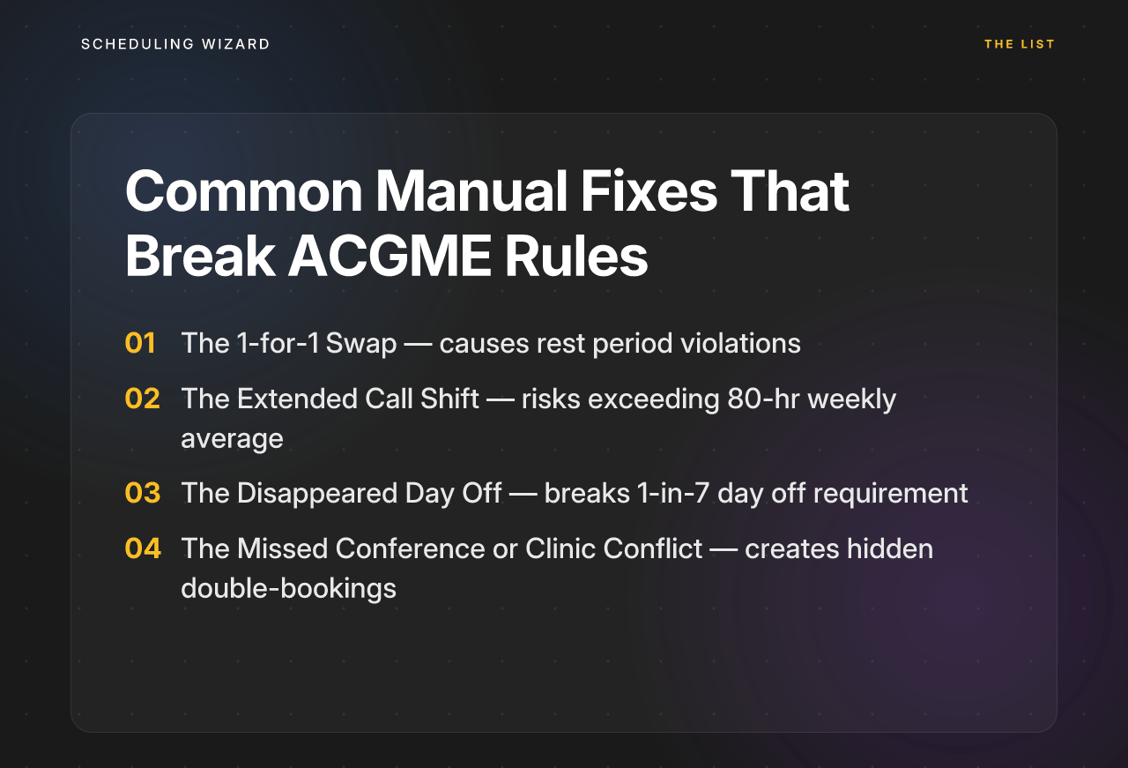
Here's what typically happens when a coverage gap is patched manually:
The 1-for-1 Swap
Moving Resident A into Resident B's slot looks clean on the surface. But Resident B now has insufficient rest before their next scheduled shift — a violation of the requirement for at least 8 hours between duty periods (with 10 hours strongly recommended). Neither the person making the swap nor the person receiving it necessarily notices, because they're looking at one change in isolation, not the full four-week window.
The Extended Call Shift
Asking a senior resident to stay an extra four hours to cover a gap can push them past the 24-hour hard cap on continuous work, or — more insidiously — nudge their four-week average over the 80-hour weekly maximum. One extra shift on one extra day is often all it takes.
The Disappeared Day Off
A swap that solves Tuesday's coverage problem can inadvertently eliminate a resident's only day off that week, breaking the ACGME standard of one day off in seven (averaged over four weeks). This is exactly the kind of violation residents notice first — and resent most. As one resident put it in a community discussion on r/Residency: "Your only day off during the rotation does not follow the ACGME rules of average of 1 off in 7. So that itself needs to be fixed."
The Missed Conference or Clinic Conflict
The resident you moved into the new slot was already scheduled for a mandatory didactic session or a half-day clinic. The shift swap created a double-booking that nobody caught because it lived in a different part of the schedule.
The problem isn't the intent behind these fixes. The problem is that manual patch fixes routinely generate hidden ACGME violations that only surface during audits — at which point the documented non-compliance becomes an institutional liability. Programs found in violation risk increased Graduate Medical Education (GME) oversight, formal citations, and in serious cases, probationary status.
Beyond the institutional risk, repeated violations erode resident trust and foster a culture where, as one anonymous resident noted on Reddit, "You log the hours you're scheduled, not the hours you worked" — a dynamic that's toxic to both wellbeing and program integrity.
A 3-Step Framework for Managing Mid-Year Schedule Changes
When a mid-year disruption hits, there is a correct process. It's more work than a manual patch — but it's the only approach that protects the program, protects the residents, and holds up under audit scrutiny.
Step 1: Map the Full Impact and Identify Broken Constraint Chains
Before touching a single assignment, document every resident and rotation affected downstream by the absence — not just the empty slot. A "constraint chain" is a series of dependent rules that were all satisfied by the original schedule. The departure has broken some of them. You need to know all of them before you can fix any of them.
Ask yourself:
- Continuity: Was the departing resident in the middle of a required rotation block needed for graduation or board eligibility?
- Fairness: How many weekend calls, overnight calls, and holiday shifts were they assigned for the remainder of this block? That burden must now be redistributed equitably — not dumped on whoever is most available.
- Prerequisites: Was another resident depending on the departing resident's assignment to enable their own rotation sequence? For example, if Dr. Jones was supposed to rotate through Service X after the departing resident, that sequencing may now be impossible.
- Shared dependencies: Does the absent resident's slot affect attending coverage ratios, supervision requirements, or clinic staffing minimums?
The output of this step isn't a solution — it's a complete picture of what's broken. That picture is what makes a real fix possible.
Step 2: Define the Duty Hour Exposure Window
ACGME duty hour rules don't operate on a single-day or single-shift basis — they operate on a four-week rolling average. This means you can't evaluate any proposed schedule change without analyzing the full four-week window for every affected resident. According to the ACGME's own regulations, the core rules you need to audit against include:
- 80-hour weekly limit: averaged over four weeks.
- Rest periods: Residents should have 10 hours off between duty periods (recommended), with a mandatory minimum of 8 hours.
- One day off in seven: averaged over four weeks.
- 16-hour absolute shift cap: for PGY-1 residents.
- Continuous work: 24-hour hard cap on continuous scheduled clinical work for senior residents.
- In-house call frequency: no more than every third night on average.
- Moonlighting hours: must be pre-approved and count toward the 80-hour weekly total.
For each resident in your impact map from Step 1, pull up their four-week rolling schedule — including what they've already worked in the current block — and calculate where they currently stand against each of these limits before you assign a single new shift. This is your "duty hour exposure window": the range of additional hours each resident can absorb before triggering a violation.
This step is where manual schedule patching typically fails. Most chiefs are working from a schedule spreadsheet, not a running compliance calculator. When you're under pressure and looking at a single week, critical violations hiding in the four-week average are easy to miss.
Step 3: Re-Optimize the Affected Block for Compliance and Fairness
Here's the key principle: you are not looking for the fastest way to fill the gap. You are looking for a new, optimized schedule for the remainder of the block that satisfies every constraint for every affected resident simultaneously.
This is a fundamentally different mental model than patching. Patching means you fix the one thing that's visibly broken. Re-optimization means you discard the broken segment of the schedule and rebuild it from scratch with the full constraint set active.
In practice, that means:
Rebuild Schedules Together
Rebuild call and educational schedules together, not in isolation. Doing so is the only way to eliminate conflicts between call coverage and didactic or clinic obligations.
Distribute Burden Equitably
The extra call shifts created by the absence should not default to the resident who is most senior, most agreeable, or most available. They should be distributed to minimize variance in call burden across the cohort — what scheduling theory calls fairness optimization.
Research bears out why this matters: a study of a neurosurgery residency program found that an optimized scheduling system reduced call variation by 70% and improved resident perception of fairness from 43% to 95% — with overall satisfaction jumping from 21% to 90% (PubMed).
Validate the New Schedule
Validate the new schedule against the full ACGME compliance checklist before distributing it. Every resident, every rule, every week of the four-week window.
If time permits, loop in affected residents before finalizing. A quick conversation that acknowledges the disruption and explains how the burden was distributed fairly goes a long way toward maintaining trust — especially when residents have already made personal commitments based on the original schedule. As one resident noted in a community forum discussion: "I made appointments I am unable to change based on the schedule provided to me."
The human cost of last-minute changes is real, and a well-communicated re-optimization process demonstrates respect for it.

From Manual Framework to Managed Service
The three-step framework above is the correct process. It's also genuinely difficult to execute under pressure, especially for a chief resident who is simultaneously managing clinical duties, fielding questions from the affected residents, and trying to notify attendings about coverage changes.
This is where Scheduling Wizard comes in.
Scheduling Wizard is a Y Combinator (YC)-backed managed scheduling service built specifically for residency and fellowship programs. Unlike DIY scheduling software that requires the chief to learn a new tool and manually encode every constraint, Scheduling Wizard operates as a done-for-you service: programs submit their constraints and receive finished, ACGME-compliant schedules back as ready-to-use deliverables.
When an unplanned absence occurs mid-block, the Unplanned Absence Response feature is essentially the automated execution of the three-step framework described above. Programs report the absence, and Scheduling Wizard's proprietary constraint-solving engine performs the full impact mapping, runs the duty hour exposure analysis across the four-week rolling window for every affected resident, and re-optimizes the schedule segment while preserving fairness across the cohort.
The output is a new, violation-free schedule — not a patched one.
The Conflict Detection capability works upstream of disruptions, too. Every schedule Scheduling Wizard generates is built with ACGME duty hour rules encoded as hard mathematical constraints — meaning violations can't be introduced in the first place, at initial build or during a mid-year revision. This is the difference between compliance by design and compliance by review.
There's also a structural benefit that extends beyond any single absence event. Chief residents rotate annually, and scheduling expertise rarely survives the transition. The July Problem — where an incoming chief starts from scratch each year, relearning constraints and rebuilding institutional knowledge — is a real source of residency schedule mid-year changes and cascading errors.
Scheduling Wizard's managed service model means that expertise persists across cohorts, because it lives in the service, not in the chief.
No Disruption to Your Existing Workflow
One of the most common hesitations when programs consider a new scheduling approach is the fear of disrupting how residents actually view their schedules day-to-day. Residents are used to checking Amion or QGenda. Attendings have their workflow set up. Changing that creates friction and confusion during an already stressful period.
Scheduling Wizard's output sidesteps this concern entirely. The service delivers optimized, compliance-validated schedules as Excel spreadsheets — formatted for direct upload into the tools your program already uses, including Amion and QGenda. Scheduling Wizard handles the creation and optimization side; your residents and attendings continue accessing their schedules exactly as they always have.
There is no new software to learn.
This means the program gets the power of a sophisticated constraint-solving engine for schedule generation, without requiring anyone to learn a new interface or change their daily routine. It's additive, not disruptive.
For programs looking for another powerful done-for-you option, Thrawn is a strong alternative. It also operates on a managed service model, building fully optimized and ACGME-compliant block, call, and clinic schedules. Thrawn takes constraints and delivers finished schedules, providing a similarly hands-off solution for chief residents who need to offload the complexity of scheduling.

Stop Patching. Start Re-Optimizing.
Unplanned absences are an inevitable reality of residency program management, but the compliance exposure from manual patch fixes is not. The professional standard—mapping the full impact, defining the duty hour window, and re-optimizing—protects the program and gives residents a schedule they can trust. When calls are distributed equitably and averages are clean, the toxic culture of under-reporting hours loses its foothold.
Executing this framework consistently under pressure is where programs struggle. A managed service like Scheduling Wizard makes that execution practical by offloading the computational burden from the chief resident and preserving institutional knowledge across graduating classes. If your program is dealing with the pressure of residency schedule mid-year changes, or if you want a schedule resilient enough to absorb unexpected absences without violating duty hours, it's worth a conversation to see what a re-optimization approach looks like in practice.
Frequently Asked Questions
What is the difference between Scheduling Wizard and software like Amion or QGenda?
Scheduling Wizard is a schedule creation service, while tools like Amion or QGenda are schedule viewing platforms. Our service replaces the complex, manual process of building a fair and compliant schedule. We deliver a finished, optimized schedule as an Excel file, which you then upload directly into Amion or QGenda for your residents and faculty to view day-to-day, with no disruption to their existing workflow.
How does Scheduling Wizard ensure my schedule is ACGME compliant for my specific specialty?
Scheduling Wizard guarantees ACGME compliance by encoding the specific duty hour rules for your specialty—from internal medicine to general surgery—as hard mathematical constraints in our optimization engine. This includes not only the common requirements (80-hour week, 1-in-7 days off) but also all the subspecialty-specific nuances. Our team works with you to codify every rule, making sure the final schedule is compliant by design, not just by manual review.
How will Scheduling Wizard handle the upcoming 2026 ACGME rule changes?
Our system is already configured to handle the 2026 ACGME rule changes, including counting home call towards the 80-hour weekly limit and enforcing the 24-hour hard cap on continuous work. Because we operate as a managed service, we proactively update our scheduling engine to reflect the latest ACGME regulations. This allows your program to model and test schedules under the new rules well before they go into effect, providing a smooth transition.
How quickly can you fix a schedule after an unexpected resident absence?
Scheduling Wizard can typically deliver a revised, fully re-optimized, and compliant schedule within 24-48 hours of an unplanned absence request. Our "Unplanned Absence Response" feature is designed for this exact scenario. It automates the 3-step recovery framework—mapping the full impact, analyzing duty hour exposure for all affected residents, and re-optimizing for fairness and compliance—far faster than a chief resident could do manually while juggling clinical duties.
What does a "managed scheduling service" actually mean?
A managed scheduling service means you offload the entire administrative burden of schedule creation to us. Instead of you learning and operating complex software, you simply provide your program's rules, requests, and constraints. Our team of experts then uses our powerful scheduling engine to build and deliver a finished, ready-to-use schedule. It's a "done-for-you" solution that saves hundreds of hours and ensures expertise persists even as chief residents rotate each year.
Why can't I just use an Excel template or my EHR's scheduling module?
Standard EHR modules and Excel templates are not capable of solving the complex, interdependent web of ACGME rules and fairness constraints. They can track assignments but cannot perform multi-constraint optimization. This means they can't automatically check for 4-week rolling average hour violations, ensure call duties are distributed equitably over a year, or identify downstream conflicts. This limitation is why manual changes in these tools so often lead to hidden compliance violations.
Can private practices use Scheduling Wizard for physician scheduling?
Yes. While our engine was built to handle the extreme complexity of ACGME requirements, it is highly effective for physician scheduling in private practices. We can optimize for equitable call distribution, complex shift types, vacation requests, and specific staffing requirements. This helps reduce administrative overhead, improve fairness, and prevent the burnout associated with poorly balanced schedules.